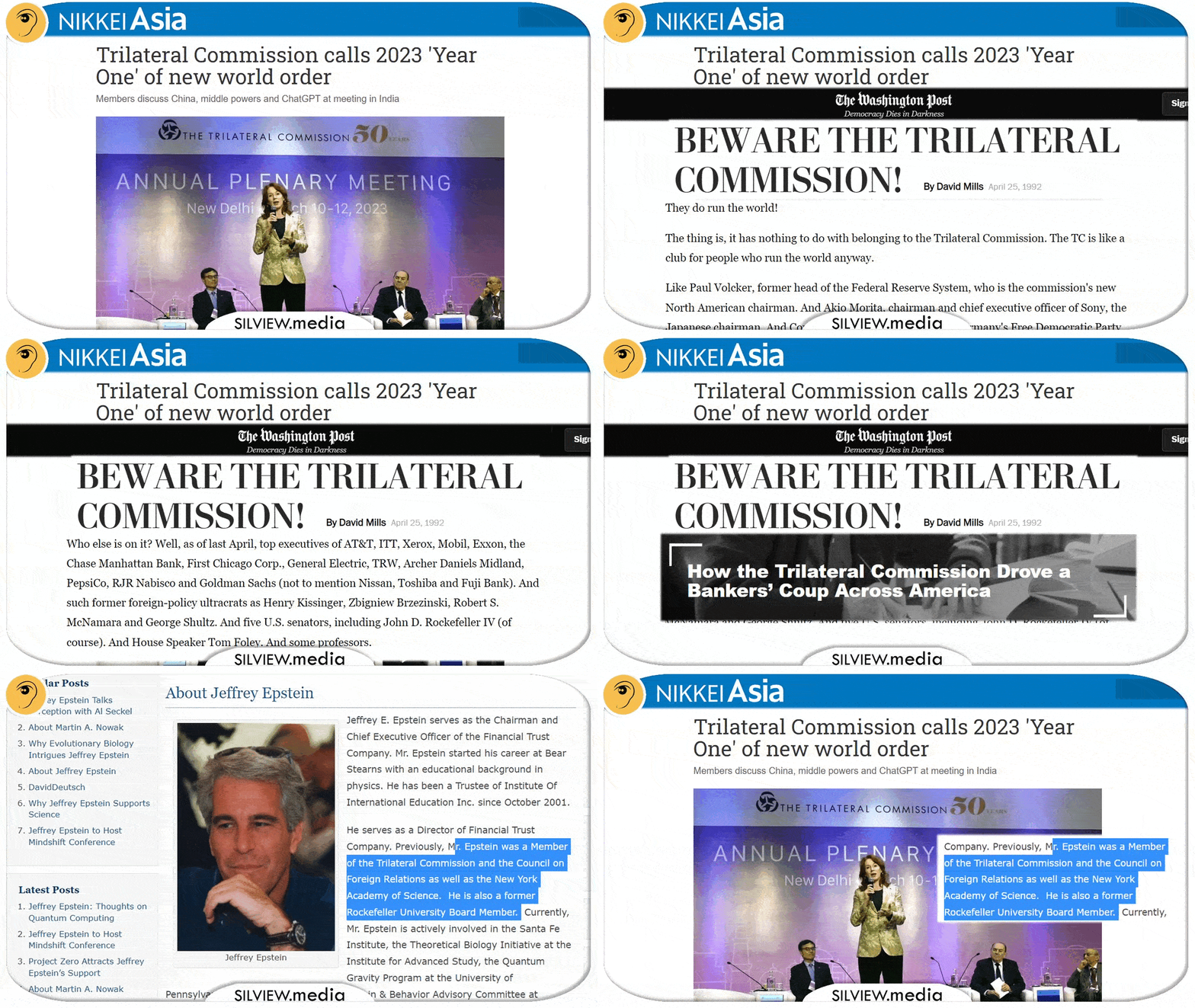
• HITLER’S BANKERS WHO ONCE HID DENTAL GOLD FROM AUSCHWITZ ARE TODAY’S “CENTRAL BANK OF CENTRAL BANKS”

    “Via the BIS, the American and British bankers would maintain a mostly secret friendship with their Nazi and Japanese counterparts straight through World War II while thousands and thousands of American and British men in uniform were being killed and maimed in the fight to defeat the Nazis and Japanese.” 

    John Strausbaugh, Victory City, A History Of New York and New Yorkers During World War II

    Except they were mostly Jewish Germans with no real loyalty to either America, UK, Germany or even Jewry.

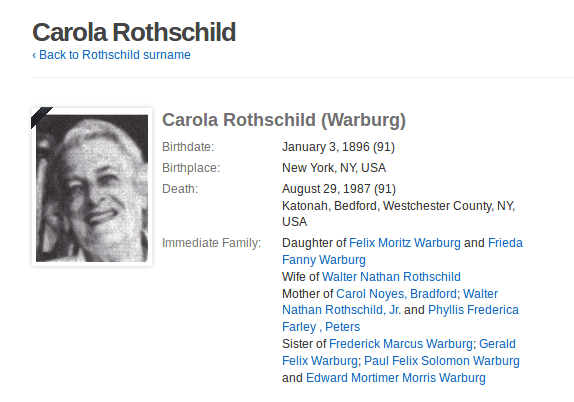
    In its early years, intermarriage among the German-Jewish elite was common. Consequently, the partners of Kuhn, Loeb were closely related by blood and marriage to the partners of J & W SeligmanSpeyer & Co.Goldman, Sachs & Co.Lehman Brothers and other prominent German-Jewish firms. Prior to the Second World War, a particularly close relationship existed between the partners of Kuhn, Loeb and M. M. Warburg & Co. of Hamburg, Germany, through Paul and Felix, who were Kuhn, Loeb partners. Later on, following World War II, their cousin Sigmund Warburg would briefly continue this relationship as a partner and Executive Director of the firm.

    Wikipedia

    This chapter explores the conflicting pressures to which the American investment banking firm Kuhn, Loeb and Company was exposed during the period of American neutrality preceding US entry into World War I. All the partners were of German Jewish origin. Two, Paul M. Warburg and Felix M. Warburg, were brothers of Max M. Warburg, who was heavily involved in financing the German war effort. Others, including the senior partner Jacob H. Schiff, were emigres from Germany. Some, however, especially partner Otto H. Kahn, were staunchly anglophile in outlook. Many Wall Street bankers, notably the pre-eminent investment bank J. P. Morgan and Company, were fiercely pro-Allied in sympathy, and put heavy pressure on Kuhn, Loeb to participate in Allied war loans. Their German associates, however, Kuhn, Loeb to abstain from such business, and if possible to take part in German war financing. With partners in the firm divided, Kuhn, Loeb tried to remain neutral. The firm did not invest in Allied war loans. Jacob Schiff, a leading member of the Jewish community, stated that this stance did not reflect any sympathies with Germany, but the fact that Tsarist Russia, notorious for its persecution of its Jewish minority, was one of the Allies. Meanwhile, certain individual partners made well-publicized purchases of these securities.

    A CONFLICT OF LOYALTIES: KUHN, LOEB & COMPANY AND THE FIRST WORLD WAR, 1914-1917. IN STUDIES IN THE AMERICAN JEWISH EXPERIENCE II: CONTRIBUTIONS FROM THE FELLOWSHIP PROGRAMS OF THE AMERICAN JEWISH ARCHIVES, EDS. ABRAHAM J. PECK AND JACOB RADER MARCUS. ROWMAN AND LITTLEFIELD, 1984, PP. 1-32, 169-182.

    THE SHORT COURSE:

    (MY EDIT)

    “The BIS would shelter hundreds of millions of dollars in Nazi gold, stolen from conquered nations and from slaughtered Jews (including dental fillings, jewelry, and such).”

    John Strausbaugh, Victory City, A History Of New York and New Yorkers During World War II
    SHARE

    Also:

    How the Swiss Backed Hitler and Protected His Gold

    THE LONG COURSE:

    SOURCE

    “BANKING WITH HITLER” – DOCUMENTARY / HISTORY CHANNEL

    371 Swiss banks stand accused of collaborating with the Nazis during World War II. This was suspected at the time by by U.S. Secretary of Treasury Henry Morgenthau, who began investigating this collaboration. He found the Swiss were not alone. His archives reveal that both British and American bankers continued to do business with Hitler, even as Germany was invading Europe and bombing London.

    This investigative film next shows in detail the roles played by the Anglo-German banking clique. Key members of the Bank of England together with their German counterparts established the BIS, the Bank for International Settlement, which laundered the plundered gold of Europe. On its board were key Nazis such as Walther Funk and Hjalamar Schact The president of BIS was an American, Thomas McKittrick, who readily socialized with leading Nazis. Not only the BIS, but other allied banks worked hand in hand with the Nazis. One of the biggest American banks kept a branch open in Occupied Paris and, with full knowledge of the managers in the U.S., froze the accounts of French Jews. Deprived of money to escape France, many ended up in death camps.

    When Pres. Roosevelt died in April 1945, Morgenthau lost his protector and his crusade against the banks came to an end. He was further weakened when men in his department were accused of being Communists during the McCarthy era. This incredible story contains interviews with surviving members of banking families and Morgenthau’s investigative team as well as newly found archive material.

    SHARE

    The leader of the BIS during the war was a Wall Streeter named Thomas McKittrick.
    “He traveled freely in Nazi territory and in Mussolini’s Italy during the war. In 1943, U-Boats received orders not to meddle with the ship that carried him back to NY for high-level meetings to discuss BIS business, after which he traveled to Berlin for a debriefing at the Reichsbank.”

    When the war ended, McKittrick was made Vice President at the Rockefeller’s Chase National Bank. He couldn’t have picked a more suitable employer.

    It turns out six months before Hitler invaded Poland, Chase Bank wired $25 million for his war machine.

    SOURCE

    Chase and J.P. Morgan weren’t done in their role as Hitler’s private bankers.

    “When Germany occupied France in 1940, most American businesses there left. Chase and J.P. Morgan kept their banks in France open for the duration. They did business with and for the Nazi occupiers, from seizing the accounts of Jewish customers to funding the Gestapo’s brutal activities against the Franch people.”

    Evidently, one of Chase’s growth strategies targeted Nazi-occupied France.

    The Daily News reported:

    “The relationship between Chase and the Nazis apparently was so cozy that Carlos Niedermann, the Chase branch chief in Paris, wrote his supervisor in Manhattan that the bank enjoyed “very special esteem” with top German officials and “a rapid expansion of deposits,” according to Newsweek. Niedermann’s letter was written in May 1942 five months after the Japanese bombed Pearl Harbor and the U.S. also went to war with Germany.”

    Sometimes Wall Street gets a bad rap, often serving as a scapegoat for populist leaders looking to rally the troops against a pretty unlikable foe.

    Sadly, this isn’t one of those cases. – Source: Victory City by John Strausbaugh

    THE TOWER OF BASEL

    Hitler’s Bankers Rebranded

    James J Puplava with Adam LeBor, author of “Tower of Basel – The Shadowy History of the Secret Bank That Runs the World”

    A Very Unauthorized History of the Bank for International Settlements (BIS) in Switzerland

    “In a special reprise edition of the Financial Sense Newshour from earlier this year, Jim welcomes journalist Adam LeBor, author of “Tower of Basel”, a very unauthorized history of the Bank for International Settlements (BIS) in Basel, Switzerland. For many decades it has stood at the center of a global network of money, power and covert global influence. LeBor and others call it the most important bank the world. The BIS predates both the IMF and the World Bank, yet very few have heard of it or knows what it does. The BIS helped finance the Nazi war machine before, and during, WWII. It also hosted much of the planning and technical preparation for the Euro. LeBor believes without the BIS, the Euro would likely not exist. The bank is also immensely profitable, making over a billion dollars tax-free in 2012, from a very small number of important customers. The BIS continues to host the world’s most powerful central bankers every year in Basel.”

    Never mind the Czech gold the Nazis stole…

    The Bank for International Settlements actually financed Hitler’s war machine

    By Adam Lebor, The Telegraph, 31 Jul 2013

    The documents reveal a shocking story: just six months before Britain went to war with Nazi Germany, the Bank of England willingly handed over £5.6 million worth of gold to Hitler – and it belonged to another country.

    The official history of the bank, written in 1950 but posted online for the first time on Tuesday, reveals how we betrayed Czechoslovakia – not just with the infamous Munich agreement of September 1938, which allowed the Nazis to annex the Sudetenland, but also in London, where Montagu Norman, the eccentric but ruthless governor of the Bank of England agreed to surrender gold owned by the National Bank of Czechoslovakia.

    The Czechoslovak gold was held in London in a sub-account in the name of the Bank for International Settlements, the Basel-based bank for central banks. When the Nazis marched into Prague in March 1939 they immediately sent armed soldiers to the offices of the National Bank. The Czech directors were ordered, on pain of death, to send two transfer requests.

    The first instructed the BIS to transfer 23.1 metric tons of gold from the Czechoslovak BIS account, held at the Bank of England, to the Reichsbank BIS account, also held at Threadneedle Street.

    The second order instructed the Bank of England to transfer almost 27 metric tons of gold held in the National Bank of Czechoslovakia’s own name to the BIS’s gold account at the Bank of England.

    To outsiders, the distinction between the accounts seems obscure. Yet it proved crucial – and allowed Norman to ensure that the first order was carried out. The Czechoslovak bank officials believed that as the orders had obviously been carried out under duress neither would be allowed to go through. But they had not reckoned on the bureaucrats running the BIS and the determination of Montagu Norman to see that procedures were followed, even as his country prepared for war with Nazi Germany.

    His decision caused uproar, both in the press and in Parliament. George Strauss, a Labour MP, spoke for many when he thundered in Parliament: “The Bank for International Settlements is the bank which sanctions the most notorious outrage of this generation – the rape of Czechoslovakia.” Winston Churchill demanded to know how the government could ask its citizens to enlist in the military when it was “so butter-fingered that £6 million worth of gold can be transferred to the Nazi government”.

    It was a good question. Thanks to Norman and the BIS, Nazi Germany had just looted 23.1 tons of gold without a shot being fired. The second transfer order, for the gold held in the National Bank of Czechoslovakia’s own name, did not go through. Sir John Simon, the Chancellor of the Exchequer, had instructed banks to block all Czechoslovak assets.

    THE TELEGRAPH
    WIKIPEDIA

    The documents released by the Bank of England are revealing, both for what they show and what they omit. They are a window into a world of fearful deference to authority, the primacy of procedure over morality, a world where, for the bankers, the most important thing is to keep the channels of international finance open, no matter what the human cost. A world, in other words, not entirely different to today.

    The BIS was founded in 1930, in effect by Montagu Norman and his close friend Hjalmar Schacht, the former president of the Reichsbank, known as the father of the Nazi economic miracle. Schacht even referred to the BIS as “my” bank. The BIS is a unique hybrid: a commercial bank protected by international treaty. Its assets can never be seized, even in times of war. It pays no taxes on profits. The Czechoslovaks believed that the BIS’s legal immunities would protect them. But they were wrong.

    The Bank of England’s historian argued that to refuse the transfer order would have been a breach of Britain’s treaty obligations with regard to the BIS. In fact there was a powerful counter-argument that the Nazi invasion of Czechoslovakia had rendered any such obligations null and void as the country no longer existed.

    A key sentence in the Bank of England documents is found on page 1,295. It reads: “The general attitude of the Bank of England directors of the BIS during the war was governed by their anxiety to keep the BIS to play its part in the solution of post-war problems”. And here the secret history of the BIS and its strong relationship with the Bank of England becomes ever more murky.

    During the war the BIS proclaimed that it was neutral, a view supported by the Bank of England. In fact the BIS was so entwined with the Nazi economy that it helped keep the Third Reich in business. It carried out foreign exchange deals for the Reichsbank; it accepted looted Nazi gold; it recognised the puppet regimes installed in occupied countries, which, together with the Third Reich, soon controlled the majority of the bank’s shares.

    Indeed, the BIS was so useful for the Nazis that Emil Puhl, the vice-president of the Reichsbank and BIS director, referred to the BIS as the Reichsbank’s only “foreign branch”.

    The BIS’s reach and connections were vital for Germany. So much so, that all through the war, the Reichsbank continued paying interest on the monies lent by the BIS. This interest was used by the BIS to pay dividends to shareholders – which included the Bank of England. Thus, through the BIS, the Reichsbank was funding the British war economy. After the war, five BIS directors were tried for war crimes, including Schacht. “They don’t hang bankers,” Schacht supposedly said, and he was right – he was acquitted.

    Buried among the typewritten pages of the Bank of England’s history is a name of whom few have ever heard, a man for whom, like Montagu Norman, the primacy of international finance reigned over mere national considerations.

    Thomas McKittrick, an American banker, was president of the BIS. When the United States entered the war in December 1941, McKittrick’s position, the history notes, “became difficult”. But McKittrick managed to keep the bank in business, thanks in part to his friend Allen Dulles, the US spymaster based in Berne. McKittrick was an asset of Dulles, known as Codename 644, and frequently passed him information that he had garnered from Emil Puhl, who was a frequent visitor to Basel and often met McKittrick.

    Declassified documents in the American intelligence archives reveal an even more disturbing story. Under an intelligence operation known as the “Harvard Plan”, McKittrick was in contact with Nazi industrialists, working towards what the US documents, dated February 1945, describe as a “close cooperation between the Allied and German business world”.

    Thus while Allied soldiers were fighting through Europe, McKittrick was cutting deals to keep the Germany economy strong. This was happening with what the US documents describe as “the full assistance” of the State Department.

    The Bank of England history also makes disparaging reference to Harry Dexter White, an official in the Treasury Department, who was a close ally of Henry Morgenthau, the Treasury Secretary. Morgenthau and White were the BIS’s most powerful enemies and lobbied hard at Bretton Woods in July 1944, where the Allies met to plan the post-war financial system, for the BIS to be closed.White, the Bank history notes rather sneeringly, had said of the BIS: “There is an American president doing business with the Germans while our boys are fighting the Germans.”

    Aided by its powerful friends, such as Montagu Norman, Allen Dulles and much of Wall Street, the BIS survived the attempts by Morgenthau and White to close it down. The bank’s allies used precisely the argument detailed on page 1,295 of the Bank of England’s history: the BIS was needed to plan the post-war European economy.

    From the 1950s to the 1990s the BIS hosted much of the planning and technical preparation for the introduction of the euro. Without the BIS the euro would probably not exist. In 1994, Alexander Lamfalussy, the former BIS manager, set up the European Monetary Institute, now known as the European Central Bank.

    The BIS remains very profitable. It has only about 140 customers (it refuses to say how many) but made a tax-free profit of about £900 million last year. Every other month it hosts the Global Economy Meetings, where 60 of the most powerful central bankers, including Mark Carney, Governor of the Bank of England, meet. No details of meetings are released, even though the attendees are public servants, charged with managing national economies.

    The BIS also hosts the Basel Committee on Banking Supervision, which regulates commercial banks, and the new Financial Stability Board, which coordinates national regulatory authorities. The BIS has made itself the central pillar of the global financial system.

    Montagu Norman and Hjalmar Schacht would be very proud indeed.

    Adam LeBor is the author of ‘Tower of Basel: The Shadowy History of the Secret Bank That Runs the World’, published by PublicAffairs

    SOURCE

    Following his retirement, he was raised to the peerage as Baron Norman, of St Clere in the County of Kent, on 13 October 1944. In addition to receiving the Distinguished Service Order, Norman was sworn of the Privy Council in 1923 and was created a Grand Officer of the Order of the Crown.

    Wikipedia

    Let me rephrase that: The Nazi-loving chief of Bank of England was anointed among Crown’s most trusted dozen, having only the Jewish-blooded queen and princes above him.

    From “Secrets of the Federal Reserve – The history, organization and controlling interests behind the Federal Reserve”, by: Eustace Mullins, 1983, we find out that…

    <<Chairman McFadden informed the House of a dispatch in the Public Ledger of Philadelphia, October 24, 1931, “GERMAN REVEALS HOOVER’S SECRET. The American President was in intimate negotiations with the German government regarding a year’s debt holiday as early as December, 1930.” McFadden continued,

    “Behind the Hoover announcement there were many months of hurried and furtive preparations both in Germany and in Wall Street offices of German bankers. Germany, like a sponge, had to be saturated with American money. Mr. Hoover himself had to be elected, because this scheme began before he became President. If the German international bankers of Wall Street — that is Kuhn Loeb CompanyJ. & W. SeligmanPaul WarburgJ. Henry Schroder — and their satellites had not had this job waiting to be done, Herbert Hoover would never have been elected President of the United States.

    The election of Mr. Hoover to the Presidency was through the influence of the Warburg Brothers, directors of the great bank of Kuhn Loeb Company, who carried the cost of his election. In exchange for this collaboration Mr. Hoover promised to impose the moratorium of German debts. Hoover sought to exempt Kreuger’s loan to Germany of $125 million from the operation of the Hoover Moratorium. The nature of Kreuger’s swindle was known here in January when he visited his friend, Mr. Hoover, in the White House.”

    Not only did Hoover entertain Francqui in the White House, but also Ivar Kreuger, the most famous swindler of the twentieth century.

    On December 13, 1932, Chairman McFadden introduced a resolution of impeachment against President Hoover for high crimes and misdemeanors, which covers many pages, including violation of contracts, unlawful dissipation of the financial resources of the United States, and his appointment of Eugene Meyer to the Federal Reserve Board. The resolution was tabled and never acted upon by the House.

    In criticizing Hoover’s Moratorium of German War Debts, McFadden had referred to Hoover’s “German” backers. Although all of the principals of “the London Connection” did originate in Germany, most of them in Frankfurt, at the time they sponsored Hoover’s candidacy for the Presidency of the United States, they were operating from London, as Hoover himself had done for most of his career.

    Also, the Hoover Moratorium was not intended to “help” Germany, as Hoover had never been “pro-German”. The Moratorium on Germany’s war debts was necessary so that Germany would have funds for rearming. In 1931, the truly forward-looking diplomats were anticipating the Second World War, and there could be no war without an “aggressor”.

    Hoover had also carried out a number of mining promotions in various parts of the world as a secret agent for the Rothschilds, and had been rewarded with a directorship in one of the principal Rothschild enterprises, the Rio Tinto Mines in Spain and Bolivia.

    Francqui and Hoover threw themselves into the seemingly impossible task of provisioning Germany during the First World War. Their success was noted in Nordeutsche Allgemeine Zeitung, March 13, 1915, which noted that large quantities of food were now arriving from Belgium by rail. Schmoller’s “Yearbook for Legislation, Administration and Political Economy” for 1916, shows that 1 billion pounds of meat, 1.5 billion pounds of potatoes, 1.5 billion pounds of bread, and 121 million pounds of butter had been shipped from Belgium to Germany in that year.

    A patriotic British woman who had operated a small hospital in Belgium for several years, Edith Cavell, wrote to the Nursing Mirror in London, April 15, 1915, complaining that the “Belgian Relief” supplies were being shipped to Germany to feed the German army. The Germans considered Miss Cavell to be of no importance, and paid no attention to her, but the British Intelligence Service in London was appalled by Miss Cavell’s discovery, and demanded that the Germans arrest her as a spy.

    Sir William Wiseman, head of British Intelligence, and partner of Kuhn Loeb Company, feared that the continuance of the war was at stake, and secretly notified the Germans that Miss Cavell must be executed. The Germans reluctantly arrested her and charged her with aiding prisoners of war to escape. The usual penalty for this offense was three months imprisonment, but the Germans bowed to Sir William Wiseman’s demands, and shot Edith Cavell, thus creating one of the principal martyrs of the First World War.

    With Edith Cavell out of the way, the “Belgian Relief” operation continued, although in 1916, German emissaries again approached London officials with the information that they did not believe Germany could continue military operations, not only because of food shortages, but because of financial problems. More “emergency relief” was sent, and Germany continued in the war until November, 1918.>>

    ALSO READ: COVID, HITLER, BLM, THE GREAT RESET – MANY BRANDS, ONE CARTEL. AUSCHWITZ PERFECTED AND GLOBALIZED

    Mr. Paul M. Warburg Seriously Ill: Founder of American Federal Reserve Bank System and Brother of FeLIX WARBURG

    JEWISH TELEGRAPHIC AGENCY, January 15, 1932

    Mr. Paul M. Warburg, the famous banker, who was the initiator of the American Federal Reserve Bank System, a brother of Mr. Felix M. Warburg and of Herr Max Warburg, is seriously ill with pneumonia, and his condition is causing extreme anxiety.

    Mr. Warburg is 63 years of age.

    If Americans were in the habit of conferring titles of distinction on creative thinkers, Paul M. Warburg would have been accorded this honour for his work in the introduction of the Currency Reform in the United States which culminated in the Federal Reserve System, Professor Edwin R. A. Seligman of Columbia University wrote in the “New York Evening Post” in 1927.

    Mr. Warburg, who like all his brothers, bears the middle name Moritz, which was the name of their father, was a member of the Kuhn, Loeb banking firm (Mrs. Warburg was before her marriage Nita Loeb) resigning all his directorships, trusteeships, etc. when he was appointed by President Wilson in 1914 as a member of the Federal Reserve Board. In 1917 he was appointed a member of the United States Section of the International High Commission.

    A year ago, Mr. Warburg delivered a speech in New York decrying the American isolation theory and advising the United States to seek larger international co-operation and courageous action to help the world to emerge from the stagnation into which it has fallen.

    When Mr. Henry Ford was still conducting his antisemitic campaign, he launched an attack on Mr. Paul Warburg in 1925, accusing him of being the head and front of a movement in which the Federal Reserve System was being used as an instrument to foist German financial methods on the United States and to bring about a German control of American industry and business. Mr. Bernard Baruch and Mr. Aaron Sapiro, whose libel action against Mr. Henry Ford was the immediate point which brought about his recantation of his antisemitism, were included with Mr. Paul Warburg as his chief assistants in the plot.

    The “Pacific Banker”, the leading financial paper in the North-west, dismissed the accusation as “a ridiculous obsession”, and wrote: Paul M. Warburg is a name which stands very high in American banking as that of the man who laid down the central idea upon which the whole Federal Reserve System was erected; who cast aside all thought of remuneration to become a member of the original Board, in fact its Deputy Governor; who has shown a genius in sound finance and a whole hearted service to the country which is recognised everywhere in responsible quarters”.

    Associated Press, 30 Jul 1996: Switzerland gave the American, British and French Allies around 60 million dollars of Nazi gold to help pay for the reconstruction of Europe after the Second World War – according to documents just revealed. Jewish groups say this is just a fraction of the hoard which belongs to them – stolen from Jews in Germany before and during the war. The documents reveal that more than four billion dollars worth of gold was shipped by the German Reichsbank to Switzerland during the war. These Swiss banks have traditionally closed their doors to any attempt to investigate their notoriously secret accounts. Now it has been revealed they made a very secret deal with the victorious Western Allies after World War II which allowed them to keep millions of dollars worth of gold. Jewish groups claim they concealed the theft and were permitted to get away with it, because of British fears that if they forced the issue, Swiss loans to their war-ravaged country would not be forthcoming.
    In a new spirit of openness, the Swiss banks are now cooperating with the World Jewish Congress. External auditors are to be allowed full access to all banking records. However a Swiss lawyer acting for many of the claimants says the task is a massive one – not least because of the difficulty in tracing who deposited the money.
    “The problem is with names – you don’t know with what name, or what code, or what fantasy name accounts existed. Did the person who put it here put it in his own name or a fantasy name or code or did he give it to a Swiss cousin, attorney or somebody else to do it? That’s the first problem – second problem is the time that has gone by. If an account is still there the old account opening form should also be there – but as result of the time that has gone by – fifty years – with computerisation in the meantime I hear, although unofficially from various banks we may not have these documents any more”, said Dr Herbert Winter, lawyer.

    Exploring the Vatican’s role in aiding Nazi criminals to escape punishment for their crimes, this book, originally published in 1991, first revealed the Vatican-Swiss bank connection to Nazi gold and documented the hidden links to Western investors in Nazi Germany. Since its publication, major revelations about the role of Swiss banks have confirmed Unholy Trinity’s expose of the flight of the Nazi’s stolen treasures; the new introduction and new final chapters, written by Aarons and Loftus for this edition, bring the book completely up to date and show how the media have missed the vital Vatican connection in the Swiss-bank story.

    Among other things, the authors demonstrate that U.S. and British code-breakers were fully aware of the Holocaust as early as 1941 but lied to the Western press; that the code-breakers bugged the Swiss banks and then buried secrets of Nazi gold transfers to protect U.S. intelligence chief Allen Dulles; and that the Australian, British, and Canadian governments are still waging a campaign to keep their citizens ignorant about the Nazi war criminals living among them.

    Covering all these topics and more, Unholy Trinity is the definitive history of a series of profoundly disturbing cover-ups involving the Holy See, Allen Dulles, the Swiss banks, and the remnants of the Third Reich.. – Amazon

    ROTHSCHILD BANKING CARTEL AND THE FEDERAL RESERVE – MAPPING THE OCTOPUS – IRANIAN TV DOCUMENTARY

    SHARE

    “In 1928, “the London Connection” decided to run Herbert Hoover for president of the United States. There was only one problem; although Herbert Hoover had been born in the United States, and was thus eligible for the office of the presidency, according to the Constitution, he had never had a business address or a home address in the United States, as he had gone abroad just after completing college at Stanford. The result was that during his campaign for the presidency, Herbert Hoover listed as his American address Suite 2000, 42 Broadway, New York, which was the office of Edgar Rickard. Suite 2000 was also shared by the grain tycoon and partner of J. Henry Schroder Banking Corporation, Julius H. Barnes.
    After Herbert Hoover was elected president of the United States, he insisted on appointing one of the old London crowd, Eugene Meyer, as Governor of the Federal Reserve Board. Meyer’s father had been one of the partners of Lazard Freres of Paris, and Lazard Brothers of London. Meyer, with Baruch, had been one of the most powerful men in the United States during World War I, a member of the famous Triumvirate which exercised unequalled power; Meyer as Chairman of the War Finance Corporation, Bernard Baruch as Chairman of the War Industries Board, and Paul Warburg as Governor of the Federal Reserve System.
    A longtime critic of Eugene Meyer, Chairman Louis McFadden of the House Banking and Currency Committee, was quoted in The New York Times, December 17, 1930, as having made a speech on the floor of the House attacking Hoover’s appointment of Meyer, and charging that “He represents the Rothschild interest and is liaison officer between the French Government and J.P. Morgan.” On December 18, The Times reported that “Herbert Hoover is deeply concerned” and that McFadden’s speech was “an unfortunate occurrence.” On December 20, The Times commented on the editorial page, under the headline, “McFadden Again”, “The speech ought to insure the Senate ratification of Mr. Meyer as head of the Federal Reserve. The speech was incoherent, as Mr. McFadden’s speeches usually are.” As The Times predicted, Meyer was duly approved by the Senate.”

    Secrets of the Federal Reserve London Connection – Eustace Mullins

    Rothschild: The Hidden Sovereign Power Behind BIS

    Posted on  by The Bernician
    With added images and links from Silview.media

    In order to prove that the House of Rothschild was the hidden hand behind the founding of the Bank of International Settlements [BIS] in Basle, Switzerland – purportedly the central bank for the central banks, pictured above – the following facts need to be sustained with compelling evidence:

    1. The men who founded BIS were working for or with the House of Rothschild when they founded the bank.

    2. The governors of the central banks which became members of the BIS board of directors were working for or with the House of Rothschild in their financial policy-making.

    3. The House of Rothschild has benefited, whether directly or indirectly, from any aspect of the business conducted by BIS.


    BIS was founded by four men on 17/05/1930,: Hjalmar Schacht [Head of Reichsbank], Charles G Dawes [Chairman of City National Bank], Owen D Young [founder of RCA and chairman of General Electric] and Montague Norman [governor of the Bank of England and partner in JP Morgan].

    From the founding of the bank until at least 1939, Schacht worked closely with Jacob Schiff, the Warburgs and Montague Norman, in funneling Wall Street and City of London money into Hitler’s rearmament program; as is documented in Professor Antony Sutton’s painstaking work, Wall Street and the Rise of Hitler:

    “In October 1931, Warburg received a letter from Hitler which he passed on to Carter at Guaranty Trust Company, and subsequently another bankers’ meeting was called at the Guaranty Trust Company offices. Opinions at this meeting were divided. “Sidney Warburg” reported that Rockefeller, Carter, and McBean were for Hitler, while the other financiers were uncertain.

    Montague Norman of the Bank of England and Glean of Royal Dutch Shell argued that the $10 million already spent on Hitler was too much, that Hitler would never act. The meeting finally agreed in principle to assist Hitler further, and Warburg again undertook a courier assignment and went back to Germany.

    On this trip Warburg reportedly discussed German affairs with “a Jewish banker” in Hamburg, with an industrial magnate, and other Hitler supporters.

    One meeting was with banker von Heydt and a “Luetgebrunn.” The latter stated that the Nazi storm troopers were incompletely equipped and the S.S. badly needed machine guns, revolvers, and carbines.”

    This evidence shows that the transfers of those funds into the accounts held in trust by BIS for Hitler’s regime were all facilitated by the Warburgs, a family which long ago assimilated itself into the House of Rothschild by marriage and without whom the Rothschild’s hand in world affairs would not have been capable of remaining hidden for so long.

    It is therefore fair to deduce from this circumstantial evidence alone that the Warburgs were acting as Rothschild proxies in the financing of Hitler’s rise to power, in which they were aided and abetted by at least two of the four BIS founders, in Schacht and Norman.

    SOURCE

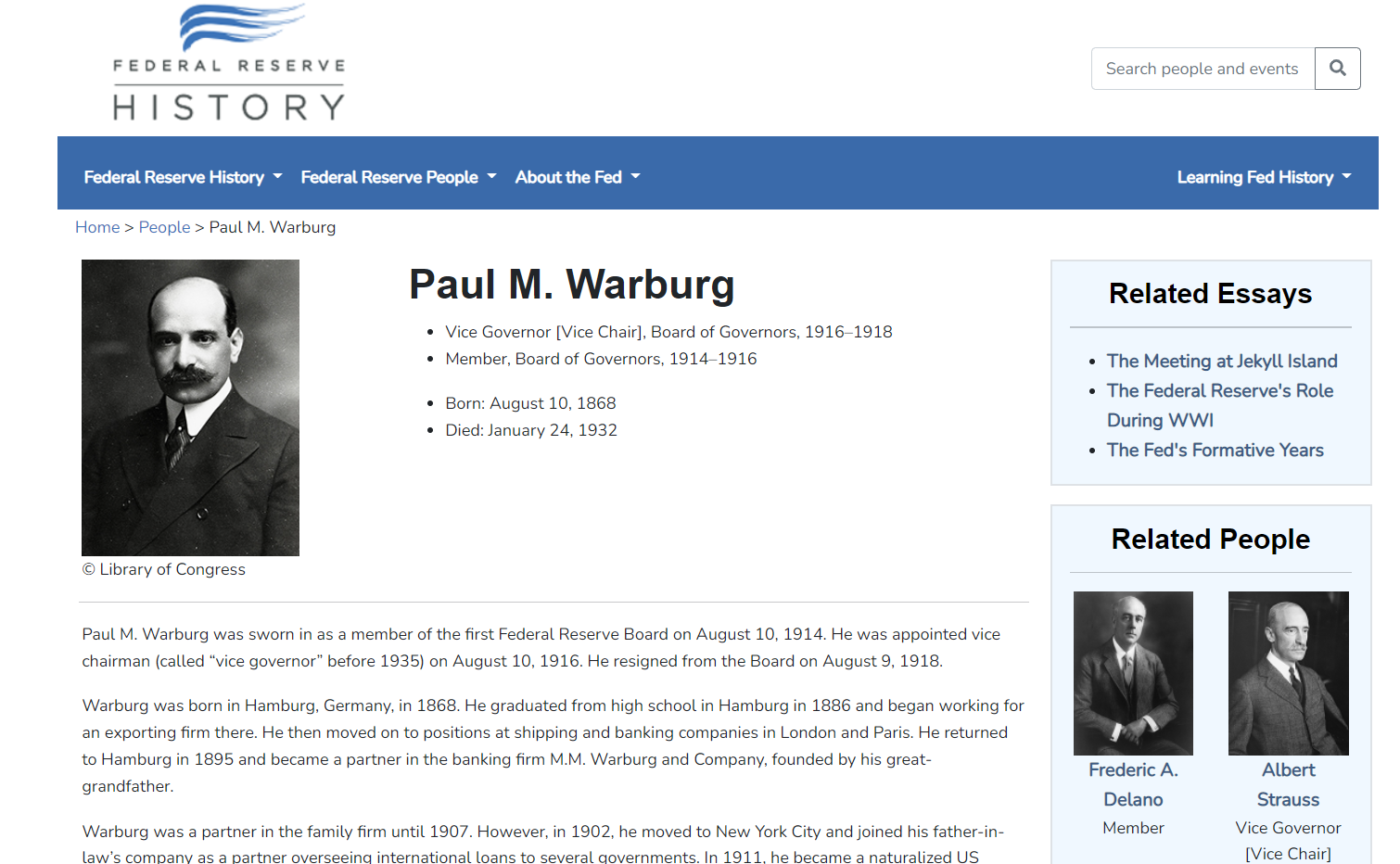
    Paul Warburg was also the driving force behind the creation of the US Federal Reserve, which congressman Charles Lindbergh described as: “…the most gigantic trust on earth. When the President [Wilson] signs this Bill, the invisible government of the monetary power will be legalised… The greatest crime of the ages is perpetrated by this banking and currency bill.”

    Warburg’s reward for bringing into being the U.S. Federal Reserve was to be its first chairman. While speaking before the House Committee on Banking and Currency in 1913, he confessed that, having emigrated to America in 1902, following an extensive education in international banking in Europe, he became a partner of Kuhn, Loeb & Co, which was to become a Rothschild-controlled shareholder of the American central bank.

    It is self-evident that the education Warburg received was given by the Rothschilds, just as it was given to Jacob Schiff whilst he lived at their Frankfurt home before emigrating to America.

    Between the American Civil War and the beginning of the First World War, the main U.S. agents of the Rothschild Empire were JP Morgan, Abraham Kuhn and Solomon Loeb. Newsweek magazine published a brief history of Kuhn, Loeb & Co on February 1st 1936, which stated:

    “Abraham Kuhn and Solomon Loeb were general merchandise merchants in Lafayette, Indiana, in 1850. As usual in newly settled regions, most transactions were on credit. They soon found out that they were bankers…

    In 1867, they established Kuhn, Loeb and Co., bankers, in New York City, and took in a young German immigrant, Jacob Schiff, as partner. Young Schiff had important financial connections in Europe.

    After ten years, Jacob Schiff was head of Kuhn, Loeb and Co., Kuhn having retired. Under Schiff’s guidance, the house brought European capital into contact with American industry.”

    Those European “financial connections” were the Rothschilds, in whose Frankfurt house Jacob Schiff was purportedly educated; and their German partners, the M.M. Warburg Company of Hamburg and Amsterdam, who were and remain but an extension of the same all-powerful banking house – Rothschild by anther name.

    During the latter decades of the previous century, the Rothschilds provided John D. Rockefeller with enough finance to develop and dramatically expand his Standard Oil business. The mechanics of the investment were performed by the Warburgs and Jacob Schiff at Kuhn Loeb, who also financed Edward Harriman’s and Andrew Carnegie’s rail-road and steel empires; whilst JP Morgan’s empire was founded on credit extended by the Rothschild-controlled bank in New York.

    It naturally follows that, on the basis that the names of Warburg, Morgan and Schiff are synonymous with that of Rothschild, the banking house is widely considered to have power, control or undue influence over every member of the Federal Reserve board, as well as the selection of its chairman.

    In August 1976, the House Banking Committee Staff Report was published, detailing the history of the board members of the Federal Reserve, a portion of which can be seen below:

     N.M. Rothschild , London - Bank of England
                                     ______________________________________
                                    |                                     |
                                    |                           J. Henry Schroder     
    
                                    |                             Banking | Corp.
                                    |                                     |
                              Brown, Shipley - Morgan Grenfell - Lazard - |
                               & Company        & Company       Brothers  |
                                    |               |              |      |
                --------------------|        -------|              |      |
                |                   |        |      |              |      |
     Alex Brown - Brown Bros. - Lord Mantagu - Morgan et Cie -- Lazard ---| 
     & Son      |  Harriman       Norman     |    Paris          Bros     |
                |                   |        /      |            N.Y.     |
                |                   |       |       |              |      |
                |            Governor, Bank | J.P. Morgan Co -- Lazard ---| 
                |            of England    /  N.Y. Morgan       Freres    |   
                |            1924-1938    /   Guaranty Co.      Paris     |
                |                        /    Morgan Stanley Co.  |      / 
                |                       /           |              \Schroder Bank   
                |                      /            |              Hamburg/Berlin
                |                     /      Drexel & Company         /  
                |                    /       Philadelphia            / 
                |                   /                               /
                |                  /                           Lord Airlie
                |                 /                               /
                |                /     M. M. Warburg       Chmn J. Henry Schroder
                |                |      Hamburg ---------  marr. Virginia F. Ryan
                |                |         |               grand-daughter of Otto
                |                |         |                Kahn of Kuhn Loeb Co.
                |                |         |                        
                |                |         |                        
    Lehman Brothers N.Y -------------- Kuhn Loeb Co. N. Y.                         
                |                |     --------------------------                     
       µ
                |                |       |                      |                     
               8
                |                |       |                      |
    Lehman Brothers - Mont. Alabama   Solomon Loeb           Abraham Kuhn
                |                |     __|______________________|_________
    Lehman-Stern, New Orleans   Jacob Schiff/Theresa Loeb  Nina Loeb/Paul Warburg
    -------------------------    |       |                      |
                 |               | Mortimer Schiff        James Paul Warburg
    _____________|_______________/       |
    |            |          |   |        |
    Mayer Lehman |     Emmanuel Lehman    \
    |            |          |              \
    Herbert Lehman     Irving Lehman        \
    |            |          |                \
    Arthur Lehman \    Phillip Lehman     John Schiff/Edith Brevoort Baker
                  /         |             Present Chairman Lehman Bros
                 /  Robert Owen Lehman    Kuhn Loeb - Granddaughter of
                /           |             George F. Baker
               |           /               |
               |          /                |
               |         /           Lehman Bros Kuhn Loeb (1980)
               |        /                  |
               |       /             Thomas Fortune Ryan
               |      |                    |
               |      |                    |
          Federal Reserve Bank Of New York |
               ||||||||                    |
      ______National City Bank N. Y.       |
      |        |                           |
      |   National Bank of Commerce N.Y ---|
      |        |                            \
      |   Hanover National Bank N.Y.         \
      |        |                              \
      |   Chase National Bank N.Y.             \
      |                                        |
      |                                        |
    Shareholders - National City Bank - N.Y.   | 
    -----------------------------------------  |  
      |                                        /
    James Stillman                            /
    Elsie m. William Rockefeller             /
    Isabel m.  Percy Rockefeller            / 
    William Rockefeller          Shareholders - National Bank of Commerce N. Y.   
    J. P. Morgan                 -----------------------------------------------
    M.T. Pyne                    Equitable Life - J.P. Morgan
    Percy Pyne                   Mutual Life - J.P. Morgan
    J.W. Sterling                H.P. Davison - J. P. Morgan
    NY Trust/NY Edison           Mary W. Harriman
    Shearman & Sterling          A.D. Jiullard - North British Merc. Insurance
    |                            Jacob Schiff
    |                            Thomas F. Ryan
    |                            Paul Warburg
    |                            Levi P. Morton - Guaranty Trust - J. P. Morgan
    |
    |
    Shareholders - First National Bank of N.Y.
    -------------------------------------------
    J.P. Morgan
    George F. Baker
    George F. Baker Jr.
    Edith Brevoort Baker
    US Congress - 1946-64
    |
    |
    |
    |
    |
    Shareholders - Hanover National Bank N.Y.
    ------------------------------------------
    James Stillman
    William Rockefeller
    |
    |
    |
    |
    |
    Shareholders - Chase National Bank N.Y.
    ---------------------------------------
    George F. Baker

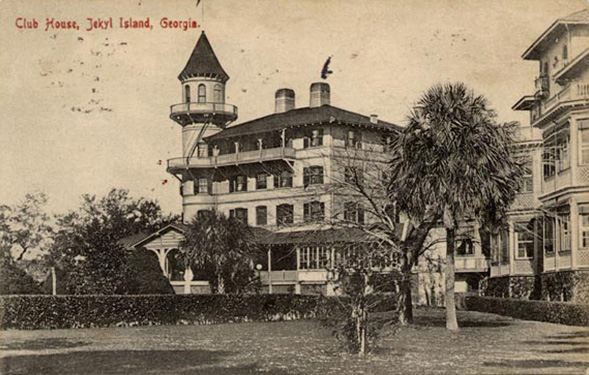
    The chart above first published 1976, reveals the linear connection between the Rothschilds and the Bank of England, and the London banking houses which ultimately control the Federal Reserve Banks through their stockholdings of bank stock and their subsidiary firms in New York. The two principal Rothschild representatives in New York, J. P. Morgan Co., and Kuhn,Loeb & Co. were the firms which set up the Jekyll Island Conference at which the Federal Reserve Act was drafted, who directed the subsequent successful campaign to have the plan enacted into law by Congress, and who purchased the controlling amounts of stock in the Federal Reserve Bank of New York in 1914. These firms had their principal officers appointed to the Federal Reserve Board of Governors and the Federal Advisory Council in 1914. In 1914 a few families (blood or business related) owning controlling stock in existing banks (such as in New York City) caused those banks to purchase controlling shares in the Federal Reserve regional banks. Examination of the charts and text in the House Banking Committee Staff Report of August, 1976 and the current stockholders list of the 12 regional Federal Reserve Banks show this same family control.
    Source: Federal Reserve Directors: A Study of Corporate and Banking Influence. Staff Report, Committee on Banking,Currency and Housing, House of Representatives, 94th Congress, 2nd Session, August 1976.

    In the event this table is accurate [and there is no reason to believe it is not], there is not one individual or bank or investment company included that could not be considered a Rothschild interest, whether by partnership, investment, lending, commissioning or founding, at the time the Federal Reserve Act was passed into law.

    Back in 1907, before the creation of the Federal Reserve, Rothschild-controlled Kuhn Loeb chief, Jacob Schiff, warned the New York Chamber of Commerce that:

    “…unless we have a Central Bank with adequate control of credit resources, this country is going to undergo the most severe and far reaching money panic in its history.”

    Not long after this speech, the Rothschilds’ agents created a financial panic on Wall Street by making margin calls on the market’s biggest borrowers, just as Nathan Rothschild did by selling government bonds low in the aftermath of the Battle of Waterloo in 1815, both of which resulted in an enormous transfer of wealth to the international bankers during the financial panics that ensued.

    Reflecting upon the 1907 panic, Paul Warburg, when speaking to the Banking and Currency Committee, confirmed that he was a driving force behind the Aldrich Plan for the creation of a privately owned US central bank:

    “In the Panic of 1907, the first suggestion I made was, “let us have a national clearing house” [Central Bank]. The Aldrich Plan [for a Central Bank] contains many things that are simply fundamental rules of banking. Your aim must be the same.”

    In addition to this compelling evidence of the hidden hand of Rothschild influence and control, the Telegraph newspaper published an article on 31/07/2013, detailing the revelations contained in documents released by the Bank of England, concerning the transfer of Czech gold to the Reichsbank BIS account. The article stated:

    “The documents reveal a shocking story: just six months before Britain went to war with Nazi Germany, the Bank of England willingly handed over £5.6 million worth of gold to Hitler – and it belonged to another country.

    The official history of the bank, written in 1950 but posted online for the first time on Tuesday, reveals how we betrayed Czechoslovakia – not just with the infamous Munich agreement of September 1938, which allowed the Nazis to annex the Sudetenland, but also in London, where Montague Norman, the eccentric but ruthless governor of the Bank of England agreed to surrender gold owned by the National Bank of Czechoslovakia.

    The Czechoslovak gold was held in London in a sub-account in the name of the Bank for International Settlements, the Basel-based bank for central banks. When the Nazis marched into Prague in March 1939 they immediately sent armed soldiers to the offices of the National Bank. The Czech directors were ordered, on pain of death, to send two transfer requests.

    The first instructed the BIS to transfer 23.1 metric tons of gold from the Czechoslovak BIS account, held at the Bank of England, to the Reichsbank BIS account, also held at Threadneedle Street.

    The second order instructed the Bank of England to transfer almost 27 metric tons of gold held in the National Bank of Czechoslovakia’s own name to the BIS’s gold account at the Bank of England.”

    In more simplistic terms, Montague Norman transferred 21 tonnes of Czech gold held by BIS in a Bank of England account, to a Reichsbank account it also held in trust at the English central bank, in order that his friend and fellow central bank head Schacht could finance the final stages of the rearmament of Hitler’s Germany; in addition to transferring 27 tonnes of Czech gold into another BIS account held at the Bank of England, for purposes we can realistically suppose were of a similar criminal nature.

    Before any further investigations, it is already clear that Schacht and Norman, the governors of the Reichsbank and the Bank of England respectively, turned a blind eye to a massive theft of wealth from a sovereign nation, to provide arms for the Hitler’s Reich, for whom the drums of war had been beating since 1930. This was done in their unaccountable capacities as trustees of BIS national accounts.

    Whilst there is a mountain of additional evidence, for the purposes of this essay, it has already been shown that, on the balance of probabilities, two of the four men who founded BIS were working for or with the House of Rothschild, on the ground that all of the money transferred to Schacht’s Reichbank was sent by Rothschild proxy, Jacob Schiff [or his agents] at Kuhn Loeb; whilst the gold transfer from the Bank of England was authorised by Schacht’s fellow BIS founder, Montague, who both must have known that Hitler’s troops had invaded Prague and that the Czech government would never have consented to gifting such a vast amount of gold to Hitler’s Reich and BIS at the time the transfer was sanctioned.

    The only question remaining is whether the House of Rothschild has benefited from the operations of BIS, but the answer arises swiftly from a summary of the answers to the other two questions posed.

    We have already established that Schacht and Montague co-founded BIS in 1930 and were carrying out Nazi money laundering operations for Rothschild interests, MM Warburg and Kuhn Loeb; and that Paul Warburg was appointed the first chairman of the Federal Reserve in 1914, after the Act he drafted was passed into law; so it is reasonable to assert that the House of Rothschild benefited from these events in the following ways:

    1. A Rothschild agent was placed in charge of the issue of American credit, at the helm of a new privately owned US central bank, the board of which was entirely made up of the representatives of Rothschild interests. This meant that when the heads of the central banks were appointed to the BIS board of directors, Rothschild agents were guaranteed influence over the bank’s operations.

    2. This sequence of events significantly increased Rothschild influence and power over both the US Government and the European nations who needed BIS to facilitate loans to their central banks in order to wage WWII; the evidence of which can still be seen today in the form of Donald Trump’s Commerce Secretary, Wilbur Ross, who worked for Rothschild Inc for three decades, as well as Rothschild controlled President Macron of France.

    3. The House of Rothschild clearly used their agents, Schacht, Montague, Warburg and Schiff, to fund both sides in WWII in order to provide the circumstances required for the creation of the Zionist state of Israel; which could not have been achieved with such efficiency and secrecy without the participation of BIS, the sovereign bank which grants the protection of immunity from criminal prosecution to any Rothschild agent appointed to the board or to act as its representative, under the terms its Headquarters Agreement with the Swiss Federal Council. This allows Rothschild operations to be carried out above and beyond any legal jurisdiction or national government scrutiny.

    There is a veritable plethora of evidence which would further substantiate the logical assertion that the Rothschilds have benefited, both directly and indirectly, from the operations of the Bank of International Settlements since its creation, but the compelling sources cited in the foregoing passages substantiate that in and of themselves.

    The inescapable conclusion is therefore that BIS is and always has been a House of Rothschild interest, despite the fact that the evidence is disguised by the governors of the world’s central banks sitting on the board, every one of which is controlled in much the same way the Rothschilds control the Bank of England and the Federal Reserve. A rigged system in their favour, if ever there was one.

    To be continued?
    Our work and existence, as media and people, is funded solely by our most generous supporters. But we’re not really covering our costs so far, and we’re in dire needs to upgrade our equipment, especially for video production.
    Help SILVIEW.media survive and grow, please donate here, anything helps. Thank you!

    ! Articles can always be subject of later editing as a way of perfecting them

  • UKRAINE WAR ZONE OVERLAPS WITH FORMER JEWISH COLONIES NEGOTIATED BY THE ROTHSCHILDS, FUNDED BY THE WARBURGS WITH AMERICAN MONEY AND DISMANTLED BY STALIN

    This territory is the birthplace of the Chabad guru, rabbi Menachem Mendel Schneerson, of the first mayor of Tel-Aviv and ofKlezmer music. Also a good home to Trotsky, for a while.
    It was meant to be a second Palestine, but Stalin ruined their plans.
    And the only gentile I know that got this far with his research on this topic was murdered.

    SOURCE

    ABSTRACT

    SHARE

    PREAMBLE

    1. Zelensky is controlled by Chabad.
    2. Putin is controlled by Chabad.
    3. Chabad doesn’t argue itself.
    4. Chabad doesn’t find a peace resolution in Ukraine.

    _______________________________________
    Conclusion: The resolution is war.

    Which would explain why Russia doesn’t seem to hurry or throw its best resources into this pit.

    Groomers admit Russia is throwing 50 years-old junk in Ukraine, then struggle to spin it

    If Chabad wins either way, who loses either way?

    The local population, the dead ones especially. The ones in the separatist regions and the South most specifically, as they’re the only Ukrainians shelled by Ukrainian Army rather than by the “invaders”.
    But the ripples are global and can be manipulated in more ways than we can imagine.

    “Be cursed, Zelensky!” shout the Mariupol people you won’t see on JTV

    Doesn’t that victimized local population include lots of Chabad / Jews?

    Not quite, they’re mostly gone by now, but promise to return, as this Kharkov Chabad rabbi announced on April 22, 2022:

    Who are the Jews of Ukraine, according to Chabad.org :


    “Today, Ukraine boasts a thriving Jewish infrastructure that includes synagogues, mikvahs, a matzah bakery, Jewish schools and yeshivahs, and social services organizations. The first permanent post-Perestroika Chabad-Lubavitch emissaries to Ukraine arrived in 1990 to what was still the Soviet Union, and began leading the synagogues in Kharkov and Dnipro (Dnepropetrovsk until 2014) that had just been returned to the Jewish community by the authorities. Their work built on Chabad’s deep roots in the region, including decades of underground Jewish activism throughout the Soviet era.

    Chabad maintains Jewish orphanages in Zhitomir—the children were evacuated farther west this week—Odessa, and Dnipro. It is far from only relief work that they are engaged in. As the quality of life in Ukraine has risen, so has the quality of Jewish life. Chabad maintains a Jewish university in Odessa and has built the largest Jewish center in the world in Dnipro. Kosher restaurants dot the country as well, signaling a level of material and spiritual comfort few could have predicted just a few decades ago.

    According to the United States Holocaust Memorial Musuem, prior to Hitler’s invasion of the Soviet Union in 1941, “Ukraine was home to the largest Jewish population in Europe… While scholars are still researching the scale of the Holocaust in Ukraine, they estimate at least one and a half million Jews were killed there.” The Nazis, with the help of local collaborators, gathered Ukraine’s Jews in local ghettos, but, for the most part, instead of deporting them to camps, shot them in forests and fields close to home. Such killing fields dot the entire Ukraine, with places such as Babi Yar outside of Kiev—where some 40,000 Jews were murdered—among the most well-known.

    Many surviving Jews returned home after the war, and traces of the former Pale of Settlement were readily visible as late as the 1980s and early 90s. Back then, small, historically Jewish towns in western Ukraine still had synagogues and significant numbers of native Yiddish speakers, their concentration diminishing the farther east one went. When Chabad of Zhitomir was established in the early 1990s by Rabbi Shlomo and Esther Wilhelm, one of their responsibilities was to reach out to the dozens of smaller Jewish towns where throngs of older Jews still lived.” – Chabad.org

    What I pictured so far suggests an ethnically targeted depopulation agenda and a revenge agenda that don’t argue, just may overlap with other agendas. A reverse pogrom.

    Goyim depopulation operation going well in Ukraine


    Depop policies are not entirely new to them, Ukraine has hardly survived through Holodomor once, under the helms of Jews…

    “Last July, the Ukrainian Security Service released a list of high-ranking Soviet state and Communist Party officials — as well as officials from NKVD, the police force of Soviet Russia — that essentially blamed Jews and Latvians responsible for perpetrating and executing the famine because most of the names on the list were Jewish.”

    JEWISH TELEPGRAPHIC AGENCY, JUNE 15, 2009

    “Zelensky told reporters that he had asked Netanyahu to recognize as a genocide the 1932 Holodomor famine caused by Soviet policies, but Netanyahu did not.”

    JEWISH TELEPGRAPHIC AGENCY, AUG 20, 2019
    SOURCE


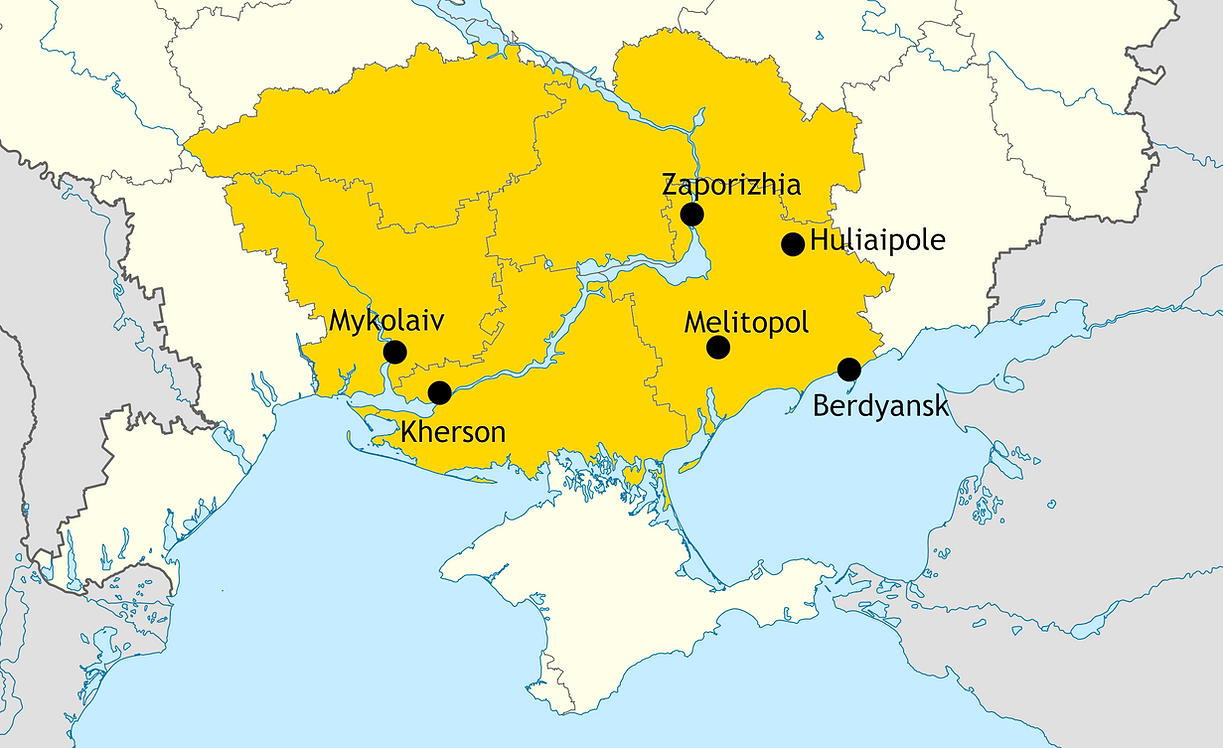
    But why just those specific areas, what do they have in common?

    SOURCE

    Well, it seems the disputed territory map largely overlaps with a former area of high Jewish interest:

    SOURCE


    Rare documents and press reports tell a rare story.

    A CRAZY HIDDEN STORY OF ROTHSCHILD-WARBURG PROTO-COMMUNISM

    THE LIFE STORY OF SHMUEL YELISHEVITCH
    Related orally in Yiddish by Shmuel Yelishevitch in 1992, at the age of 92.
    This written record was translated simultaneously from Yiddish and written in Hebrew.[Translated by Chaim Freedman, 1998/9]

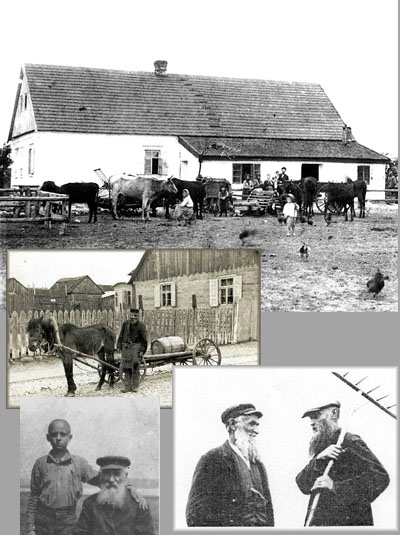
    I was born in a Jewish house, father, mother and seven children. I was the youngest of the six sons and the daughter who was the firstborn. We lived in an old house on an estate called Azarevitch. The estate had a Russian landowner and we worked his land. When we built a larger house, my grandfather and grandmother continued to live in the old house. Grandfather was a religious Jew and attended the synagogue every day which was one kilometer from the house. One day, a severe winter day, on the way home from the synagogue he fell and broke his foot. Due to his inability to work he wanted to move to his son Gotlieb who lived close to the synagogue. Grandmother was afraid to sleep alone in the house at night. She paid me two kopecks per night so that I should stay with her. I was then aged six and grandmother told me each evening about the history of the family which is engraved in my memory.

    The Colonies

    The estate was founded in 1800 before which it was desolate. Rothschild, who was friendly with Queen Katerina was aware of the difficult life of the Jews in Polotsk and in Vitebsk and it was forbidden for them to live in the villages unless they were craftsmen. In the same period army service in Russia was by those who were abducted whose service was for twenty five years.

    Rothschild approached the Queen Katerina and suggested to her to grant the Jews an area of land and he would finance the settlement of Jews there. The idea found favor with the queen, she visited the Ukraine, passed through the steppes and discovered that it was desolate and uncultivated. She suggested to Rothschild to accompany her and visit the area and it was decided to establish Jewish colonies in that area. She promulgated an order to divide the area such that each family would receive a plot of land and that those families who settled there would not be enlisted in the army.

    That is how they established seventeen settlements of one to two hundred families each. The largest colony was called Bakher3. Others were called Latent4, Engels, Myadler, Peness, Di Vilner, Kabilni, Gravskoy, these were on one side.On the other side there were, amongst them, Horkes, Nazrivka ( in Yiddish Azeritch where I was born), Priud, Kavalevsk, Haloshkas, Pervi (2) numer, Dritten (3) numer, Numer (4) Ferten numer, Hopalover. In between an area of sixty kilometers there were also Russian villages.
    Every family received forty kilometers of land, a two-family house and next to it for each family, a dunam of land to grow household needs. Two thousand dunams was left in reserve for family expansion.
    SOURCE
    SOURCE

    SOURCE

    Felix Warburg Expresses Satisfaction with Jewish Settlements in Crimea

    JTA, May 19, 1927

    The inspection tour of the new Jewish colonies made by Felix M. Warburg and his party came to a close today with a visit to the Julius Rosenwahl Colony.

    Of the 136 new Jewish colonies, 27 were visited by, Mr Warburg, who was accompanied by James II. Becker, Dr. Bernard Kahn and Dr. Joseph A. Rosen, head of the Agro-joint in Russia. In addresses to the settlers, Mr. Warburg expressed his pleasure at the rate of development and at the energy and efficiency of the colonists and the management of the Agro-joint, the agency of the American Jewish Joint Distribution Committee responsible for the colonization work.

    SOURCE

    SOURCE

    What a fantastic year for mr. Felix!

    And these two had more brothers, one of them, called Max, was dealing i the same money and people trafficking business “niche”:

    “Together with his brother Felix M. Warburg, who was a successful banker in the U.S., Max M. Warburg organized financial aid for Jews in Eastern Europe. As the war led to increasing antisemitism, Warburg started to ask officials to protect Jews against discrimination. During the war Warburg came to be one of the leading figures to advise German politicians, diplomats, and the military in financial matters. In October 1918 he was appointed a financial advisor to the chancellor (Reichskanzler) Prinz Max von Baden. In 1919, Warburg served the German delegates during the negotiations on the Versailles peace treaty as an economic specialist. Warburg preferred to keep a low profile. When Walther *Rathenau asked him in early 1922 to join the cabinet (Reichsregierung) as minister of finance he refused, saying that two Jewish ministers would be too much for Germany. After the assassination of Rathenau the murderers planned also to kill Warburg. In 1924 he was appointed a member of the board (Generalrat) of the Reichsbank. The Warburg Bank was still one of the most important banking companies in Germany. From the late 1920s on Warburg intensified his interest in Zionism.

    From World War I on, his brothers Felix M. and Paul M. Warburg opened the doors to the leading financial circles in North America for their brother. This was – again – especially helpful, when Germany urgently needed fresh capital during the world economic crisis between 1930 and 1932. After the Nazis came to power in Germany, the Warburg Bank came under increasing pressure. Max M. Warburg focused on helping Jewish emigrants to get their money out of Germany via the Palaestina-Treuhand GmbH. After the Warburg Bank was closed by the National Socialists, Warburg himself immigrated in 1938 to New York, where he died.”

    BIBLIOGRAPHY:

    M.M. Warburg, Aus meinen Erinnerungen (1952, edited by Eric M. Warburg); E. Rosenbaum et al., Das Bankhaus M.M. Warburg & Co. 1798 bis 1938 (1976); R. Chernow, The Warburgs (1993).


    Sources: Encyclopaedia Judaica

    If this is how they treated their home-country, Germany, how much can you hope from them for America and the Federal Reserve?
    Or Ukraine…

    WARBURG WHO?
    WARBURG FEDERAL RESERVE

    Previously on SILVIEW.media: “THE QUESTION IS ONLY WHETHER WORLD GOVERNMENT WILL BE ACHIEVED BY CONSENT OR BY CONQUEST” – WARBURG / ROTHSCHILD PROGENITURE IN 1950 US SENATE HEARINGS

    AND MR. FED REPORTED TO…

    SOURCE

    On December 15, 1931, Chairman McFadden informed the House of a dispatch in the Public Ledger of Philadelphia, October 24, 1931, “GERMAN REVEALS HOOVER’S SECRET. The American President was in intimate negotiations with the German government regarding a year’s debt holiday as early as December, 1930.” McFadden continued,

    “Behind the Hoover announcement there were many months of hurried and furtive preparations both in Germany and in Wall Street offices of German bankers. Germany, like a sponge, had to be saturated with American money. Mr. Hoover himself had to be elected, because this scheme began before he became President. If the German international bankers of Wall Street — that is Kuhn Loeb CompanyJ. & W. SeligmanPaul WarburgJ. Henry Schroder — and their satellites had not had this job waiting to be done, Herbert Hoover would never have been elected President of the United States.

    The election of Mr. Hoover to the Presidency was through the influence of the Warburg Brothers, directors of the great bank of Kuhn Loeb Company, who carried the cost of his election. In exchange for this collaboration Mr. Hoover promised to impose the moratorium of German debts. Hoover sought to exempt Kreuger’s loan to Germany of $125 million from the operation of the Hoover Moratorium. The nature of Kreuger’s swindle was known here in January when he visited his friend, Mr. Hoover, in the White House.”

    Eustace Mullins – Secrets of the Federal Reserve London Connection

    From Wikipedia:
    Kuhn, Loeb & Co. was an American multinational investment bank founded in 1867 by Abraham Kuhn and his brother-in-law Solomon Loeb.[1] Under the leadership of Jacob H. Schiff, Loeb’s son-in-law, it grew to be one of the most influential investment banks in the late 19th and early 20th centuries, financing America’s expanding railways and growth companies, including Western Union and Westinghouse, and thereby becoming the principal rival of J.P. Morgan & Co.

    In the years following Schiff’s death in 1920, the firm was led by Otto Kahn and Felix Warburg, men who had already solidified their roles as Schiff’s able successors. However, the firm’s fortunes began to fade following World War II, when it failed to keep pace with a rapidly changing investment banking industry, in which Kuhn, Loeb’s old-world, genteel ways, did not seem to fit; the days of the gentleman-banker had passed.

    The firm lost its independence from the Bulge Bracket in 1977 when it merged with Lehman Brothers, creating Lehman Brothers, Kuhn, Loeb Inc. The combined firm was itself acquired in 1984 by American Express, forming Shearson Lehman/American Express and with that, the Kuhn, Loeb name was retired.

    History

    Kuhn, Loeb & Co. was an investment bank located in New York City. It was founded in 1867, by Abraham Kuhn and Solomon Loeb. Kuhn and Loeb had created a successful merchandising business in CincinnatiOhio, when they decided to move east, to New York, to take advantage of the country’s burgeoning economic expansion. Company records indicate that by the time Kuhn and Loeb established their partnership, they were able to capitalize it at $500,000 (equivalent of about $9.7 million in 2021). On January 1, 1875, Jacob Schiff (1847–1920), Solomon Loeb’s son-in-law, joined the firm. He eventually became its leader and grew the firm into the second most prestigious investment bank in the United States behind J. Pierpont Morgan’s J.P. Morgan & Co.
    ….

    It also acted as the leading investment house for John D. Rockefeller, through the guidance of his investment adviser, Frederick T. Gates. Rockefeller invested in many syndicates with the bank, including major stakes in the prominent railroad companies, as well as contributing to its consolidation of the Chicago meatpackers, which resulted in the formation of a leading trust. Overseas ventures that Rockefeller also got involved with included the bank’s loans to the Chinese and Imperial Japanese governments.

    The firm also joined a partnership with Rockefeller in 1911 to gain control of the Equitable Trust Company, which was later to merge and become the Chase Bank.[2]

    Famous partners of the firm included Otto KahnPaul WarburgFelix WarburgMortimer SchiffBenjamin Buttenwieser, Abraham Wolff, Lewis Strauss, and Sigmund Warburg, founder of S.G. Warburg.

    In its early years, intermarriage among the German-Jewish elite was common. Consequently, the partners of Kuhn, Loeb were closely related by blood and marriage to the partners of J & W SeligmanSpeyer & Co.Goldman, Sachs & Co.Lehman Brothers and other prominent German-Jewish firms. Prior to the Second World War, a particularly close relationship existed between the partners of Kuhn, Loeb and M. M. Warburg & Co. of Hamburg, Germany, through Paul and Felix, who were Kuhn, Loeb partners. Later on, following World War II, their cousin Sigmund Warburg would briefly continue this relationship as a partner and Executive Director of the firm…

    Although the Kuhn, Loeb name is probably gone forever, the firm’s legacy is not. Former Kuhn, Loeb employees remain in senior positions throughout Wall Street, and until recently, at Lehman Brothers. Vestiges of the firm survived in the form of Lehman Brothers’ extensive fixed income capabilities, including many of their bond indices, such as the Government/Credit index. This index, originally created in 1973 by Kuhn, Loeb, as the Government/Corporate index, was among the first generation of bond index data to measure the fixed income market. It is still the preeminent benchmark in its class.

    Longest Serving Partners: Jacob H. Schiff (45 years), Felix M. Warburg (40 years)

    Clients of the Firm

    And the Warburgs report to…

    SOURCE

    Then came Purim. Firstly we baked Homentashen, filled with poppy seed, with raisins, with plums. We went to Shule `to kill’ Haman. The children used their `Gregers'(# noisemakers) when they heard his `holy’name. In the morning we sent `Sholekh Mones’. On two trays were arranged all sorts of good things, covered with a white cloth. The children took firstly to Grandfather and Grandmother. Father and mother had sent `Sholokh Mones’. Grandmother took off the trays what the children had brought and put all sorts of her good things. And Grandfather gave a few koppecks. We felt so rich, like Rothschild. We went home happy.

    THE MEMOIRS OF ROKHEL LUBAN
    Rokhel Luban was born in 1898 in the Jewish agricultural colony called Trudoliubovka (also known to the Jews as Engels) in the government of Yekaterinoslav in the southeastern Ukraine.

    Ukraine stats

    • The latest population estimate for Ukraine is 42,800,000.
    • As of 1 January 2016, the core Jewish population of Ukrainians was estimated to be 56,000 (0.13% of the wider population) and the enlarged Jewish population was estimated at 140,000.
    • An estimated 200,000 Ukrainians qualify for Israeli citizenship under the Law of Return.
    • The largest Jewish population centres in Ukraine are Kiev, Dnepropetrovsk, Kharkov and Odessa.

    The paragraph below is from Introduction to the Study of the Jewish Agricultural Colonies in the Ukraine by Chaim Freedman, written in 2005. Since then, under the lead of Sylvia Walowitz, Jewish Gen has added a large digital database Courland-Kherson Jewish Relocation 1837-1840 (lists searchable in Latvia and Ukraine databases on Jewish Gen http://www.jewishgen.org).

    “In the late 18th century large areas of territories in south-east Ukraine came under the control of the Russian Tsarist regime. At that time this area was known as Novorussia (New Russia) and was divided roughly into three Guberniyas (provinces): Kherson, Yekaterinoslav and Tavritch (the latter included the Crimean peninsula and part of the adjacent mainland). The Russian government was anxious to develop this region by settlement from the rest of the Russian Empire. At the same time the government sought a way to relieve itself of the so-called “Jewish Question”, particularly in what are now Lithuania, Latvia and Belarus. With the accession of Tsar Alexander the First, legislation was passed to define and partially relieve the situation of the Jews. One objective of this legislation was to encourage Jews to leave the crowded and economically poor centers in the north and establish new settlements in Novorussia. Those Jews who qualified to be included in this enterprise were promised financial support to set up agricultural colonies, with the added incentive of exemption from military service (the period of exemption changed at various times throughout the 19th century).”

    Russian Jewish agricultural colonies became models for communal agricultural efforts worldwide. Karl Marx cited the kolonii as examples of workers taking control and lifting themselves up through hard work. Zionists in the early 20th century used Russian kolonii as models for Kibbutzim in Israel, particularly in the Second Aliyah after 1904. After the Russian Revolution of 1917, the Bolshevik government carried out collectivization efforts during 1920–1938, see Komzet and OZET. Many kolonii became kolkhozes during this period.

    Wikipedia

    A more detailed but very brushed history of the colonies is available in the Jewish Encyclopedia.

    See also

    List of Jewish Agricultural Colonies

    Map of the Jewish settlements in Crimea for December 17, 1926
    SOURCE

    Ekaterinoslav (Dnyepopetrovsk) Gubernia

    • Alexandrovsk (Zaporozhe)
    • Andreyevka
    • Bakkers (Zatishe)
    • Bogodarovka (Novodarovka, Kovilevsk)
    • Donetsk (Yuzovka, Stalino)
    • Gaichul (Hichur, Novoukrainka)
    • Gorykaya (Nazarevitch)
    • Gottland
    • Grafskoy (Prolotarsky)
    • Grunau
    • Gulaipole
    • Karla Leibnekta
    • Khlebodarovka (Suntsove)
    • Krasnoselka (Driternumer)
    • Ludvigstahl
    • Marienfeld (Marinopol)
    • Marionovka
    • Mariupol
    • Mezheritch (Ferternumer)
    • Nadeshnaya (Der Vilner)
    • Nechayevka ( Gorki, Peness)
    • Melitopol
    • Mikhailovka
    • NovoZlatopol (Pervernumer)
    • Orekhov
    • Priyutnaya (Takni)
    • Reichenfeld (Shirokoye)
    • Roskoshnoye (Galushkes)
    • Rovnopol (Lates)
    • Rozovka
    • Sladkovodnaya (Kobilnye)
    • Tokmak
    • Trudoliubovka (Engels)
    • Tsarakonstantinovka (Kubishevo, Kamenka)
    • Vasilkovka
    • Velikomikhaylovka
    • Veselaya (Hoopolova)
    • Zaparozhe (Aleksandrovsk)
    • Zatishye (Bakhers)
    • Zelenopole (Myadler)
    • Dribovka

    Kherson Gubernia

    • Berislaw
    • Bolshoi Nagartav
    • Bolshoi Sedeimenukha
    • Bobovri Kut
    • Dibrovka
    • Dobraya
    • Efingar
    • Inguletz
    • Israelovka
    • Izluchistoye
    • Lvovo
    • Malaya Nagaratav
    • Malaya Sedeimenukha
    • Novo Berislav
    • Novo Poldol’skiy
    • Novopoltavka
    • Novo Vitebsk
    • Lvovo
    • Romanovka
    • Volnaya

    Tavrida Gubernia

    • Berdyansk

    Jewish Colonies

    Now let’s do a little Jewish Ukraine Travel:

    Mykolaiv

    Mykolaiv has had a Jewish population since its founding, and Jewish laborers were involved in its construction. Aside from construction work, many merchants came to the city in order to build businesses selling to the Navy and its sailors. However, Jews were banned from Mykolaiv from 1829-1859, during the reign of the arch-conservative Emperor Nicholas I.

    Mykolaiv’s most famous son is Menachem Mendel Schneerson (1902-1994), probably the most important religious figure in 20th century Judaism. His family moved to Yekaterinoslav (Dnipro) in 1907 when his father became the city’s Rabbi. As an adult, he studied in Berlin before the Nazis took power, then went to Paris, where he stayed until the Nazis followed him there as well. The Rebbe escaped to New York on the very eve of the Nazi conquest of Paris. In 1950, he succeeded his father in law to become the seventh leader of Chabad-Lubavitch.

    The Rebbe was most influential through his innovations in the field of Kiruv, or outreach. Chabad Houses are found all over the world, and their members are a frequent site handing out shabbat candles and helping men wrap tefilin. Their website is a fantastic resource for Jewish learning as well. Chabad emissaries were sent to Ukraine after the fall of the Soviet Union in order to rebuild Jewish life and most synagogues in the country are Chabad-affiliated. His enormous personal magnetism allowed him to build relationships both across the spectrum of Jewish observance and into the non-Jewish world.

    DSC03878.jpg

    Another famous Jew, though one with a more spotted reputation, who passed through Mykolaiv was Leon Trotsky. Trotsky moved to Mykolaiv as a young adult and began his career as a revolutionary organizing other workers here in 1896. He would later go on to lead the Bolshevik Red Army during the Civil War and was a favored candidate to succeed Lenin, but lost the power struggle to Joseph Stalin. He would then go into exile in Mexico before Stalin had him assassinated.


    KHERSON

    Located at the mouth of the Dnipro River, the most important trade and transport artery in Ukraine, Kherson was originally envisioned as the heart of the Russian Empire’s expansion on the Black Sea Coast. So much so that it is the final resting place of Grigory Potemkin, the Prince who oversaw the conquest and colonization of the region. However, the Dnipro estuary proved to be too shallow to be as useful of a port, so the city became eclipsed by neighboring Mykolaiv and Odessa.

    The Map of Jewish Agricultural Colonies of Kherson Guberniya
    Ed. note: The colony Vol’naya is not specified on a map because of its isolated position. This colony was located north west of Odessa.
    SOURCE

    Jews settled in Kherson as soon as the city was founded, and soon made up a large percentage of the city’s merchants. Lumber and grain export were the largest businesses. Outside of the city itself, Kherson region hosted several Jewish agricultural colonies.

    The main synagogue of the city, located at Teatralna Street 27, was originally constructed in 1895, but was burned down during the Nazi occupation. After renovating the building, the Soviet authorities turned it into a dormitory for workers at the Petrovsky factory, then later a ward for treating alcoholics. It was handed back to the Jewish community after Ukrainian independence in 1991. It is now renovated and fully operational, with a school and several community organizations.

    DSC04003.jpg

    Kherson oblast is the second least densely populated in Ukraine, and is home to many sites for nature tourism. These include Oleshky Sands, the largest desert in Europe, Askania Nova Nature Preserve, Dzharylhak National Nature Park, and the Dead Sea-like salt pools surrounding Lake Syvash.

     CHABAD IN KHERSON

    MELITOPOL

    Melitopol is a moderately sized city in the south of Zaporizhia Oblast that has some of the oldest archaeological finds in Ukraine. The Kamyana Mohyla site, in the outlying village of Myrne, was a religious site from the Neolitic era up through the Medieval period. Before the Russian conquest, the city was a fortified town of the Nogai Turks called Kyzyl-Yar. As the Russian Empire took over the lands of the Crimean Khanate, it became a small village occupied by Cossack families.

    In 1842, Melitopol was given its status as a city along with its name, which is Greek for Honey City. Melitopol is still famous for producing honey, as well as cherries. By the late 19th century, it was roughly 40% Jewish. While nearly all of Melitopol’s Jews were killed in the Holocaust and the city is now predominantly ethnic Ukrainian and Russian, they are proud of their diverse roots and are a participant in the Council of Europe’s Intercultural City Program.

    Melitopol Synagogue is located on Interkulturna Street, in between Chernyshevs’koho and Mykhaila Hrushevskoho. There is also a memorial to Holocaust victims and the Righteous Among Nations. The statue is, in part dedicated to Vera and her Alla Zemtseva, who rescued Zhanna Tsyparska from the fascists.

    THE CROWN JEWEL – ODESSA

    SOURCE

    Although a settlement existed on the site in ancient times, the history of the modern city began in the 14th century when the Tatar fortress of Khadzhibey was established there; it later passed to Lithuania-Poland and in 1480 to Turkey. The fortress was stormed by the Russians in 1789 and the territory ceded to Russia in 1792. A new fortress was built in 1792–93, and in 1794 a naval base and commercial quay were added. In 1795 the new port was named Odesa for the ancient Greek colony of Odessos, the site of which was believed to be in the vicinity.

    Encyclopedia Britannica

    Tatars are a Turkic nomadic population related to Khazars, and the two could’ve been easily mistaken one for another by ancient historians.

    This stream of immigration carried Jews in large numbers into the city. Eventually this would give Odessa one of the largest concentrations of urban Jews to be found anywhere in the world. During the period from 1815 to 1861, the Jewish population rose from under four thousand to well over seventeen thousand individuals. In 1854, seven thousand Jews were citizens of Odessa, while six thousand other Jewish residents were officially considered to belong to other Russian towns. An English traveler observed: “The Jews form the largest portion of the foreign population. … A few are very rich and engage in the banking business; many make large purchases of imported goods from the foreign merchants and sell them retail in their own shops.

    Not only did Odessa offer Jews unprecedented economic opportunities and freedom to pursue their own cultural interests, but its liberal atmosphere allowed them some participation in political affairs—a rare prerogative in tsarist Russia. In the 1850s, eleven Jews served in city offices. Both Vorontsov and his successor Stroganov insisted that Jews participate fully in all aspects of the city’s life. This steady influx linked the urban population through familial and other networks with the Jewish settlements in the hinterland. This laid the basis for still more massive immigration after 1861. ” 

    Patricia Herlihy, “Odessa: A History 1794-1914”. Harvard Ukrainian Research Institute, Cambridge, Massachusetts 

    ODESSA ACCORDING TO Cultural Guide to European Jewry – JGuideEurope

    SOURCE

    Established in 1794, Odessa was captured by Admiral de Ribas from the Turks for Empress Catherine II of Russia. The city developed rapidly during the nineteenth century, largely due to the arrival of colonists from “New Russia”. It soon became a melting pot of Russians, French, Armenians, Poles, Greeks, Moldavians, and Jews. Forbidden to reside in Saint Petersburg, Moscow or Kiev, Jews poured into the southern Russian cities of Odessa and Nikolayev, eventually constituting a third of their population before the Second World War. Even today, Odessa still bears their mark.

    A Jewish city

    An Odessan was asked one day,
    -How many people live in Odessa?
    -One million.
    -And how many of them are Jews?
    -I just told you. One million.

    You see, in people’s minds, “Odessan” and “Jews” are often confused.

    Jewish Odessa began at the Greek Square (“Gretsk, that’s what they call the street where the Jews do business”, Sholem Aleichem wrote), Alexandrovski Prospect, the old marketplace, and the streets named Evreiskya, Bazamaya, and Malaya-Arnautskaya. It continued on the other side of Preobrajenska Street, down Tiraspolskaya to Staroportofrankovskaya streets, and beyond that to the neighborhood by the train station. It covered the entire Moldavanka suburb, where the famous Privoz market is found, and ended at the Slobodka district, where the deportation convoys waited during the German-Romanian occupation. The Jewish quarter encompassed a tremendous area, in other words, stretching from downtown all the way to the western and northern suburbs. Before the war, 350000 Jews lived here. They number no more than 50000 today.

    Odessa, between yesterday and today

    Today, only 3% of Odessa’s population is Jewish, approximately 30000 people. However, the city is still seen as one of Europe’s Jewish capitals. When, in 1916, Isaac Babel, wrote about a “city built by Jews”, he didn’t only refer to the number of Jews, but also to the general atmosphere, tolerant toward minorities.

    Recently, archaeologists unveiled Jewish tombs dating from 1770, thus proving that a Jewish community existed there before Odessa’s creation. Indeed, in the 18th century, Jews were salt dealers in this province, that was then known under the name Hadjibey. According to the records, before its conquest by Iossif Derbos, about 10 Jews lived in this region. A hundred year later, there were 138000. The first Jewish inhabitants of Odessa came from the Russian Empire’s shtetls, and from the well-known city of Brody in Galicia. A lots of Jews bore the name of the shtetl they originated from.

    The first Jewish inhabitants of Odessa were attracted by the privileges offered by the Russian Empire to the volunteers willing to settle in South Russia. For the Jewish community, it meant escaping the oppression they suffered from in the rest of the Empire. In Odessa, Jews were almost equal to other citizens. Therefore, 100 years after its creation, one third of Odessa’s population was Jewish, and became known as “the star of exile”, as Babel described the zionist movement in the city. Let’s add that leaving the shtetl for Odessa meant -in general- an increased quality of life. For some, the possibility of emigrating to Palestine, from a dream, became a reality. The frequent pogroms also fostered the rise of zionism in Odessa. Still, in 1941, half of the population was Jewish.

    Life in the different quarters of the city

    To the difference of many cities in the Russian Empire, Odessa didn’t have a Jewish quarter. Although some locations such as Moldavanka, Yevreyskaya, Bazarnaya, and Malaya Arnautskaya were at the center of the everyday community life. Being from small communities, the Jewish population tended to reproduce in Odessa the structural system they knew in the shtetl. Everyday life evolved around the synagogue, the mikveh, the school, the kosher butchery and charitable organizations. The first community newspaper was published in 1795.

    The community elite was personified by Brodsky’s Jews, seen as the most educated, wealthy and liberals. In general, the European aspiration of the Brodsky Jews, the fact that Odessa was geographically far away from the centers of Judaism, the diversity if nationalities and social classes composing the city : all those elements explain why Odessa’s community was unique.

    At the beginning of the 20th century, Odessa became the biggest market for exchanges and buisinesses in South Russia. Jews managed 90% of the seed export business ; owned 50% of the factories ; produced the white stones that served to the city’s construction ; the Korelsky family managed the biggest tobacco factory of the Empire etc…On the other side, one third of the city’s Jews lived in poverty.

    The “Gate to Zion”

    Historian Steven Zipperstein notes that the history of Odessa’s Jewish community is closer to the one of San Francisco than the one of Kiev. In this port city, the Jews lived without the constraints and limitations of the Russian Empire. They were not isolated and were an active part of the city’s life. The language barrier didn’t apply as well. However, at the end of the 19th and beginning of the 20th century, the tolerant and multicultural Odessa was nicknamed “Gate to Zion”. Indeed, it became one of the centers of the zionist movement, and the city where thousands of Jews left to Palestine.

    The center of the zionist activity was the “Palestine Committee”. This organization helped the relocation of farm workers and craftsmen in Palestine. The committee was initiated in the 1880s by Lev Pinsker, Ahad Haam, Bialik, Klauzner, or Ben Ami were also part of the board. The members also raised funds to buy lands in Palestine. The land were the Hebraic University of Jerusalem was built was purchased by the committee. This is why Lev Pinsker was displaced there in 1934.

    One of the most active members of this committee, Meir Dizengoff, was the first mayor of Tel Aviv. This is merely a coincidence. In some respect, Tel Aviv was built in Odessa. Lilienblum, one the yishuv first journalist, wrote that in Odessa, Jews arrived to the shores of the black sea, built a city and developed a port. If they were able to to that in Odessa, they would achieve their goal on the shores of the Mediterranean as well.

    Another center of the zionist activity was the Brodsky synagogue. Around 70 houses were built through fund raising executed by the synagogue. Those buildings were the first of the future city of Nes Ziona.

    To properly prepare the future emigrants, an Hebrew-only school was opened in 1903. In the same time, the publishing house Moria published school books in Hebrew and sends them to Tel Aviv.

    From 1919 to 1927, the boat Ruslan shipped a numerous part of the Odessa intelligentsia to Palestine. Among them, lots were about to become the leaders of the future Israel.

    SOURCE

    The State Archives of Odessa Region (SAOF) is one of the largest archives in Southern Ukraine. Document holdings include more than 13,100 fonds (record groups) consisting of more than 2,009,604 files. These documents date back to the end of the eighteenth century until the present and reflect the history of the City of Odessa, Odessa Region and Southern Ukraine (formerly Novorussia). A large number of these documents are concerned with Jewish history.

    The State Archives of Odessa Region was founded in 1920 as the Odessa Historical Archives. Its main function was the collection of archival documents in the territory of Odessa and Odessa Guberniya (Province), control under departmental archives, responsibility for the safety of valuable materials and the researching and publication of documents. Many famous scientists, public leaders and officials took part in the establishment of the state archival system in Odessa Region.

    SAOR began with 22 fonds and collections from various organizations, agencies, religious institutions that concluded their activities after the revolution.

    The main fonds of the pre-revolutionary period were:

    • Administration of Novorussia and Bessarabia Governor-General
    • Odessa City Chief
    • Odessa City Council
    • Guardianship Committee for Foreign Settlers in Southern Russia
    • Odessa Police Office
    • Commercial Court
    • Banks
    • Odessa Port Offices and Customs
    • Novorussijsky University, colleges and schools
    • Building organizations
    • Cultural Societies

    Jewish materials were represented as separate parts of those finds (Jewish sections) or in common management records.

    From the mid 1920s until 1940, the Odessa Archive received 33 fonds from Jewish institutions, including:

    • Odessa Affiliate of the Committee of Society for the Spreading of
       Learning Among the Jews in Russia
    Private Banks of Ashkenazi and Barbash
    • Odessa City Rabbi
    • Talmud Torah
    • College for Artisans of Society “Trud” (Labor”), KOMZET, ORTVERBAND
    • Odessa Pedagogical Jewish College

    These fonds were of great interest to researchers. During this time, there was open support and acceptance of various ethnic groups. In 1931, the Jewish section in the Odessa Archives was established; the Search Room opened in 1927 and scientists received extensive access to documents. The first Odessa historians working with Jewish records were:

    • S. Borovoj (“Jewish Colonies in Novorussia, 1830-1840”)
    • L. Strizhak (“Economic state of the Jews in the Steppe Ukraine”)
    • A. Buzhevich (Jewish Commissions, 1882”)
    • D. Rishman (“History of Jews in Novorussia”)
    • A. Reminik (“Jewish Theatre”

    The academician, M. Slabchenko, prepared the materials of Zhaporozje Sich Kosh for publication and located Jewish records among them; but the research and qualified description of them was made by the a young scientist, Saul Borovoj. In 1940, S., Borovoj defended a doctoral dissertation on the subject of “Studying the History of Jews in Ukraine, XVI-XVIII centuries.”

    With the beginning of World War II and German-Romanian occupation of Odessa in 1941, a major portion of the documents were evacuated to Stalingrad and later to the town of Uralsk in the West Kazakhstan Region. In Odessa, the City Chief Alexianu ordered the liquidation of “all Soviet garbage” and to convert the archives into a horse stable. The Director of the Archives, G. Serbsky, did not obey and valuable documents were salvaged. Replacements and evacuations led to irrecoverable waste; more than one million files (50% were lost during the war. Jewish fonds also suffered very much. For example, documents destroyed included great portions of materials of:

    • Odessa City Rabbi (320-819 files)
    • Odessa Affiliate of the Committee of Society of the Spread of
       Learning Amount the Jews in Russia (462-495 files)
    • Odessa House of Jewish
    • Culture (82-84 files, and others

    In April 1944, SAOR renewed its work in Odessa. After the war, there were not significant incoming Jewish materials other than some private fonds. Since 1990, SAOR has begun the process of declassifying about 900 fonds of German-Romanian Occupying Administrative and other Institutions. These files contain information about the creation of 139 concentration camps and ghettos in”Transnistra,” names of the imprisoned Jews and the policy of genocide.

    In 1992, SAOR included records of the former Archives of Odessa Regional Committee of the Communist Party of the USSR (more than 6,000 fonds), including Jewish fonds such as:

    • Odessa Region and City Committees of Poalei-Zion
    • Odessa Region Committee of Jewish Communist Union of Youth
    • Editorial Office of the newspaper “Kommunistische Stimme” and others.

    From 1945 until the early 1990s, scientists did not conduct special research on Jewish history. In spite of the fact that Jewish fonds were not secret, there was not any information about them in the Guide to Odessa Archives published in 1961.

    Interest in this subject developed from the beginning of the 1990s. During the last 13 years, fifteen foreign researchers, representing scientific center in Germany, Israel, USA, Canada and Japan as well as Ukrainian historians and others have made great contributions to Jewish history using extensive archival sources.

    The historical focus on national minorities in Novorussia is one of the main directions of activity in the Odessa Archives in recent years. Materials on Jewish history were presented at some exhibits at the Odessa Historical and Literary Museums. In 2000, the complete register of fonds and collections, including Jewish ones, for pre-revolution period was published, Also, some databases were created including:

    • Name Indexes of the Odessa Jews on Materials of the First All-Russian
       Census in 1897 (not complete)
    • Odessa Board for Small Businesses, 1894-1918

    The name and thematic catalogs of Jews were also brought up to date. SAOR participates in the international program “Documents on History and Culture of Jews in Archives of Ukraine” (Ukraine-Russia-USA).

    One of the recent projects of the Odessa Archives is an archeographical edition of Jews of Odessa and Southern Ukraine: History in Documents (End of XVIII-Beginning of XX Century). The book was prepared with support from the Odessa department of the “Joint” and was published in 2003. The book includes:

    1Survey of 72 basic fonds of the Odessa Archives for pre-revolutionary and Soviet periods which contain documents on Jewish history (33 fonds of Jewish institutions, 24 fonds of administrative, court, statistics, customs and other institutions that were related to the subject and 15 private fonds). Description of every fond provides information about inclusive dates and quantity of files, varieties and contents of documents in general.
    2Documental Digest. 250 documents on pre-revolutionary history of Jews are represented on 12 thematical lines including:
    • Legislation on Jews, State policy and the Jewish subject in the
       Russian Empire
    • Settlement in Novorussia, Jewish colonies, migration and emigration
    • Trade, industry, banks
    • Educational movements; science
    • Religious and moral life
    • Charity
    • Medical institutions and societies
    • Publishing business
    • Jewish pogroms
    • Army service
    • Participation in revolution movements
    • Criminal world

    Document examples
    • Regulation for Jews (April 13, 1835)
    • Directions of Higher Authorities about the foundation of the Commission
       for Education of Jews (1842)
    • Abolition of kahals (1844)
    • Settlement of Jews on State lands (1847)
    • Prohibition of special Jewish clothes (1851)
    • Visits to police office on day off (1852)
    • Election order for Jews (1857)
    • Registration Rules for Jews – foreign subjects (1880)
    • Materials of the Commission on the Jewish Problem (1881)
    • Directions regarding admission of Jews to universities (1913)
    • Circular of the Ministry of Jewish Affairs regarding election to Jewish
       public boards (1818)
    • Information about resettling Jews from Podolia to Kherson Guberniyas
       and the number of Jewish colonies (1835-1839)
    • Project of some merchants from Kremenchug, Pavlograd and Uman
       to establish a model Jewish colony of Michailsdorf in Bessarabia (1840)
    • Report of the Governor-General M.S. Vorontsov regarding reformation
       of the Jews in Russia (1844)
    • Appointment of the Mennonite Quenzer to the post of Chief in the
       colony of Gromokleva (1857)
    • Conflict and fighting between the Jews and Gypsies in Rezina
       (Bessarabia)
    • Activities of the Odessa Society for Relief to Jews, Peasants and
       Artisans in Syria and Palestine (1888)
    • Jewish Colonization Society (1892)
    • Emigration from Odessa to Argentina (1895)
    • Inclusion of Jews to the Odessa merchants and petty bourgeois
    • Foundation of A. Rafalovich’s firm (1850)
    • Society for Bilateral Aid to Jewish counterman (manager) (1862)
    • Registration of owners of manufacturing enterprises in Odessa (1898)
    • Information about activities of the M. Ashkenazi firm (1898)
    • S. Barbash’s bank (1915)
    • Materials about the Foundation of the Jewish College for Boys in
       Odessa (1826)
    • Odessa Jewish Society “Beseda” (Converse”) (1863)
    • Society for Bilaterial Aid to the Jewish teachers in Novorussia (1866)
    • Activities of the Talmud Tora in Odessa (1877)
    • Statistical information about Jewish students in the Novorussijsky
       University (1881)
    • Establishing of S. Gurovich and R. Khari scholarships at Odessa Commercial College (1888, 1892)
    • Activities of the Society “Trud” (1895-1901)
    • Odessa Affiliate of the Committee of Society of the Spread of Learning
       among Jews in Russia (1897)
    • Cheders in Ekaterinoslav and Tavrich Provinces (1903)
    • Building of the Second Talmud Torah in Odessa (1904)
    • Activities of Societies of “Ivrija” (1907)
    • Lovers of Jewish Language (1907)
    • Club “The Jewish Public Meeting” (1908)
    • Odessa Jewish Public Nachman Byalik Library “Seifer” (1919)
    • The College “Yeshivot” (1915-1916)
    • Documents about the number of synagogues and houses of prayer
       in Odessa (1840)
    • Commendation to the Rabbi of the colonies of Novo-Vitebsk, Novo-
       Podolsk and Novo-Kovno – Rabbi Benjamin Knyazhik with gold medal
       for good service (1862)
    • Registration of 63 synagogues and houses of prayer in Odessa with
       dates of foundation and addresses (1890-1894)
    • Materials about parishioners of the Brodsky Synagogue (1892-1894)
    • Statute of the Odessa Society for Jews Converted to the (Russian)
       Orthodox Faith (1894
    • Birth entry of David Oustrach (1908)
    • Information about the Jewish Hospital in Odessa (1832,1854)
    • Establishing of the Iosif Valtuch Orthopedic Institute (1888)
    • Klara Weinberg’s Medical Center for Vaccination against smallpox
       (1893)
    • Documents about prohibition of the merchant Aksenfeld to open a
       printing house in Odessa (1852)
    • Program of the first magazine for Jews in Russian “Rassvet” (*1860)
    • Information about edition of “Hamelitz (1867)
    • “Kadima” (1906)
    • “Unser Leben” (1912)
    • “Jewish Anecdotes” (1916
    • Materials from the editorial collection of Sergey Stern
    • Materials about the establishment of:

         • Odessa Jewish Charity Society (1866)
         • Kogan’s House (1873)
         • Jewish Hospice (1880)

    • Benefections of A. Brodsky, R. Khari, OKhais, M. Morgulis, M.
       Rabinovich, Rafalovich, Katzen, Luisa Ashkenazi and others for
       Jewish orphans (1866-1898)
    • Activities of the Societies of “Druzhelyubije” [“Friendship”] (1898)
    • Central Jewish Registration Bureau
    • Reports and notes of the extraordinary Odessa Governor-General,
       gubernial authorities and Odessa City Chief about pogroms in Odessa
       and Novorussia in 1881, 1886, 1905
    • Evidence from witnesses including Rosa Drutman’s statement about
       the murder of the Veitzman family in 1905.
    • Information about the liberation of Jewish students from military
       service (1844)
    • Drafting of Jewish peasants who were avoiding military service (1847)
    • Materials about legal proceedings charging E. Kenis with abetting Jews
       in avoiding military service (1885-1888).
    • Materials from the police court case of David Bronstein (Lev Trotsky)
       arrested for revolutionary activities in Nikolayev (1898)
    • Reports of police officers about participation of Jews in revolutionary
       developments, court materials accusing M. Bogomolny with having
       illegal Bund and Poalei-Zion literature (1904)
    • Activities of the Jewish Self-Defense guard in Moldavanka
       [Odessa] (1906)
    • Relationship of cadets (political party) to the “Jewish Problem” (1908)
    • Reports of Police and Customs authorities about the Jews engaged in
       contraband, forgery, prostitution (international), discreditable
       practices with securities, etc.
    3Genealogical Chapter, Fond 359: Odessa Board for Small Business, Jewish Section, 1894-1918 (alphabetical name index of 4,505 heads of Jewish families that had a status of Odessa Meshchanin (petty bourgeois) with address locations.
    Page 179 from the above book
    with an alphabetical name index
    of 4,505 heads of Jewish families.
    Information includes name,
    address, date of birth,
    age and list number.


    [Enlarge image]

    Genealogical research is a way to examine the facts through the history of families and to determine the place of an individual in society and his influence on the world. This is an important research focus in order to understand the historical period, its affect on individual families and our place in history.

    For example, family history research for the Odessa petty bourgeois Krakhmalnikovs revealed an engrossing story of the development of confectionary production that began in 1892 as a factory and trade firm “The Krakhmalnikov Brothers” and continues to operate now as the Joint Stock Company “Odessa.” By the way, descendants of this family now live in the USA after emigrating from Odessa in 1906. Some family members continue in this occupational field including Bruce Kreig, a grandson of Abram Krakhmalnikov. While he is a professor of Archeology at Chicago University, at the same time he is a famous international expert in food and cooking. After searching the documentary materials in the Odessa Archives, he wrote “We are very happy to know that we are a part of the history of Odessa.”

    The Public Archive of Odessa region Survey of funds and documents
    HISTORY OF THE JEWS OF ODESSA And SOUTH OF THE UKRAINE
     “the Jews of Odessa and south of the Ukraine: history in the documents “
    (The first volume – end OF THE XVIII – THE XX centuries)
    SOURCE

     ADMINISTRATIVE ESTABLISHMENTS
    Control of the Novorossisk and Bessarabian governor general
    Office of the Odessa mayor
    Trustee committee about the foreign settlers of the southern edge of Russia
    Odessa urban on the compulsory military service presence

    ESTABLISHMENTS OF THE URBAN And CLASS SELF-GUIDANCE
    Odessa urban thought, the Odessa urban setting
    Odessa petty-bourgeois setting

    POLICE, JUDICIAL, PROSECUTOR And NOTARIAL ESTABLISHMENTS
    Odessa municipal magistracy
    Office of the Odessa police chief
    Elder notary of the Odessa circuit court
    Odessa merchant’s court
     
    FINANCIAL ESTABLISHMENTS And THE JARS
    Banker house Of Ashkenazi in Odessa

    ESTABLISHMENTS OF THE RELIGIOUS CULT
    Odessa municipal ravvinat

    Cultural-educational SOCIETIES
    Committee of the Odessa department of the society of the propagation of education among the Jews

    THE EDUCATIONAL INSTITUTIONS
    Funds for the higher educational institutions of g.Odessy, general education secondary schools, schools and schools and oranov of their control
    Odessa Jewish School “Of Talmud- Thor”
    Odessa 6- Class School Of efrussi

    FUNDS FOR THE SOVIET PERIOD
    Funds for the establishments of the period of the temporary German- Rumanian occupation

    ADMINISTRATIVE ESTABLISHMENTS

    Control of the Novorossisk and Bessarabian governor general
    f. 1, 1797-1874, 29624 matters


    General- governor archive both by the volume and on the significance, is placed in the category of the separately valuable funds GAOO. Since 1803 Odessa was the administrative center of Novorossisk edge and the residence of governor general, who accomplished control of the enormous territory of the Kherson, Ekaterinoslav, Tavricheskeye provinces and Bessarabian region. In the archive of governor is concentrated the information on the history of Jews in the south of the Ukraine v on the different aspects.

    Legislative acts are widely represented, the resolutions of imperious organs – emperor edicts about the rules of the settling of Jews in by Novorossisk edge, positions about Jews 1835, 1844, position about the box collection of 1839, rules about the production by the Jews of crafts only in the small cities, the settlements and the places (op.2ya8 (1847), d.eeeya). Was preserved the matter for particular office concerning the report of the governor general of the graph Of m.S.Vorontsova to emperor “relative to the assumed measures to the conversion of Jewish people in Russia” (1843, f.y, op.yshche, d.y28).

    There are opinions and decisions of the chiefs of provinces, information about their fulfillment on the following questions: on the settling of Jews on the particular, landowner’s and fiscal earth (1847-1859 yr, op.2ya9, d.”‘; 1849, op.y92, d.e0; 1854, op.y9e, dd.88-89); on the moving out of Jews to 50 versts from the border of Austria and Prussia (1852, op.2yshch, d.ey); on the limitation of Jews in the trade – opinion of the chiefs of provinces about the equation in the rights of Jews with the Christians (1857, op.y9shch, d.shchya9); on the department of Jews into the special blocks (1856, op.20e, d.ya”); on the prohibition by them entrance into Moldavia (1861, op.y”e, d.2ya); on the order of the selections of Jews to the urban and public posts (1857, op.y9shch, d.”0″); on the subordination of Jews to general control and the destruction of kagalov (1844, op.yshchya, d.e”; 1845, op.y92, d.90); on the establishment of commissions for the formation of Jews (op.y92 (1842), of d.e9); on permission to buy to Jews the earth in the Crimea; on the assignment to the Jew- farmers of the 50- summer privilege of release from the rekrutskoy duty, about the isolation of loans to the acquisition of economy, about the establishment in the Ekaterinoslav province of the colonies of “Israeli Christians”, about the candle and box collections (pub. 248 (1858), dd.2yaye, 2415; op.2ya8 (1843), d.y0shch), the device of hospitals and almshouses (op.2ya8 (1843), of d.y09; op.y9e (1854), d.yy8; op.2ya8 (1854), d.2′”0; op.y”(1868), d.y2y). Was preserved the information about a quantity of kagalov, synagogues and Jewish schools in the edge (op.2yya (1834, d.e), about the collection of donations to the construction of synagogues and of houses of prayer (1842, op.2ya8, d.9’), about the establishment in Odessa of Jewish school (op.y90 (1826 g.) d.ya”) and handicraft classes in by Novorossisk edge (op.y9e (1853), d.98).

    A number of documents they reflect the process of Jewish colonization. These are materials about land surveying of the earth for the device of colonies, application of the Jews of Podolskiy, Grodnenskoy and Vitebskoy of provinces about the migration into the Kherson province (1837, op.yya8, d.y; 1838, d.shch; 1840, d.ee, 2728); the information about the desire of merchants to found model Jewish colony in Bessarabia (1840, op.2yshch, d.y’). There are permissions of authorities to the delivery of passports for the entrance from abroad or of migration from other provinces of Russia, information about the state of Jewish colonies (1841, op.2ya8, d.2″Рё; 1843, op.2ya8, d.y08, 115), about the Jew- farmers (1859, op.y’, d.y0shch), about the measures for an improvement in control of the Jewish settlings (1843, op.2ya8, d.yy0), about the “disorders” in the colonies (1841, op.2ya8, d.89). Materials on the colonization are concentrated in the fund also on the separate inventory – “about the Jewish colonies of Novorossisk provinces” (inventory 2, 1837-1847, 101 matters). This of order and the reports of the central and local administrative bodies of control about the outlet of the earth in the Kherson and Ekaterinoslav provinces for the settling of Jews and device for them of agricultural colonies, the assignment of fiscal means for the building of the houses of colonists, the determination of the staff of officials and supervisors for control of the newly formed settlings. There are petitions of Jews of Podolskiy, Kurlyandskeye, Vitebsk, Mogilev, Grodnensk, Kovenskeye and Minsk provinces about the migration into Novorossiyu, and also applications of some colonists about the permission by it to return in the previous place of residence, about the delivery of passports and tickets for the departure to the earnings.

    In the documents is contained valuable information about the development of Jewish colonies beaver Kut, greater and small Nagartav, Seydemenukha, Ingulets, Yefengar, Kamenka, tortuous (Khortitskiy district), Izrailevka (Bobrinetskiy district), new Berislav, L’vov, Romanovskoye, Novopoltavka (Kherson district) – statistical evidence, reports and the review of the officials of the department of the state asset and other officials about the development of agriculture and handicraft matter, wine ransom, about a quantity of inhabitants and the status of the health of population, the device of training and medical institutions, in particular, in Nagartave, the passage of some colonists from judaic to orthodox faith, applications of Jews about their reckoning in farmers, about their release from the rekrutskoy duty.

    Office of the Odessa mayor
    f. 2, 1802-1837, 1848-1854, 1856-1917, 20890 matters


    The materials of fund are systematized on 16 inventories, comprised in accordance with the structure of the office: tables capable, secret, economic, construction, certified, societies and meetings, 1 All-Russian population census. Inside each inventory the matters are systematized in the chronological order with some retreats. Materials on the history of Jews do not compose united collection, but they bear the separate nature and they are included in all structural parts.

    Capable table (inventories 1, 1a, 1b, 4 – ch.2, 1796-1919 yr.)

    Orders of mayor about the order of compilation of public sentences, about the order of conducting, to checking and zasvidetel’stvovanii of the Jewish metric books, about the establishment of handicraft classes with the fiscal Jewish schools, about the introduction of examination for the teachers of Jews, about the Odessa Jewish hospital.

    Lists about a quantity of Jews in Odessa, kagalov, synagogues and houses of prayer, information about discovery and activity of synagogues and of houses of prayer, selections of their officials. Information about the Odessa rabbis, in such cases to shvabakhere, doctor of philosophy To krepse.
    Information about the commercial houses, the enterprises, the drugstores and the therapeutic establishments – Abraham rafalovich, the steamer offices Kossodo, Rappoport et al., particular hospitals Of gurovich, Polukhera, Meringa and the assertion of the regulations of the orthopedic institute of Joseph val’tukh in Odessa.

    Orders relative to Jewish rites and customs – about the prohibition since 1851 to the Jews of the carrying of special Jewish clothing, about the prohibition to appear into the urban police during subbotniye and authorized days, to arrange wedding festivals on the streets of Odessa, to woman- jewesses to shave heads, to accomplish some religious rites not by rabbis.

    Matters about the assignment of the right of trade in Russia to Jews -inostrannopoddannym only to the merchants of the 1st guild, about the enumeration of Jews into the agricultural title, about the permission to Jews to open printing houses, in particular, to merchant aksenfel’d. Permissions to the publication of newspapers and periodicals, in such cases. “dawn”, “gamelits”. Information about the collisions between the Jews and the Christians on the religious soil, about the activity of London missionaries for the rotation of Jews into Christianity.

    Permissions about the erection of Jews into the honorable citizenship – I.Gorovitsa, M.Gurovicha, etc.

    _ matter about permission found different society – mutual assistance Jewish salesman, “conversation, mutual assistance Jew, mutual assistance jewess, Jewish blagotvoritelСЃogo charity association, society for propagation education between Jew, society for propagation craft between Jewish woman, mutual assistance Jew, assistance farmer and craftsman in Syria and Palestine, society for assistance inverted in Christianity Jew, society care about poor and homeless Jewish child, society mutual aid merchant agent and different merchant- Jew, society sanitary colony for treatment and training weak health study indigent Jewish population Odessa, society assistance require toiler- Jew Odessa, society for benefit former pupil commercial school Fa1ga, society care about poor Jewish population on settlement -Romanovke, society assistance by the student of the commercial school Of gokhmana, society of working aid to the requiring themselves Jews of Odessa, society “friendliness” and other.

    Materials about the charitable activities – about the donation A.Brodskim of house and 50 thousand rubles for the Jewish orphans and the device of barracks for 30 patients, about the establishment in the Jewish orphan house of allowance to im.Ashkinazi and of other nominal allowances, and also of allowance Of rafalovicha in the Jewish orphan house, the device of house for the aged Jews, the establishment by the Jews of almshouse, the donation Of l.Ashkinazi 76500 rub to the construction of operating building in the Odessa Jewish hospital.

    Orders concerning the educational institutions, in particular, school “eshibot”, the commercial school of the name Of gurovicha, school “labor”, the musical classes Of plinera, “Talmud- tori”, the dancing classes Of khaimovicha and Krymershmoysa, musical is course Rafalovicha, bandmaster it is course Kauffmann, drawing is course Reynbol’da, to the professional school of the practical painting Of tovelevicha.
    Materials about the establishment into 1875 with the mayor of the post of scientific Jew and reports of scientific Jews (Genikesa and of others.)

    Secret table (inventory 2, 1820-1912; op.ye, 1874-1910 yr.)

    On inventory 2: the matter for search and establishment of supervision after the persons, suspected of the criminal and political crimes, on the delivery of evidence about the loyalty. Lists of political prisoners, materials on the dispatch to the settling into Siberia and other province. Circular about the prohibition of voluntary offerings among the Jews by the name “collection to the Israeli earth”. Documents and the protocols of commission for Jewish problem. Matters about the transfer from Warsaw to Odessa of the monthly Jewish journal “gaboker-Or”, about the assertion of the program of weekly political- public and literary Jewish newspaper in the Russian language “love” edited by Yakov Prilukera.

    On inventory 13: the matter of office about the Jewish pogroms in Odessa in 1905 (dd.e-shch).

    Economic table (inventory 3, 1830-1916)

    Permissions to the discovery of industrial and commercial enterprises, information about the state of factories and plants, commercial houses, application in questions of owner’s activity. Deal about the construction of Odessa Jewish hospital of 1860; on the sums of box and candle collections and the content of Jewish schools 1864 about the discovery of the enterprises: Gamsheyem by Wolf, By b.Rozenbergom – vodka distilleries, by Siegal, by Schechter, by Vaynberg – factories of water and lemonade, Rafalovichem – the plant of starch and of solodovareniya, Gurovichem – the factory of finishing it is pin and the preparation of vinegar, By perel’muterom – cosmetic institution, by Frenkel – the factory of the preparation of fraction, dynamic meter Gusevs, By roytblat, b. by goose, by Barban – cotton factories, Shorshteynom – sheet metal factory, Brodskim – sugar refinery, by Bronstein – the medovarennogo plant, etc; on the assertion of plan for the construction of Jewish cold synagogue.

    Sudnyy table (inventory 4, 1828-1914 yr.)

    Materials about sale of the immovable properties for the debts, selection of complaints and claims, spiritual wills and guardianships, penalty of duties, expulsion of an alien abroad on the charge in the criminal and political crimes, performance of judicial sentences, into t.ch.:ob abduction by foreign Jews abroad of the russkopoddannykh women for the completion in Konstantinopole of public houses (d.”, 2483); on the delivery to the Jews of metric evidence; “about the investigation of denunciation about the formed gang of Jews, which issues the false of passport to the departure abroad. 1882 g.”,” on the complaint of the parishioners of Odessa main synagogue of improper actions of the warden of the synagogue Of a.Kupervassera on the post “; the alphabets of prisoners; rule for the activity in Russia of joint-stock Jewish colonization company and information about its work 7670); “about the meetings of Zionist- Jews”.

    Construction committee (inventory 5, 1812-1901 yr.)

    Information about the construction of public buildings, the outlet of the urban earth to private individuals, the activity of urban architects, in particular, about the service in the post of the architect of the 5th part of Odessa not the class artist of Joseph kolovich (drafter Of brodskoy synagogue).

    Certified table (inventory 6, 1808-1912 yr.)

    Passport, tickets to the entrance into Russia or the departure beyond its limits for the years 1808-1898 (they were preserved not completely). Matters to the individual citizens on the reckoning in Odessa petty bourgeois merchants, on the drive to the oath and the delivery of evidence to those, who accepted Russian citizenship, to the delivery of foreign passports, in particular, to avstriyskopoddannomu rabbi gersh To dannemarku in the passage into S- Petersburg, Moscow and Kiev. Lists about the foreigners, who arrived from abroad.

    Table of societies and meetings (inventory 7, 1906-1914 yr.)

    There are permissions to the establishment, the regulations and the information about the activity of societies and meetings of g.Odessy. Are introduced the society of the mutual aid of those been of handicraft society “labor”, the society of assistance to Jew- farmers and craftsmen in Syria and Palestine, Odessa territorialistskoye emigratory society, the union of Jewish charity associations and establishments “central Jewish registration bureau”, the department of Vilenskiy of the charitable Jewish society Of “gmilus-Khesed”, the society of the amateurs of Jewish language, Jewish public meeting in Odessa, the Jewish society Of “ivriya”, and also different professional societies with the traditionally high percentage of the participation of Jewish population – particular agents, brokers, photographers, industrialists, etc.

    First All-Russian population census of 1897 (inventory 8, 9, 10)

    The sheets of census with 3 thousand addresses were preserved, in them were registered the surname, name and patronymic of inhabitant, his age and the place of generation, citizenship, class, formation, religion, social position, profession, sources of income. (in 1897 the number of Odessa residents, who showed by native language Jewish, was 124511 man. – 2-4 on the number national group after Russians).

    Trustee committee about the foreign settlers of the southern edge of Russia
    f. 6, 1800-1873, 14815 matters


    In the fund for 9 inventories, in the inventories в„–в„– 1a, 3 and 4 there are divisions on the Jewish table, in the rest the materials according to the Jews are not isolated as separate complexes.

    In the fund were put off the materials on the colonization of Novorossisk edge, in such cases about the appearance and development of Jewish colonies in the Ekaterinoslav and Kherson provinces. These are reports and the list of the supervisors of Jewish colonies, circumferential orders and shul’tsev about the population, the welfare of colonies (statistical evidence since 1811), the penalty of taxes, the delivery of loans, the elections of officers, the development of agriculture, horticulture, trade; the application of the Jews of the western provinces of the Russian Empire about the migration into the newly formed colonies, about their reckoning in colonists and other classes, about the Jewish schools, about the fight with the vagabondage of Jew- colonists. Interest they can represent materials about the realization of government plan with respect to the involvement of Jews in productive zemledel’chestvo on the model of the well organized German farmer economies, the reciprocal effect of Jewish and mennonitskikh colonies – for example, about the building by mennonitami of houses for the arrived Jews in the colony To nechayevke, about the designation of wardens from mennonitov into the Jewish settlings, in particular, David Hertz into the colony to L’vov, about the migration of mennonitov in a constant place of residence into the Jewish colonies for the purpose of the development of there particular production, about the creation of the mixed settlings (Yudenplan in Khortitse), about the isolation by mariupol’skimi mennonitami of wheat for the sowing to Jew- colonists, about the orders by the Jews of agricultural instruments and seeds in molochanskikh mennonitov, etc.


    Odessa urban on the compulsory military service presence
    f. 315, 1884-1920, 1022 matters


    Materials according to the Jews are not isolated as separate complex.

    Lists of reservists and their metric vypisi (beginning from 1884 of generation), the private affairs of draftees, correspondence on the postponements of military service.

    ESTABLISHMENTS OF THE URBAN And CLASS SELF-GUIDANCE

    Odessa urban thought, the Odessa urban setting
    ff. 4, 16, 1796-1920, 67818 matters


    The Duma and setting knew by economic, financial, construction and businesses. Jewish department:

    f. 4, inventory 107 (1824-1872, 1034 matters)
    f. 4, inventory 108 (1884-1895, 120 matters)
    f. 16, inventory 109 (1896-1903, 76 matters)
    f. 16, inventory 110 (1904-1912, 183 matters)
    f. 16, inventory 124, part of 2, p. 399-423 (1870-1920 yr.)


    Annual reports of Jewish department. Information about the start of the arrived in Odessa Jews in petty-bourgeois and merchant class, the transfer from the class into the class, the restoration in the class and the exception from the same. Family and personal lists of Odessa Jew- petty bourgeois, merchants and craftsmen. Lists of Jews musical spark gaps and shops.

    Metric books and the lists of the borne and dead Jews (men), not registered in Odessa municipal ravvinate, in particular, by that belonging not to what konfessii. Correspondence on the certification of metric evidence about the generation, marriage, death and to the correction of errors in metric records. The decisions of setting about the establishment of the events of the generation of those, who do not be registered according to the metric books, and the alphabetical lists of such citizens. Correspondence on the delivery of passports, it is specific to the residence, evidence and other documents.

    Tax lists of Odessa petty-bourgeois Jewish class. Correspondence and lists on the rekrutskim collections, on the apportionment of candle and box collections.

    Lists of Jewish schools and materials about their content, in particular, the report of the member of the setting N.A. Of gantsa about the delivery in 1919 to the Jewish community of subsidy in the amount of 3806000 rub to the content of 28 elementary schools. Lists of Jews, which entered educational institutions.

    Information about building and discovery of synagogues and houses of prayer. Lists of synagogues and houses of prayer and their terms. Information about the officials of Jewish society – rabbis To fil’shteyne, Stopchike, Polinkovskom, To shvabakhere, the wardens of synagogues Abraham -Xasime, To kupervassere, scientific Jew Solomon To guroviche, etc.

    Materials about the donations, the content disabled, charitable actions, allocation of assets to the content of Jewish hospital, Jewish cemeteries, shelters. Lists of philanthropists and their spiritual wills (A.M.Brodskogo, etc.).

    Besides the inventories on the Jewish department, funds for 4 and 16 contain additional those 144 comprised on the years of inventory – on the general office management, the construction and charitable departments, the public education and the bookkeeping, in which also there is an information on the history of Jewish community against the background of townspeople life. The significant interest present the yearly lists of merchants, who declared capital, to list about the collection of taxes, materials about the discovery of commodity-industry enterprises, the outlet of the sections of the urban earth under the individual building, the participation of citizens in the urban self-guidance. The comparative analysis of documents can give idea about the formation, the increase and the motion of the private capital, formation and development of Jewish commercial houses, economic state of both the Jewish community as a whole and its individual representatives. In the fund for setting was preserved “the periodical of the honorable citizens of Odessa. 1854-1897 “, into which were carried 304 surnames of distinguished and most authoritative in the Odessa society citizens, in such cases of 96 Jews and karaites with the members of their families.

    Odessa petty-bourgeois setting
    f.eshch9, 1828-1919, 200 matters


    Jewish department (1894-1918, 44 matters) is represented by the family lists of the Odessa petty bourgeois- Jews (list it contains the names of all members of family with the indication of their age or date of generation, relation to the military service, the addresses of stay at the moment of the composition of document over the signature of the head of family).

    POLICE, JUDICIAL, PROSECUTOR And NOTARIAL ESTABLISHMENTS

    Odessa municipal magistracy
    f. 17, 1795-1839, 162 matters


    Magistracy knew by the administrative and judicial matters of Odessa petty bourgeoisie and merchants. In its office management were put off the most important and chronologically earliest materials of economic nature – the information about the delivery of commercial and estimated evidence, about the assertion of merchant women, zaprodazhnykh, borrowed letters, introductions into the estate, about the selection of commercial transactions, bankruptcies, complaints. There are also lists, lists and correspondence about a quantity of merchants and petty bourgeois, their properties and capital, organization it is shop particular applications about the reckoning into the Odessa merchants and the petty bourgeoisie, in particular, for the years 1808-1809. – M.Sh.Medyanika, Levi and Aron pibergod, Solomon and Abel Gershkovichey, Leyby of Krakow, tsesarskopoddannogo T.G.Kumana, etc. (op.e), Leyby Of balabana, Abraham bondoni, Gilelya Of manusovicha, Mordko Of moshkovicha, Mendel Doyberga, Yakuba Lando, Getselya Of fridentalya, Moshi Mangubi, etc. (op.shch), the information about the individual citizens, in such cases Jews, added into the Odessa petty bourgeoisie in 1811-1812.

    Documents about the erection of Jews in the post or the suspension from it are of interest also. In the fund there is an “alphabet about the Jews” in 1811 (op.e, d.yayashch)

    Office of the Odessa police chief
    f. 314, 1824-1917, 437 matters


    Fund contains reports, reports, correspondence of the officials of the police about search and detention of the persons, suspected and accused in the criminal and political crimes; the lists of citizens, which consist under the supervision of the police, the political prisoners of Odessa prison, exiled to the hard labor works, the members of underground organizations, participants in the revolutionary movement, Jewish pogroms in Odessa. There is information about the participation of Jews in the revolutionary movement. The political matters can serve as an example: on the participation in the preparation of attempt on governor in 1902 of the members of the party of the terrorists, in number of whom of 30 pupils of school “labor”; on the creation in 1907 by young Jews headed by leftist Mochmanom – by the workers of the plant of gene – guard by the name “young will” in contrast the “union of Russian people” and their participation in the “expropriation” of private property; on the witnesses on business Of beylisa; on the establishment By i.A.Trivusom, Ya.Landesmanom, S.Rabinovichem and By i.B.Smirom of “Odessa Zionist club KADIMA”; on the activity of “Jewish territorialisticheskoy organization” and its theorist Israel To zangvile; on supervision after the sect of subbotniks and “zhidovstvuyushchikh” and others.

    Fund is rich in the materials, which tell about the role of Jews in the criminal peace. From the criminal cases present interest materials about the activity in Odessa of the criminal groups of fal’shivomonetnogo and gambling business, sutenerstva, smuggling, and also of information about the well-known criminals – international pocket pilferer To moyshe To miroshnike-Irline (Bear- American), the international souteneurs Isaac Goldstein and the silverer, the cardsharper Zinof golender in the nickname “Pushkin” et al.


    Elder notary of the Odessa circuit court
    f. 35, 1869-1920, 32404 matters


    Funds contain the notarial reports about the buying and selling, the donation, the will of the immovable property and land sections, given to the estates, agreements about the transactions, concluded by the notaries of g.Odessy, the Odessa, Anan’evskogo and Tiraspol’ districts of Kherson province. There is, for example, information about the enterprises Of frola Of shpolyanskogo.

    Odessa merchant’s court
    f. 18, 1808-1920, 5072 matters


    Materials on the selection of commercial transactions, the delivery of estimated evidence, the collection of the commercial duties, matter for guardianship, commercial insolvency, registration of commercial institutions in the territory of Odessa mayorship. There are books of the registration of commercial establishments (1836-1843), of list about the property and capital of merchants (1826-1843), investigation and judicial matters for bankruptcies, promissory note actions, containing valuable information about activity and state of Jewish commercial houses.

    FINANCIAL ESTABLISHMENTS And THE JARS

    Banker house Of Ashkenazi in Odessa
    f. 246, 1893-1918, 5 matters


    Materials on establishment and activity of the joint-stock company of southeastern steam navigation “star” of the banker house Of ashkenazi. Balances and reports on the operation of steamship “eastern star” (1906-1916). Statements about the income, which is subject to taxation by the state income tax (1917-1918).

    ESTABLISHMENTS OF THE RELIGIOUS CULT

    Odessa municipal ravvinat
    f. 39, 1846, 1854, 1875-1920, 499 matters


    The metric books about the generation, the marriage, divorce and death of the Jews Odessa and alphabets to them – base source for the genealogical studies (documents of ravvinata for the years 1835-1874 they perished in the years of 2-1 world war).

    The funds for another konfessiy – Kherson spiritual consistory (f. 37), Evangelical- Lutheran and reform arrivals (ff. 630, 894) – contain information about the passage of Jews from judaic religion to Christian, about the marriages of israelites with the representatives of other religions, about the registration of Jews, who belong not to what faith.

    Cultural-educational SOCIETIES

    Committee of the Odessa department of the society of the propagation of education among the Jews
    f. 442, 1880-1881, 36 matters


    Regulations of the Odessa department of society, correspondence on organizational questions also about its activity. Protocols of the general meetings of the members of society; the application of students about the rendering by them of material aid, the determination to the pedagogical work; correspondence with the Petersburg committee, particular Jewish and other educational institutions for questions of the organization of enlightenment work among the Jews, delivery of means to the content of educational institutions, job placement of teachers, method of donations. Lists of instructors, members of society; the information about the Jewish schools of g.Odessy, the libraries of department and their reports. Brief survey of the activity of Odessa department, estimate of libraries and museum. Information about the members of the society

    THE EDUCATIONAL INSTITUTIONS

    Funds for the higher educational institutions of g.Odessy, general education secondary schools, schools and schools and oranov of their control
    (about 40 funds)


    Tyuey ppozvolyayut to investigate such questions as shaping of intellectual layer in the Jewish medium, level of the education of Jews, their contribution to the cultural and scientific life of city. Thus, in the materials Of rishel’evskogo face (f. 44, 1817-1865, 3262 matters) are considerable valuable information about trained in this Odessa’s first higher educational institution Jews.

    Created on the base of face in 1865. Novorossisk university (f. 45, 1865-1920, 44688 matters), only in the south of the Ukraine, played large role in the making of a Jewish intelligentsia Of novorossii. In kon.KhyKh- of nach.KhKh of substances the Jews composed significant layer among the students of Odessa. The private affairs of students – remarkable historical source, which makes possible for researcher to personify epoch. The matter contains, as a rule, application about the method into the educational institution and the release at its end, copy of metric evidence about the generation, the secondary school graduation certificate, information about the behavior and progress, photograph of student. In kon.Kh.IKh – nach.KhKh of substances in by Novorossisk university were trained many representatives of well-known Jewish families.

    In the fund for Odessa highest female it is course (f.eeya, 1906-1920, 11321 matters) numerous information about the jewess- girl students.

    Odessa Jewish School “Of Talmud- Thor”
    f. 441, 1891-1906, 13 matters


    Correspondence with the Odessa urban setting on organizational and economic questions. Circulars and the order of the inspector of people schools for training- organizational and financial-economic questions. Information about the composition of the trustee council of school, the rules of the internal regulation (d.y0); application about the delivery of benefits being required. List of students.

    Odessa 6- Class School Of efrussi
    f. 125, 1898-1901, 714 matters


    Minutes of the meeting of pedagogical council. General and examination lists about the successes, the behavior, the diligence and the abilities of students. Circular orders of the trustee of Odessa training region about the designation of teachers and their rewarding, about the grant-aided students. Lists of those entering, students and external students. Class, table and object periodicals. Curricula (op.y, d.ya’).

    the Receipt- cashbox books of payment for the instruction and the income- expense books. Photographic cards of external students (op.y, d.’y; op.2, d.eya), information and the certification of external students (op.2, d.28). The private affairs of students (op.e, 607 matters).

    FUNDS FOR THE SOVIET PERIOD

    In the funds for administativnykh control elements 1930- X yr. (councils, their executive committees and the subordinate structures of all levels) – the information about the nationalization of property in well-off citizens, the dekulakization. The materials of the inspectorates of public education (ff. 150, 134, 1919-1930, 2201 matters) tell about the activity of Jewish sections, schools, libraries, the creation in Odessa of the unique museum of Jewish culture.

    The documents of the independent funds for Jewish public organizations, educational institutions and political parties reflect many aspects of the state national policy of post-revolutionary period with respect to the poorest part of the Jewish population – creation of Jewish national regions, collective farms and agricultural comradeships, the organization of the system of the national educational institutions, cultural societies for the Jews, the activity of international organizations for rendering aid to the victims of pogroms in the period of Civil War in the Ukraine and starving, migration into Birobidzhan, departure of Jews into Palestine, activity of youth associations.

    Funds for the establishments of the period of the temporary German- Rumanian occupation
    887 funds, 1941-1944.


    The materials of the organs of authority and control, created with German- Rumanian authorities in the temporarily occupied territory of Odessa and Odessa region give idea about the catastrophe of Jewish people in period 2- of world war. The documents of boards, pretur, prefectures, working communities, enterprises and establishments contain information about the creation of the network of concentration camps and ghetto in the newly formed governorship Of transnistrii and concentration in them of Jewish population, about rendering aid concluded Rumanian Jewish communities. There are numerous lists of those, who were being located in the ghetto. By the colleagues of archive is created the alphabetical nominal card index of victims and indicator about the presence of lists on 139 ghetto Of transnistrii (Mogilev, Bershad’, Berezovka, Kameneq- Podolskiy, Obodovka, Domanevka, etc.). Since 1990 archive gave out sv.yshch of thousand of information to citizens about the confirmation of their stay in the ghetto within the framework of the implementation of international programs on the compensation for the substituted to them damage. The demands of these citizens also can be examined as the significant historical source, since the detailed descriptions of tragic events, morale of the prisoners of ghetto, fates of concrete people are contained in many.

    Sources for the Jewish Agricultural Colonies, adjacent towns and villages, located at various times in Southern Ukraine, Bessarabia, Podolia and the Crimea, are relatively hard to find. This site gathers data about the individual settlements, the points of origin of these settlers and recounts their stories.

    …AND THEN USSR PUT THE AGRO-JOINT OUT. IS THIS WHAT zELENSKY AND PUTIN ARE WORKING TO REPAIR?

    Is this what most Jews are promising to come back for, and some have even stayed to fight for?

    On page 404 we find a mention for:
    “Warburg, Edward M. (1908–1992). AJJDC Chairman, 1941–1943, 1946–1965.”

    Yeah, I know Russian Bolshevik / communist oligarchy was initially Jewish for the most part, I’ve already discussed it in earlier reports. But that changed over time, as the party became a humongous soviet monster, there simply weren’t enough Jews to provide for all regional leaderships and gentiles eventually established their own “nobility”, even though Jews maintained many top positions. A new hungry generation of commies is like a new wave of locusts. I saw the same process happening in my home-country, Romania.

    And from here everything just falls in line like a Russian-made Tetris game.

    Whatever “Ukriane” is…


    This is either too big of a coincidence or not a coincidence.
    We don’t do coincidence theories around here.

    LATER UPDATE: MORE COINCIDENCES

    SOURCE

    To be continued?
    Our work and existence, as media and people, is funded solely by our most generous supporters. But we’re not really covering our costs so far, and we’re in dire needs to upgrade our equipment, especially for video production.
    Help SILVIEW.media survive and grow, please donate here, anything helps. Thank you!

    ! Articles can always be subject of later editing as a way of perfecting them

    IF YOU’RE READING THIS, YOU’RE PROBABLY TARGETED BY A GOVERNMENT OR TWO. SO I MADE SOMETHING FOR YOU.
    SEE DETAILS / ORDER
  • BREAKING: BILLIONS COVID JABS SIT IN WAREHOUSES as Pfizer CEO sounds borderline schizophrenic: “Not much room for improvement in our efficacy, just in their compliance”

    I wouldn’t normally waste your precious life with a full Albert Bourla interview, but his latest delivery at Davos 2022 is spectacularly shameless and delusional.

    Here are a couple of short take-outs:

    “Our vaccines prevent illness & transmission, Efficacy so high not much room for improvement “
    SHARE

    Same clown spilling the beans in another circus arena not long ago:

    BILLIONS FREE PFIZER JABS SIT IN WAREHOUSES, compliance our greatest concern
    SHARE

    This falls in line with what the Moderna CEO, Stephane Bancel, has just revealed on the same stage a few days earlier:

    SHARE

    All those sitting jabs are billions lives we saved. Something to be proud of.
    The cherry top is how much we got to them, their amusement while taking on anti-vaxxers is so badly acted it gave Arnold Schwarzenegger the cringe.

    Watch the full thing (33min):

    Good job convincing people you’re not utter lunatics, boys!
    Borat called: “great success!”

    Meanwhile, Bourla seems to have problems breathing in our atmosphere with his new genetically engineered gills.

    To be continued?
    Our work and existence, as media and people, is funded solely by our most generous supporters. But we’re not really covering our costs so far, and we’re in dire needs to upgrade our equipment, especially for video production.
    Help SILVIEW.media survive and grow, please donate here, anything helps. Thank you!

    ! Articles can always be subject of later editing as a way of perfecting them

    ORDER
  • “The question is only whether world government will be achieved by consent or by conquest” – WARBURG / ROTHSCHILD progeniture in 1950 US Senate hearings

    Schooling is not education. This is.

    meet the warburgs

    Paul M. Warburg

    • Vice Governor [Vice Chair], Board of Governors, 1916–1918
    • Member, Board of Governors, 1914–1916
    • Born: August 10, 1868
    • Died: January 24, 1932

    Paul M. Warburg was sworn in as a member of the first Federal Reserve Board on August 10, 1914. He was appointed vice chairman (called “vice governor” before 1935) on August 10, 1916. He resigned from the Board on August 9, 1918.

    Warburg was born in Hamburg, Germany, in 1868. He graduated from high school in Hamburg in 1886 and began working for an exporting firm there. He then moved on to positions at shipping and banking companies in London and Paris. He returned to Hamburg in 1895 and became a partner in the banking firm M.M. Warburg and Company, founded by his great-grandfather. 

    Warburg was a partner in the family firm until 1907. However, in 1902, he moved to New York City and joined his father-in-law’s company as a partner overseeing international loans to several governments. In 1911, he became a naturalized US citizen.

    Warburg was considered one of the top authorities on central banking both in Europe and the United States and was active in the monetary reform movement taking place in the United States in the early 1900s. He gave speeches, published several articles advocating the establishment of a US central bank, and was an unofficial advisor to the National Monetary Commission, which was established following the Panic of 1907 to study banking system reform. In 1910, Warburg was one of six men, including Sen. Nelson Aldrich, to participate in a secret meeting on Jekyll Island, Georgia, that resulted in a plan for a National Reserve Association. Although the “Aldrich plan” was rejected by Congress, it laid the foundation for the 1913 Federal Reserve Act, which created the Federal Reserve System. President Woodrow Wilson appointed Warburg to the new entity’s first Board in 1914.  

    Although Warburg left the Federal Reserve Board in 1918, he continued to serve the Federal Reserve as a member of the Federal Advisory Council (1921–26). He resumed his activities in business and philanthropic circles as well. For example, he founded and was the first chairman of the Executive Committee of the American Acceptance Council in 1919. In 1921, he organized the International Acceptance Bank to promote US government financing of reconstruction in Europe following the war.

    Warburg was also a director of the Council on Foreign Relations (1921–32), a trustee of the Institute of Economics (1922–27), and a trustee of the Brookings Institution after it merged with the Institute of Economics in 1927. He also helped establish the Carl Schurz Memorial Foundation in 1930. He served at various times as a director of the Baltimore and Ohio Railroad, Union Pacific Railroad, and Western Union Telegraph Company. Warburg was also a director of the Julliard School of Music and a trustee of Tuskegee College.

    Warburg continued to take an active interest in the nation’s monetary affairs and banking system. In March 1929, he warned that the wild stock speculation resulting from stock price increases and improper bank lending practices would have disastrous results if left unchecked. On October 29 of that year, the stock market crashed.

    Throughout his career, Warburg was a prolific writer. Most notable among his published works was a two-volume set on the Federal Reserve System published in 1930. The Yale University Library (Manuscripts and Archives) is the repository for Warburg’s papers dating from 1904 to 1932. The collection includes 169 volumes on banking and finance.

    Warburg died at his home in New York in 1932. At the time of his death, he was chairman of the Manhattan Company and a director of the Bank of Manhattan Trust Company, Farmers Loan and Trust Company of New York, and First National Bank of Boston.

    Written by the Board of Governors of the Federal Reserve System. 


    THE MOST WARBURG THING TO DO

    The Meeting at Jekyll Island

    by Gary Richardson and Jessie Romero, Federal Reserve Bank of Richmond

    November 20, 1910–November 30, 1910

    A secret gathering at a secluded island off the coast of Georgia in 1910 laid the foundations for the Federal Reserve System.

    The old clubhouse, Jekyll Island, Georgia.

    The old clubhouse, Jekyll Island, Georgia. (Courtesy of Tyler E. Bagwell)


    In November 1910, six men – Nelson Aldrich, A. Piatt Andrew, Henry Davison, Arthur Shelton, Frank Vanderlip and Paul Warburg – met at the Jekyll Island Club, off the coast of Georgia, to write a plan to reform the nation’s banking system. The meeting and its purpose were closely guarded secrets, and participants did not admit that the meeting occurred until the 1930s. But the plan written on Jekyll Island laid a foundation for what would eventually be the Federal Reserve System.

    The Need for Reform

    At the time, the men who met on Jekyll Island believed the banking system suffered from serious problems. The Jekyll Island participants’ views on this issue are well known, since before and after their conclave several spoke publicly and others published extensively on the topic. Collectively, they encapsulated their concerns in the plan they wrote on Jekyll Island and in the reports of the National Monetary Commission.

    Like many Americans, these men were concerned with financial panics, which had disrupted economic activity in the United States periodically during the nineteenth century. Nationwide panics occurred on average every fifteen years. These panics forced financial institutions to suspend operations, triggering long and deep recessions. American banks held large required reserves of cash, but these reserves were scattered throughout the nation, held in the vaults of thousands of banks or as deposits in financial institutions in designated reserve and central reserve cities. During crises, they became frozen in place, preventing them from being used to alleviate the situation. During booms, banks’ excess reserves tended to flow toward big cities, especially New York, where bankers invested them in call loans, which were loans repayable on demand to brokers. The brokers in turn loaned the funds to investors speculating in equity markets, whose stock purchases served as collateral for the transactions. This American system made bank reserves immobile and equity markets volatile, a recipe for financial instability.

    In Europe, in contrast, bankers invested much of their portfolio in short-term loans to merchants and manufacturers. This commercial paper directly financed commerce and industry while providing banks with assets that they could quickly convert to cash during a crisis. These loans remained liquid for several reasons. First, borrowers paid financial institutions – typically banks with which they had long-standing relationships – to guarantee repayment in case the borrowers could not meet their financial obligations. Second, the loans funded merchandise in the process of production and sale and that merchandise served as collateral should borrowers default. The Jekyll Island participants also worried about the inelastic supply of currency in the United States. The value of the dollar was linked to gold, and the quantity of currency available was linked to the supply of a special series of federal government bonds. The supply of currency neither expanded nor contracted with seasonal changes in demands for cash, such as the fall harvest or the holiday shopping season, causing interest rates to vary substantially from one month to the next. The inelastic supply of currency and limited supplies of gold also contributed to long and painful deflations.

    Furthermore, Jekyll Island participants believed that an array of antiquated arrangements impeded America’s financial and economic progress. For example, American banks could not operate overseas. Thus, American merchants had to finance imports and exports through financial houses in Europe, principally London. American banks also struggled to collectively clear checks outside the boundaries of a single city. This increased costs of inter-city and interstate commerce and required risky and expensive remittances of cash over long distances.

    In an article published in the New York Times in 1907, Paul Warburg, a successful, German-born financier who was a partner at the investment bank Kuhn, Loeb, and Co. and widely regarded as an expert on the banking systems in the United States and Europe, wrote that the United States’ financial system was “at about the same point that had been reached by Europe at the time of the Medicis, and by Asia, in all likelihood, at the time of Hammurabi” (Warburg 1907). 

    Just months after Warburg wrote those words, the country was struck by the Panic of 1907. The panic galvanized the US Congress, particularly Republican senator Nelson Aldrich, the chair of the Senate Finance Committee. In 1908, Aldrich sponsored a bill with Republican representative Edward Vreeland that, among other things, created the National Monetary Commission to study reforms to the financial system. Aldrich quickly hired several advisers to the commission, including Henry Davison, a partner at J.P. Morgan, and A. Piatt Andrew, an economics professor at Harvard University. Over the next two years, they studied banking and financial systems extensively and visited Europe to meet with bankers and central bankers.

    The Duck Hunt

    By the fall of 1910, Aldrich was persuaded of the necessity of a central bank for the United States. With Congress ready to begin meeting in just a few weeks, Aldrich — most likely at Davison’s suggestion — decided to convene a small group to help him synthesize all he had learned and write down a proposal to establish a central bank.

    The group included Aldrich; his private secretary Arthur Shelton; Davison; Andrew (who by 1910 had been appointed assistant Treasury secretary); Frank Vanderlip, president of National City Bank and a former Treasury official; and Warburg.

    A member of the exclusive Jekyll Island Club, most likely J.P. Morgan, arranged for the group to use the club’s facilities. Founded in 1886, the club’s membership boasted elites such as Morgan, Marshall Field, and William Kissam Vanderbilt I, whose mansion-sized “cottages” dotted the island. Munsey’s Magazine described it in 1904 as “the richest, the most exclusive, the most inaccessible” club in the world.

    Brunswick, Georgia, train station. Jekyll Island meeting attendees arrived here.
    Train station in Brunswick, Georgia, near Jekyll Island. (Courtesy Tyler E. Bagwell)

    Aldrich and Davison chose the attendees for their expertise, but Aldrich knew their ties to Wall Street could arouse suspicion about their motives and threaten the bill’s political passage. So he went to great lengths to keep the meeting secret, adopting the ruse of a duck hunting trip and instructing the men to come one at a time to a train terminal in New Jersey, where they could board his private train car. Once aboard, the men used only first names – Nelson, Harry, Frank, Paul, Piatt, and Arthur – to prevent the staff from learning their identities. For decades after, the group referred to themselves as the “First Name Club.”

    An additional member of the First Name Club was Benjamin Strong, vice president of the Bankers Trust Company and the future founding chief executive officer (then called governor, now called president) of the Federal Reserve Bank of New York. But it is unlikely Strong attended the meeting on Jekyll Island. In his autobiography, Vanderlip recalls him attending, but no other account indicates Strong’s presence. Most scholars and journalists who have written about the issue, including Bertie Charles (B.C.) Forbes — the founder of Forbes magazine and the journalist who first revealed the meetings in an article in 1916 — have concluded Strong did not attend (Forbes 1916). Strong had worked closely with the Jekyll Island attendees in other venues, however, and his ideas were certainly present at the meeting even if he was not there in person. After the meeting, as the First Name Club revised the plan and prepared it for publication, Strong was frequently consulted and according to Forbes, “joined the ‘First-Name Club’ as ‘Ben’” (Forbes 1922).

    The Plan Takes Shape

    Aldrich and his colleagues quickly realized that while they agreed on some broad principles — establishing an elastic currency supplied by a bank that held the reserves of all banks — they disagreed on details. Figuring out those details was a “desperately trying undertaking,” in Warburg’s words. Completely secluded, the men woke up early and worked late into the night for more than a week. “We had disappeared from the world onto a deserted island,” Vanderlip recalled in his autobiography. “We put in the most intense period of work that I have ever had.”

    By the end of their time on Jekyll Island, Aldrich and his colleagues had developed a plan for a Reserve Association of America, a single central bank with fifteen branches across the country. Each branch would be governed by boards of directors elected by the member banks in each district, with larger banks getting more votes. The branches would be responsible for holding the reserves of their member banks; issuing currency; discounting commercial paper; transferring balances between branches; and check clearing and collection. The national body would set discount rates for the system as a whole and buy and sell securities.

    Shortly after returning home, Aldrich became ill and was unable to write the group’s final report. So Vanderlip and Strong traveled to Washington to get the plan ready for Congress. Aldrich presented it to the National Monetary Commission in January 1911 without telling the commission members how the plan had been developed. A final report, along with legislative text, went to Congress a year later with a few minor changes, including naming the new institution the National Reserve Association.

    In a letter accompanying the report, the Commission said it had created an institution “scientific in its method, and democratic in its control.” But many people, especially Democrats, objected to the version of democracy it presented, which could have allowed the largest banks to exert outsized influence on the central bank’s leadership. With a presidential election coming up, the Democrats made repudiating the Aldrich plan a part of their platform. When Woodrow Wilson won the presidency and the Democrats took control of both houses, Aldrich’s National Reserve Association appeared to be shelved.

    Leaders of the Democratic Party, however, also were interested in reform, including President Wilson and the chairs of the House and Senate Committees on Banking and Currency, Carter Glass and Robert Owen, respectively. Glass and Owen both introduced proposals to form a central banking system based on draft legislation supported by Wilson. Glass, Owen, and their staffs directly consulted with Warburg, whose technical expertise was respected by Democratic and Republican politicians alike. Wilson’s chief political adviser, Col. E. M. House, met and corresponded with Warburg to discuss banking reform in general and the Glass and Owen plans in particular. So did William McAdoo and Henry Morgenthau, senior political and policy advisers to Wilson who served in his administration. Morgenthau assured Warburg “that he sent his copy of the [January 10, 1913] memorandum to President Wilson” (Warburg 1930, p. 90). Together, these ideas formed the basis of the final Federal Reserve Act, which Congress passed and the president signed in December 1913. The technical details of the final bill closely resembled those of the Aldrich Plan. The major differences were the political and decision-making structures, which was a compromise acceptable to both the progressive and populist wings of the Democratic Party.

    Postscript

    B.C. Forbes somehow learned about the Jekyll Island trip and wrote about it in 1916 in an article published in Leslie’s Weekly (October 19, 1916 p. 423), which was recapitulated a few months later in an article in the magazine Current Opinion. In 1917, Forbes again described the meeting in Men Who Are Making America, a collection of short biographies of prominent entrepreneurs, including Davison, Vanderlip, and Warburg. Not many people noticed the revelation, and those who did dismissed it as “a mere yarn,” according to Aldrich’s biographer.

    The participants themselves denied the meeting had occurred for twenty years, until the publication of Aldrich’s biography in 1930. The impetus for coming clean was probably the publication in 1927 of Carter Glass’s memoir, An Adventure in Constructive Finance. In it, Glass, by now a senator, claimed credit for the key ideas in the Federal Reserve Act, which prompted the Jekyll Island participants to reveal their roles in creating the Federal Reserve.

    Warburg was especially critical of Glass’s description of events. In 1930, he published a two-volume book describing the origins of the Fed, including a line-by-line comparison of the Aldrich bill and the Glass-Owen bill to prove their similarity. In the introduction, he wrote, “I had gone to California for a three months’ rest when the appearance of a series of articles written by Senator Glass…impelled me to lay down in black and white my recollections of certain events in the history of banking reform.” Warburg’s book does not mention Jekyll Island specifically, although he states that

    “In November, 1910, I was invited to join a small group of men who, at Senator Aldrich’s request, were to take part in a several days’ conference with him, to discuss the form that the new banking bill should take. … when the conference closed … the rough draft of what later became the Aldrich Bill had been agreed upon … The results of the conference were entirely confidential. Even the fact that there had been a meeting was not permitted to become public. … Though eighteen years have gone by, I do not feel free to give a description of this most interesting conference concerning which Senator Aldrich pledged all participants to secrecy. I understand, however, a history of Senator Aldrich’s life … will contain an authorized account to of this episode” (Warburg 1930, pp. 58-60).

    Disagreements over authorship of the Federal Reserve Act received widespread publicity in the late 1920s. Glass defended his claim for the lion’s share of the credit in speeches, in his book, and in submissions to prominent publications including the New York Evening Post and the New York Times. Critics responded in similar venues and academic journals. For example, Samuel Untermyer, former counsel to the House Committee on Banking and Currency, published a pamphlet titled “Who is Entitled to the Credit for the Federal Reserve Act? An Answer to Senator Carter Glass,” in which he asserted that Glass’s claims of primary authorship were “fiction,” “fable,” and a “work of imagination” (Untermyer 1927). In 1914, Edwin Seligman, a prominent professor at Columbia University, wrote that “in its fundamental features the Federal Reserve Act is the work of Mr. Warburg more than of any other man.” In 1927, Seligman and Glass debated this point in a series of letters published in the New York Times.

    The Jekyll Island Club never bounced back from the Great Depression, when many of its members resigned, and it closed in 1942. Today, its former clubhouse and cottages are National Historic Landmarks. But the debates at and about the conference on Jekyll Island remain relevant today.


    Bibliography

    Forbes, B.C. Men Who Are Making America. New York: B.C. Forbes Publishing Co., Inc., 1917.

    Forbes, B.C. “How the Federal Reserve Bank Was Evolved by Five Men on Jekyl Island.” Current Opinion vol. 61, no. 6 (December 1916): pp. 382-383.

    Glass, Carter. An Adventure in Constructive Finance. New York: Doubleday, 1927.

    Glass, Carter, “Mr. Warburg and the Bank: A Reply to Prof. Seligman on the Paternity of the Federal Reserve,” New York Times, February 15, 1927, p. 24.

    Lamont, Thomas. Henry P. Davison: The Record of a Useful Life. New York and London: Harper and Brothers Publishers, 1933.

    Lowenstein, Roger. America’s Bank: The Epic Struggle to Create the Federal Reserve. New York: Penguin Press, 2015.

    New York Times. “Untermyer Assails Glass on Bank Act: Calls His History of Federal Reserve Fiction and Its Author Credulous. Claims Glory for Owen. Wilson, McAdoo and Bryan also Entitled to Credit … ” June 20, 1927, p. 4.

    Seligman, Edwin R. “Introduction: Essays on Banking Reform in the United States, by Paul M. Warburg.” Proceedings of the Academy of Political Science vol. 4, no. 4 (July 1914): pp. 3-6.

    Seligman, Edwin R., “The Federal Reserve Act. Professor Seligman Takes Issue with a Statement by Senator Glass,” New York Times, February 1, 1927, p. 26.

    Stephenson, Nathaniel Wright. Nelson W. Aldrich: A Leader in American Politics. New York: Charles Scribner’s Sons, 1930. Reissued in 1971 by Kennikat Press.

    Untermyer, Samuel. “Who Is Entitled to Credit for the Federal Reserve Act? An Answer to Senator Carter Glass.” Manuscript, June 19, 1927. Available at http://www.okhistory.org/historycenter/federalreserve/untermeyer.pdf

    United States National Monetary Commission. Letter from Secretary of the National Monetary Commission, Transmitting, Pursuant to Law, the Report of the Commission. Washington: Government Printing Office, January 8, 1912. https://fraser.stlouisfed.org/title/641, accessed on August 11, 2015.

    Vanderlip, Frank, and Boyden Sparks. From Farm Boy to Financier. New York and London: D. Appleton-Century Company, 1935.

    Warburg, Paul M., “The Defects and Needs of Our Banking System,” New York Times: Annual Financial Review, January 6, 1907, p. 14-15, 38-39.

    Warburg, Paul M. The Federal Reserve System: Its Origins and Growth. New York: The Macmillan Company, 1930.

    Wicker, Elmus. The Great Debate on Banking Reform. Columbus, Ohio: Ohio State University Press, 2005.

    Written as of December 4, 2015. 

    MORE OF THEIR HISTORY WRITTEN BY THEMSELVES

    MEET FELIX THE COOLEST CAT

    SOURCE
    SOURCE

    Recognition for the service and philanthropy of Felix M. Warburg, chairman of the American Jewish Joint Distribution Committee, was expressed by one of the new Jewish settlements in the Ukraine, at solemn exercises held yesterday.

    Djankoy, a settlement adjacent to the colonies Novy Put and Novaya Zarya, near Krivoy Rog, was renamed Felix Warburg.

    Mr. Warburg laid the cornerstone for the first intermediate school in the Jewish colonies, established at Novy Put.

    A report of the events during Mr. Felix M. Warburg’s visit to the Jewish colonies in the Ukraine, was made public yesterday by the National Headquarters of the United Jewish Campaign on the basis of a cable received yesterday from Moscow by David A. Brown, national chairman.

    Mr. Warburg and James H. Becker, accompanied by Dr. Bernard A. Kahn and Dr. Joseph A. Rosen, on their arrival in the colonies of the Cherson district, where the new Jewish “autonomous region” was recently established, were given a tremendous ovation by the Jewish settlers whose entrance upon a new permanent livelihood as productive workers on the soil was made possible by the aid of the American Jewish Joint Distribution Committee, of which Mr. Warburg is the chairman.

    The travellers came from Moscow first to the Cherson settlements, and thence to the colonies of the Krivoy-Rog district, where they were received with equal enthusiasm. The inhabitants of Novy Put and Novaya Zaria, both recently established settlements in this section, expressed the desire to have their colonies renamed in honor of Mr. Warburg. In Novy Put the visitors officiated at the laying of a cornerstone for a high school, one of the significant first landmarks in the effort for the establishment of a modern educational system for the children of the twentieth century Jewish pioneers on the Russian steppes.

    The establishment of schools and other facilities for an adequate community life goes hand in hand with the agricultural and economic aid provided by the Joint Distribution Committee, which operates in Russia under the name of Agro-Joint, with the official sanction and cooperation of the Russian government. The agricultural colonization program was begun a little over two and a half years ago when the great spontaneous “back to the soll” movement took start among the Jews of Russia, as an escape from the dwindling trading occupations of the city and the crushing political proscriptions leveled against this class under the new economic organization of the country. Its purpose was to give organized direction and support for expansion to what has been hailed by authoritative social students as an epochal new development offering revolutionizing potentialities for the future economic structure of Jewish life in Eastern Europe. More than 10,000 families have already taken up farmsteads in the Ukraine, White Russia and Crimea, on vast virgin tracts comprising over 700,000 acres whose prewar value is estimated at over $12,000,000. In addition to the free gift of the land, the government furnishes free transportation and free lumber for building, and tax and military service exemption for the first three years.

    The aid provided by American subsidies through the Agro-Joint includes loans to settlers to enable them to make the transition from the cities to the interior and to build them homes, purchase of farm implements, seed and live-stock, well drilling and road building, organization of farm cooperatives, and the maintenance of agricultural experiment stations and a staff of field experts to supervise instruction of the colonists in their new vocation. The work of the Agro-Joint is under the direction of Dr. Joseph A. Rosen, a noted American agricultural scientist, who carried out the agricultural relief program of the American Relief Administration during the great famine in the Volga region in 1921-22. Dr. Rosen is accompanying Mr. Warburg and his party on their tour of the colonies.

    With 100 new settlements already established, thousands of more families, according to Dr. Rosen have registered their desire to take up land and are anxiously waiting to be enabled to go-Further development of the work depends, however, on the amount of money which the Agro-Joint will have at its disposal. The J. D. C.’s appropriation for Russia calls for $2,000,000 for this year, of which $1,500,000 is for agricultural purposes.

    Whether this sum will actually be forthcoming depends on the payment of pledges made to the $25,000,000 United Jewish Campaign, all other resources of the J. D. C. being now exhausted. With the spring season now at its height, when the ground must be prepared for sowing, it is particularly vital that the funds for carrying on the work should be assured, and the campaign leaders have been compelled to issue an emergency call urging local leaders throughout the country to borrow on funds pledged to the state and city drives, to make the minimum amounts urgently needed not only for Russia but for all of Eastern Europe available for the transmission to Europe at the earliest possible moment. – JTA, 1927

    SOURCE

    Felix M. Warburg, chairman of the American Jewish Joint Distribution Committee, on the conclusion of his visit to the new Jewish colonies in Russia, sent a cable to David A. Brown, national chairman of the United Jewish Campaign, and James N. Rosenberg, vice-chairman of the Joint Distribution Committee, describing his impressions of his inspection.

    Mr. Warburg expressed himself as profoundly impressed with the permanent foundations of a new Jewish agricultural class being laid through the work of the Agro-Joint.

    “Later I hope to persuade American Jewry to invest further in this practical and humanitarian work,” Mr. Warburg said in his message. His visit covered more than forty colonies in the three districts of the Ukraine, White Russia, and the Crimea, in which the Agro Joint is working. There are 135 colonies in all, in which more than 10,000 families of former impoverished traders and city dwellers have established themselves. All these colonies have been founded within the last three years.

    A second cable was received at the same time from James H. Becker of Chicago, who is traveling with Mr. Warburg.

    Mr. Warburg’s cable, as made public by Mr. Brown, reads:

    “After delightful inspection our main three districts, am both satisfied proud of permanent foundation bringing these colonists only happiness only self-re-spected healthy life possible here, probably within near future. With unemployment more seriods, number anxious to become self-supporting independent farmers steadily increasing. First three years have gone according to schedule entirely satisfactory, and seeing them in their homes secure, contented, with hopes revived, working farms, starting repayments, is joy as well as vindication of Rosen’s plan. government encouraging, aiding our successful effort. Later I hope to persuade Jewry to invest further in this practical and humanitarian work. Meantime you and few who have given, worked, and seen for themselves realize that least American Jews can do is pay pledges without delay, for our obligations here must be met according to schedule. Nature’s seasons and desirable land wont wait.”

    Mr. Becker’s cable read:

    “Although have followed closely all oral, written reports, from our representatives who have seen colonization undertaking, I had no adequate picture of its magnitude of spirit. Have inspected work in all three districts. Visited and passed through more than forty out of hundred thirty-five our colonies. By October will have hundred eighty. Saw settlements in all stages of development, some formed this spring, to those completing third year. Have fine efficient business and technical organization, which receives inexperienced city dwellers, teaches them farming, helps them build houses, plant vineyards, prepared fields, sow crops, establish creameries, cooperative farm banks, etc., and remains in contact with them until they are independent farmers. This is great historic opportunity to acquire more land and continue turning declassed occupationless discouraged people into independent farmers. Although this sounds strong statement, nevertheless absolutely accurate. At present number persons we can help depends only upon money available. Can’t stress too much absolute necessity assuring funds enabling us carry out program and obligations already assumed. – JTA, 1927

    SOURCE
    SOURCE

    PURCHASE, N. Y., Aug. 30, 1975 —The marriage of Mrs. Barbara Warburg of New York and Vineyard Haven, Mass., widow of Paul Felix Warburg, the financier and philanthropist, to Leonardo Mercall of East Hampton, L. 1,, and Athens, took place here today at the home of John L. Loeb, the investment banker, and Mrs. Loeb. State Supreme Court Justice John C. Marbach performed the ceremony in the presence of members of the couple’s immediate families.

    The bride, the former Barbara Tapper of Chicago, was the widow of Baron D’Almeida when she was married to Mr. Warburg in London in 1949.

    The bridegroom, who graduated in 1923 from Oxford University, prefers in this country not to use the title of Count, to which he is entitled. He was previously married to the former Lily Stathatos of Athens.

    The couple will divide their time between New York and Europe. – New York Times

    WARBURG – THE NEXT GENERATION

    James Warburg before the Subcommittee on Revision of the United Nations Charter

    Revision of the United Nations Charter: Hearings Before a Subcommittee of the Committee on Foreign Relations  (1950) 
    United States Senate

    SOURCE

    REVISION OF THE UNITED NATIONS CHARTER
    Hearings before a Subcommittee of the Committee on Foreign Relations
    United States Senate
    81st Congress, 2d Session
    on Resolutions relative to the United Nations charter, Atlantic Union, World Federation, etc.
    Feb. 2, 3, 6, 8, 9, 13, 15, 17, and 20, 1950
    Printed for the use of the Committee on Foreign Relations
    U.S. GOVERNMENT PRINTING OFFICE, WASHINGTON, 1950: 64429
    PP. 494-508


    Subcommittee on Revision of the United Nations Charter
    Elbert D. Thomas, Utah, Chairman
    Theodor Francis Green, Rhode Island
    Alexander Wiley, Wisconsin
    H. Alexander Smith, New Jersey
    February 17, 1950Washington, D. C.

    STATEMENT OF JAMES P. WARBURG OF GREENWICH, CONN.

    I am James P. Warburg, of Greenwich, Conn., and am appearing as an individual.

    I am aware, Mr. Chairman, of the exigencies of your crowded schedule and of the need to be brief, so as not to transgress upon your courtesy in granting me a hearing.

    The past 15 years of my life have been devoted almost exclusively to studying the problem of world peace and, especially, the relation of the United States to these problems. These studies led me, 10 years ago, to the conclusion that the great question of our time is not whether or not one world can be achieved, but whether or not one world can be achieved by peaceful means.

    We shall have world government, whether or not we like it. The question is only whether world government will be achieved by consent or by conquest.

    (our emphasis added)

    Today we are faced with a divided world—its two halves glowering at each other across the iron curtain. The world’s two superpowers—Russia and the United States—are entangled in the vicious circle of an arms race, which more and more preempts energies and resources sorely needed to lay the foundations of enduring peace. We are now on the road to eventual war—a war in which the conqueror will emerge well nigh indistinguishable from the vanquished.

    The United States does not want this war, and most authorities agree that Russia does not want it. Indeed, why should Russia prefer the unpredictable hazards of war to a continuation of here present profitable fishing in the troubled waters of an uneasy armistice? Yet both the United States and Russia are drifting—and, with them, the entire world—toward the abyss of atomic conflict.

    SUPPORT OF SENATE CONCURRENT RESOLUTION 56

    Mr. Chairman, I am here to testify in favor of Senate Resolution 56, which, if concurrently enacted with the House, would make the peaceful transformation of the United Nations into a world federation the avowed aim of United States policy. The passage of this resolution seems to me the first prerequisite toward the development of an affirmative American policy which would lead us out of the valley of death and despair.


    I am fully aware that the mere passage of this resolution will not solve the complex problems with which we are confronted. Our recognition of the inadequacy of the present United Nations structure, and our declared determination to strengthen that structure by Charter amendment, will not alone overcome the Russian obstacle. But it will, at long last, chart our own goal and enable us to steer a straight course toward a clearly seen objective. Moreover, it will unite us in purpose with the vast majority of the peoples of the non-Soviet world.

    Until we have established this goal, we shall continue to befog and befuddle our own vision by clinging to the illusion that the present structure of the United Nations would work, if only the Russians would let it work. That has been our position to date.

    Until we establish this goal, we shall continue to ask other peoples to unite with us only in the negative purpose of stopping Russia. Fear-inspired negative action makes poor cement for unity.

    Once we shall have declared a positive purpose—once we shall have cemented the united will of the free peoples in a common aspiration— we shall be in a far stronger position to deal with the obstacles presented to the realization of that purpose.

    Mr. Chairman, I prefer Senate Resolution 56 to other resolutions now before you for two major reasons:

    UNIVERSAL FEDERATION REQUIRED

    First: Senate Resolution 56 goes to the root of the evil in the present state of international anarchy. It recognizes that there is no cure for this evil short of making the United Nations into a universal organization capable of enacting, interpreting, and enforcing world law to the degree necessary to outlaw force, or the threat of force, as an instrument of foreign policy. It states the objective in unequivocal terms.

    Second: Senate Resolution 56 does not commit the United States to any specific next steps to be taken toward the attainment of that objective. In the present-state of world affairs, it would seem to me unwise to commit ourselves to any fixed plan of action, without first exploring all the possibilities. In contrast to Senate Resolution 56, other proposals before you seem to me either to set a goal short of what is needed to ensure peace, or to foreclose the ultimate attainment of a universal organization by an over-eager acceptance of half measures, on the theory that half a loaf is better than none.

    Limitations of time prevent my going into detail, but I should like to state specifically the conviction that any exclusive partial federation, such as the Atlantic Union, would not only serve to harden the existing cleavages in a divided world, but would create new and dangerous cleavages within our half of the divided world.

    I should like to make it clear, Mr. Chairman, that I do not minimize the many and complicated problems which will remain to be solved, once Senate Resolution 56 is enacted. Mr. Hickerson of the Department of State listed them most carefully. In due course we shall have to define more closely what we mean by world government and by what steps we propose to get there. I have given considerable study to these problems. I believe them to be soluble—but not by the adoption of any hastily conceived formulas, and, above all, not without exploring patiently and carefully what is in the minds of other peoples, who, while friendly to us, do not share our historical background nor our particular political or economic prejudices and predilections.

    If we seek peace under law by common consent, we cannot expect to impose our imprint upon the world. We must be prepared to accept some sort of a composite pattern, in which we may preserve for ourselves the things we cherish, but in which others may be equally free to do the same. We may or may not be able to find a common pattern with the present rulers of Russia. We most certainly can, and must, find a common pattern not only with the peoples of western Europe but with the peoples of Asia, Africa, the Middle East, and Latin America. Perhaps a shorthand device for stating the point would be to say that we must find a common pattern with Nehru, before we can even think of trying to find a common pattern with Stalin.

    AFFIRMATIVE POLICY REQUIRED

    The virtue of Senate Concurrent Resolution 56 is precisely that it does not commit us to the narrow pattern which the State Department dreads. It is a broad declaration of purpose and nothing more.

    Secretary Acheson said the other day that the only agreements which can usefully be made with the Kremlin are those which rest upon established fact. I think this is true, and not only with respect to Russia. But, as to Russia, the trouble has been that we have been letting the Kremlin create the existing facts.

    One of your colleagues made a speech the other day, which seemed to me to leap straight for the jugular vein in our present foreign policy. Senator McMahon proposed that we create some facts of our own.

    One of these facts, which your colleague specifically proposed to create, would, in my judgment, be far more powerful than our recent decisions to develop and manufacture hydrogen bombs. Senator McMahon proposed that we present the Kremlin with the fact of our determination to dedicate our strength to a world-wide, cooperative crusade, waged through the United Nations, against hunger, poverty, disease, and ignorance. This is the sort of bold affirmative action in the economic field which could, if pursued, create the climate for the attainment of our political objective—namely, the establishment of a world community living at peace under law.

    Without detracting from the imaginative courage of Senator McMahon’s proposal, I regret that, in his first presentation, he has attached it to a self-negating proviso. His plan, so right in itself, would become operative only if a disarmament agreement were first reached with the Kremlin under which the United States could save $10,000,000,000 a year out of its military budget. This is extremely unlikely.

    Moreover, even if the Russians were to accept a modified Baruch plan, this would not suffice, because, at best, such a plan would outlaw only one type of weapon and one method of waging war. It would, in effect, establish world government in the limited field of atomic energy, but it would leave the use of all other types of weapons to the discretion of nation-states dwelling in a state of international anarchy.

    At a conference in New York last week, I ventured to put forward an alternative, in which Senator McMahon’s world-wide Marshall plan would not be conditioned upon anything the Kremlin might or might not be willing to do. Under this alternative, we should not wait for Russia. The benefits of the McMahon plan would become immediately available to those countries which made known their will to accept supranational authority—not only in the field of atomic energy, but in the whole field of international relations—to the extent necessary in order to establish peace under law.

    Obviously, the proposed alternative condition—agreement to outlaw all weapons and war itself—is one which we cannot impose until we ourselves have accepted it. But, once we have accepted it, by adopting the concurrent resolution now before you, we shall be in a position to proceed with Senator McMahon’s cooperative plan, hand in hand with the majority of the world’s peoples.

    Thus we should present the Kremlin with two vital new facts not of its own making:

    First. The united determination of the majority of the world’s peoples to establish a rule of law and thus eventually to free themselves from the burden of armaments and from the overhanging fear of annihilation; and

    Second. The steady progress of the massed forces of humanity embattled in a common crusade against hunger, poverty, disease, and ignorance.

    The first of these new facts would, for a time, be static. The avowed aim could not be realized without Russian cooperation. The second of these new facts would be dynamic. It would demonstrate how peoples devoting their energies and resources to cooperative effort outstrip those peoples whose governments subsist on force and pursue only the goal of widening the orbit of their own arbitrary power.

    Taken together, these two facts would exert a mounting pressure toward cooperation upon the Kremlin. It is true that a regime, which maintains itself by force at home, cannot readily renounce force as an instrument of foreign policy. Yet even such a regime can, in the long run, be brought to accept new facts which alter the conception of its own self-interest and self-preservation.

    The creation of one such new fact has been boldly proposed by a member of your committee. The creation of the other lies in your hands today.

    In order not to trespass upon your time, Mr. Chairman, I have left a number of gaps in the presentation of the suggested modification of the McMahon proposal. To fill in these gaps, I ask leave to have included in the record of my testimony, the paper already referred to, which was delivered last week at a conference of the Postwar World Council in New York.

    Senator THOMAS. Without objection, it will be included.

    (The paper referred to is as follows:)

    SENATOR MCMAHON’S PEACE BOMB-WORKABLE PLAN OR DESPERATE HOPE?

    [The Current Affairs Press, New York 17, N. Y.](By James P. Warburg)

    I. IS IT A PLAN OR JUST A HOPE?

    The speech delivered in the United States Senate on February 2, 1950, by the Honorable Brien McMahon, may well go down in history as the turning point in postwar United States policy. On the other hand, it is also quite possible that its echoes will die away within a few weeks or months, if the flame of hope which it kindled is allowed to flicker and die out.

    For the first time since the cold war began, one of the major architects of United States foreign policy stood up and denounced the sterility of the present negative approach to peace—denounced as hopelessly outworn the ancient motto: “He who wants peace had better prepare for war.” This was the beginning of hope.

    But Senator McMahon did more than merely repudiate the idea that security can be attained through maintaining the greatest arsenal of destructive weapons. He put forward a constructive proposal for an affirmative approach to peace. Was this proposal a workable plan for peace? Or was it merely the expression of a desperate anxiety that a workable plan for peace should be developed?

    Briefly stated, Senator McMahon proposed that, if the Soviet Union would accept effective international control of atomic energy, the United States should declare itself willing to cut its military expenditures from 15 to 5 billion dollars a year, and to contribute the $100,000,000,000 so saved to a world-wide economic recovery program, channeled through the United Nations. The Senator envisaged a cooperative program, to which other nations would likewise contribute—a program lasting perhaps 5 years and calling for a total contribution of $50,000,000,000 from the United States. The present European recovery program, the point 4 program, atomic energy development and, presumably, all other programs of economic rehabilitation and development would be combined in this single over-all plan. Under it, all nations, including the Soviet Union, would be eligible for assistance.

    This proposal falls into two parts: the proposal itself, and the conditions upon which it was put forward. Let us consider each separately.

    II. THE CONCRETE PROPOSAL

    The plan itself recognizes and squarely meets several major defects in our present foreign-aid policies.

    By implication, it recognizes the futility of all military aid as opposed to economic assistance. Explicitly, as to economic assistance itself, Senator McMahon’s proposal corrects three major errors in our present procedures:

    1. We have so far been attempting to deal with isolated parts of the world economy without an over-all concept or plan. For example, we are trying desperately to “integrate” western Europe by one major effort, while making another wholly separate effort to raise the living standards of the so-called underdeveloped areas of Asia, Africa, and the Middle East. We have so far -overlooked the fact that parts of western Europe are actually much more closely “integrated” with parts of Asia, Africa, and the Middle East than they are with each other.

    Senator McMahons’ plan recognizes the need for a single, coordinated, worldwide effort, applied at whatever may be the points of maximum leverage on the world’s economy.

    2. We embarked, in 1947, upon a wholly negative concept of extending economic and military aid wherever needed to contain Soviet-communism. We then tried to switch to a positive approach, when Secretary Marshall, in launching his well-known project, declared: “Our policy is not directed against any country or doctrine, but against hunger, poverty, desperation, and chaos.” Our attempt to make this switch was frustrated by Molotov’s famous walk-out, which doomed the Marshall plan to become primarily an instrument in the negative cold war. (It is beside the point of this discussion to speculate upon which would have happened, if Russia had accepted Secretary Marshall’s invitation.) In January, 1949, President Truman made a second start toward an affirmative policy, when he enunciated the point 4 principle. This declaration of principle remains as yet unimplemented and the legislation now before Congress would, if enacted, constitute only a very small first step in its execution.

    Senator McMahon’s proposal carries the affirmative emphasis over into the whole of our foreign economic assistance effort. It restores the original Marshall plan concept.

    3. We have been operating, in our foreign-aid programs, almost wholly outside the United Nations. The basic tenet of our policy has been to strengthen the United Nations; nevertheless, we have acted unilaterally in western Europe, in Greece and Turkey, and in China. President Truman’s point 4 program will apparently attempt to channel at least some of the proposed technical aid through the United Nations, but most, if not all, of the needed capital investments are expected to flow unilaterally from the United States to the participating countries, in accordance with bilateral bargains made outside of the United Nations. Senator McMahon’s proposal recognizes the need for channeling the whole program through the United Nations.

    These are three major contributions to the making of an American policy that might lead to enduring peace. There is a fourth contribution implicit in the Senator’s proposal.

    Because we have committed so large a part of our resources to military preparations and to European aid, we have arrived at the crisis in Asia feeling impoverished. Our budget is heavily out of balance. Taxes are already burdensome. Therefore, whatever we do in Asia must, we think, be done without spending any substantial funds from our Treasury. This led President Truman to speak of “our vast imponderable resources” and to think in terms of technical advice rather than financial assistance. Since then, however, it has become clear that technical advice without substantial help in carrying it into effect would be of no great usefulness, and so we have built a point 4 program on the hypothesis that private investors can be induced to provide the necessary capital. To a very great extent, I believe this hypothesis to be an illusion, especially in the initial stages of the program.

    Senator McMahon’s proposal would make aid to the underdeveloped areas an integral part of an over-all program financed largely by Government contributions channeled through the United Nations. This would in no way preclude private investment. It would, on the contrary, create the only conditions in which private capital might be willing and able to make an important contribution.

    We see, then, that the McMahon proposal might, if reduced to a practicable plan, cure precisely those defects from which our past efforts have suffered and from which the point 4 program will suffer, if we pursue our present course.

    III. THE SELF-NEGATING PROVISO

    Let us now consider the conditions upon which this extremely interesting proposal has been put forward.

    The whole plan rests upon the assumption that the United States can save $10,000,000,000 a year (two-thirds of its present military budget). This assumption, in turn, rests upon Russian acceptance of a modified Baruch plan for the international control of atomic energy.

    Various commentators have pointed out that this point of departure negates the whole proposal and makes it merely a clever propaganda maneuver. They have pointed out that, if Russia would not accept the Baruch plan when we had an atomic monopoly, she would certainly not accept it now; in other words, that the Baruch plan is out of date.

    This criticism seems to me wide of the mark. It is true that the Baruch plan is out of date. But I can find no conclusive evidence in the Senator’s speech to suggest that he would object to modifying it, so long as it remained an enforceable plan fortified by the right of inspection. The real difficulty lies elsewhere.

    The Acheson-Lilienthal report, from which the Baruch plan derived, was a revolutionary document. It said, in so many words, that there was no way to prevent the construction and probable use of atomic weapons, short of establishing a world authority capable of enacting, administering, and enforcing law. The Baruch plan was, in effect, a plan for the establishment of world government in the field of atomic energy.

    Now the amazing thing was this: We, the United States, were willing to put forward this far-seeing proposal and to abide by it, but without recognizing the revolutionary nature of our own proposition. It never occurred to us that the principle, which we recognized as valid with respect to atomic weapons, was equally valid with regard to all weapons. We talked about government under law with respect to A-bombs, but went on talking about international anarchy with respect to TNT-bombs. This is something like a community which decides to outlaw murder by the use of firearms, enacts a law to that effect, and hires a policeman to enforce it, but leaves murder by knives, hatchets, and poison to the discretion of individuals. For what, pray, is any attempt to control so-called conventional armaments by treaty between sovereign nation states, other than leaving the use of such armaments to the discretion of the individual governments?

    The trouble with the Baruch plan-even if brought up to date-is that it deals only with one type of weapon. It outlaws one method of waging war. What we need to do is to outlaw all weapons of aggression. What we need to do is to outlaw war itself.

    The puzzling thing about Senator McMahon’s proposal is that he did not make this the condition-if there was to be a condition-for the adoption by the United States of an affirmative policy toward peace. It would be less puzzling if Senator McMahon had not himself sponsored a resolution, now before both Houses of Congress, which would make the development of the United Nations into a world federation the avowed aim of American policy. In signing his name to this resolution, Senator McMahon recognized that there can be no peace without a world organization capable of enacting, administering, and enforcing world law, in such a way as to prevent aggression by any nation against another with any weapons of force-from hatchets to H-bombs.

    Why not, then, combine two bravely taken positions of wise statesmanship into one? It seems to me that, were he to do this, Senator McMahon would have a theoretically impeccable plan.

    It is true that the proposals thus modified would still not be a practicable plan, because the Russians would hardly accept world government with regard to all weapons any more readily than they would accept the enforcement of law with regard to one type of weapon. This brings me to the final observation I should like to make concerning the Senator’s proposal.

    IV. THE PLAN MADE REALISTIC

    If the policy suggested by Senator McMahon is a wise policy for the United States to pursue, why must it be made conditional upon any Russian action? The obvious answer is that we cannot afford to cut our military expenditures by $10,000,000,000 a year unless there is an effective agreement to disarm; and that, unless we can save the $10,000,000,000 out of our military budget, we cannot afford to spend them on economic reconstruction.

    The first half of this answer must be accepted as correct. Disarmament by example will get us nowhere.

    The second half of the answer seems to me open to question. Suppose we take for granted that no effective disarmament agreement is possible at the present time, and that we cannot, therefore, count on any substantial saving in our military budget. Is it so certain that we cannot afford to go ahead nevertheless with the constructive program put forward by Senator McMahon?

    To begin with, we should not be talking about a ‘net increase of $10,000,000,000, a year in our expenditure. The money we are now spending in western Europe and in other parts of the world for purely economic aid—excluding military assistance—comes to at least $4,000,000,000 a year. If these existing programs were integrated, as proposed, in the new over-all plan, we should be adding only six billions to our annual expenditure. Thus, the 5-year program would cost us 30—not 50 billions. Furthermore, it seems reasonably certain that, with or without the over-all McMahon plan, we shall have to spend considerable sums in Asia and the Middle East during the next 5 years if we intend to hold our own in a continuing cold war. It is, therefore, fair to say that the adoption of the McMahon plan without any conditions whatever would probably not add more than four or five billion dollars a year to our expenditures.

    Can we afford such an increase?

    I should like to put the question to you In reverse: Can we afford not to undertake such a plan? The last war cost us over $1,000,000,000,000. It cost us very early as much per week as this program would cost us per year. No one knows what the next war would cost.

    Clearly we can afford it, if the program can reasonably be expected to get us off the greased slide that leads to atomic war and on to the long and arduous road that leads to peace.

    I, for one, believe that Senator McMahon has outlined a plan that can reasonably be expected to lessen the existing tensions, to strengthen the United Nations, to put the United States into an unassailable moral position and to improve the lot of mankind. I believe that the United States should embark upon such a plan without making its decision subject to whatever the Kremlin may or may not be willing to do at the present time.

    Secretary of State Acheson has said that the only agreements that can be made with the Kremlin are agreements which rest upon existing facts. Let us, then, present, the Kremlin with a fact far more powerful than our decision to develop and manufacture ever more horrible weapons of destruction. Let us present the Kremlin With the fact that the United States is determined, in spite of its military burdens, to commit an act of faith-to dedicate its great strength to constructive cooperation with all the world’s peoples in a world-wide crusade against hunger, poverty disease, and ignorance. Let us present the Kremlin with the fact of a challenge not only to its military power but to its purposes, which are the ultimate roots of its power.

    V. SHOULD WE LET RUSSIA PARTICIPATE IN THE NEW OVER-ALL PLAN?

    The condition I would attach to Senator McMahon’s proposal is one that we shall not be able to impose until we, ourselves, have accepted it. That condition is that only those nations shall be eligible to participate in the plan whose peoples have made known their will to accept the rule of law—not merely in the field of atomic weapons but in the whole field of international relations—to the degree necessary in order to outlaw force, or the threat of force, as a method of settling disputes.

    Once we declare our own willingness to transform the United Nations into an organization capable of enforcing peace under law, we shall find ourselves in company with the entire non-Soviet world. We shall then be in a position to proceed with our over-all cooperative plan hand in hand with the majority of the world’s peoples.

    When the rulers of the Russian people decide that they, too, wish to participate on these terms, then, at long last, the arms race can come to an end, and all the world’s peoples can be released from the burden which lies so heavily upon them, and from the overhanging threat of annihilation which beclouds their lives with fear.

    It would, I think, be foolish to think that this can happen in the immediate future as the result of any sort of negotiations. A regime which maintains itself at home by the use of force cannot readily renounce force as an instrument of foreign policy. In the long run, however, even such a regime can be brought to realize—by “demonstration of fact”—that those peoples, who devote their energies to peaceful cooperation, will outstrip the peoples whose governments pursue only the sterile aim of widening the orbit of their own arbitrary power. The alternatives with which we are faced today are not whether we should or should not “talk to the Russians.” The alternatives we face are whether or not to do—in spite of the Russians—what needs to be done and what. in our hearts, we know we should do.

    Freed from its self-defeating proviso, Senator McMahon’s proposal can become a mighty weapon for peace.

    Freed from its own myopic, penny-pinching fears, our Government can use this proposal to end the long nightmare in which we have been living.

    QUESTIONS

    Senator THOMAS. Senator Smith?

    Senator SMITH of New Jersey. Mr. Warburg, I am interested in your program here. I gather from your statement that you are not prepared to go as far as the so-called Hutchins plan, which is a proposed set-up for a world federation—you are not prepared to go that far?

    Mr. WARBURG. No, sir.

    Senator SMITH of New Jersey. I also gather that you are not in accord with the proposals of the Atlantic Union group which contemplates a preponderance of power at this time in order to give us a strong bargaining position with Russia?

    Mr. WARBURG. No, sir; I am not in favor of that, as I stated in my testimony.

    Senator SMITH of New Jersey. And you think the proposals we have had to move step by step are not adequate?

    Mr. WARBURG. That is right.

    WORLD “FEDERATION” OR “ORDER”?

    Senator SMITH of New Jersey. Now there is one difficulty that has been raised in these hearings, in regard to a particular resolution, and that is to the use of the word “federation,” and that is on the theory that it prejudges the kind of world set-up to exist. In other words, it is sort of copying after our own state or Swiss state. Some think that it goes too far and some think that unless we can see the thing through and blueprint it as to what it means, we should not use it. I have been asked as to those things, and as to the substitution of the word “order” for the word “federation” so that you won’t have the implication of some kind of federated. states, if that might not be better in this resolution, if adopted.

    Mr. WARBURG. I would hesitate to express an unconsidered opinion as to this, Senator. It seems to me that “federation” is as broad as “order,” and a little more specific in the sense that it is more limited if you like, because it means that you delegate power to a federal government, whereas “order” might be unitary government, and if I were afraid of having this too broad, I would prefer the word “federation” because it does imply a limited delegation of power.

    Senator SMITH of New Jersey. You feel it presupposes that we might commit ourselves to something like the Swiss Federation, or our own federation, or any other existing federation at the approach. I am wondering whether you are prepared to go that far, where you say in your statement that you are not trying to outline the details, you mean you are not prepared to say yet what kind of over-all federal legislature should be set up to enact the kind of laws you contemplate?

    Mr. WARBURG. No; because I don’t think we alone are capable of thinking that out. I think that is a cooperative matter that calls for cooperative effort.

    Senator SMITH of New Jersey. I just wondered whether you wanted the United States to commit itself to that approach, and to the implication of the word “federation” at this time.

    Mr. WARBURG. I think the essential thing we should undertake is that we declare our willingness to participate in some sort of world organization capable of enacting, administering, interpreting, and, enforcing world law, whether you call it a federation, a government, or world order, I don’t think that matters. I don’t share in Mr. Hickerson’s anxiety that this limits us to a narrow approach. I think this is a broad approach, and I like it for that reason; whereas some of the other proposals are not, and I think they would be a misstep at the present time.

    Senator SMITH of New Jersey. Would you be willing, irrespective of whether this is passed or not, to support the Thomas-Douglas proposal, or the so-called Ferguson Resolution, if you know what they are?

    Mr. WARBURG. I don’t know the Ferguson Resolution.

    Senator SMITH of New Jersey. The Ferguson Resolution is simply an approach through the United Nations, recognizing the United Nations, and presupposes that it has in it a possibility of expansion and proposes that that area of expansion should be explored under the United Nations as it is today, a trial-and-error approach, rather than contemplating a blueprint for the future.

    Mr. WARBURG. I couldn’t support that because it doesn’t seem to go to the root of the matter, which is simply that the United Nations in its present form is a league of sovereign states, and the root of the evil is that it is not a league of sovereign people. Unless you cure that, I don’t think you can attack the root of the evil. I don’t think our present resolutions go far enough, I may be incorrect, but in my understanding, the resolution won’t go far enough to change the United Nations from a league of nations to a league of people.

    Senator THOMAS of Utah. It would not change the structure of the United Nations at all.

    Senator SMITH of New Jersey. That is all I had in mind, Mr. Chairman. I wanted to bring out, if I could, Mr. Warburg’s position on these things, and the relation to other proposals. We are dealing with lots of proposals and we will have to meet in executive session when the hearings are over, and think through the positions taken by the different witnesses.

    I feel grateful to you for your splendid presentation, Mr. Warburg. Your point of view is very valuable.

    Mr. WARBURG. If I might sum it up, I think Senate Resolution 56 does the minimum required to undertake the job we have to undertake without going any further than is necessary, to accomplish that minimum, at the present time.

    Senator SMITH of New Jersey. You don’t claim Senate Resolution 56 would meet any of the immediate present crises before us?

    Mr. WARBRG. No, but I think it would get us on a course with a charted goal toward which we could steer, which would enable us to meet the crises, and without such a goal, I don’t see how we can, because we will go on zigzagging.

    DISARMAMENT PROPOSAL

    Senator SMITH of New Jersey. Would you care to comment on Senator Tydings’ suggestion that the President call a disarmament conference to deal with that as the immediate problem before us, before we get to Senator McMahon’s proposal?

    Mr. WARBURG. With all due respect to Senator Tydings, I have never seen any hope in disarmament or limitation of armaments by agreement between sovereign nations or states, because all of the treaties between the sovereign nations or states are such that anyone can break them at their convenience, and the result is that you give a head start to the aggressor.

    Senator SMITH of New Jersey. I ought to say, in behalf of Senator Tydings’ proposal that he wouldn’t think of going into it unless there were some practical plan for international inspection.

    Mr. WARBURG. I would find it difficult to imagine any practical plan which did not involve some form of world government.

    Senator SMITH of New Jersey. That is one of the difficulties we have. Thank you, Mr. Chairman.

    IMPLEMENTATION OF SENATE CONCURRENT RESOLUTION 56

    Senator WILEY. Mr. Chairman, Senate Resolution 56 merely expresses the sense of the Congress. Do you think, Mr. Warburg, that it should be a fundamental objective of the foreign policy of the United States to support and strengthen the United Nations and seek its development into a world federation open to all nations with defined and limited power?

    Where do you go from there?

    Mr. WARBURG. I don’t think one needs to answer that question at the present time, sir. I can tell you where I think, or where I would try to go. As far as I can see today, the next thing I would do would be to explore with the other nations, and as I said in my statement, particularly with a nation like India, what the common ground is on which we could reasonably hope to build a pattern on which they could live and we could live, each keeping the things we cherish. If we could do that, find the common pattern or the common meeting ground for the non-Soviet world, and I believe it can be done, then one begins this trial-and-error business, finding out how the details would work out in terms of a constitution, and so forth.

    Senator WILEY. I want to thank you for that explanation, because I agree fully with you that all the resolution does is to express the sense of the Congress the hope and wish that through man’s ingenuity and vision he can evolve something that may do this job.

    Mr. WARBURG. I should say, if I might, sir, it is more than a wish. I think it is a determination. I think if the Congress enacts this concurrent resolution, it is requesting the President to declare this as an avowed aim of the American policy, and aims of American policy have a habit of being more than wishes.

    Senator WILEY. I won’t quibble with you about the meaning of words. What I have in mind is that it is not a mandate because under the Constitution this is a question of foreign policy. It virtually says to the President, “Now, get busy and see if you can do something about this terrible situation that we are in.” The State Department says that they have been busy. They have been trying in every way, through the United Nations, through their ambassadors, to try to reach some workable arrangement with Joe Stalin. The only reason I am interjecting this angle is because, as you have heard today, two Congressmen have intimated that the passage of one of these resolutions would be unconstitutional. When those very suggestions get to the public, and they connect them with the daily news, a bad psychological condition is created. I think it is well to have it clear that all we are doing here is exploring these suggestions. If any resolution is passed, all it does is to suggest to the President who, under the Constitution, has responsibility for our foreign relations, that we want him to keep on exploring to see if we can do something to antidote the Russian influence.

    EFFECT OF RESOLUTION ON PEOPLE OF THE WORLD

    Now, I want to ask another question: Assume now that pursuant to this resolution the President is requested to head in a certain direction in foreign relations to take steps to support and strengthen the United Nations in such a way that there will be developed a world federation open to other nations.

    Assume that we are successful in getting this resolution through. Suppose we get India and Pakistan and their 500,000,000 people to enter our organization. We could make a lot of other assumptions.

    All right, how are we going to, by having this mechanism, change the ideological approach of these people? I am interested, vitally interested, because I think that is the crux of the thing-how are we going to win the battles of the mind?

    Mr. WARBURG. What I attempted to suggest, and let me restate it because I think it is the nub of the problem. I don’t think that by our avowed intention to transform the United Nations into a world federation, that we change an existing crisis with Russia, and the whole Communist orbit.

    Senator WILEY. That should be set out—

    Mr. WARBURG. It may, hitch together, because that is only half of what I want to say.

    I don’t think we can meet that crisis in any other way except by embarking on this road, and then doing some other things as well. I don’t think then, even if you attained world government, you would necessarily have a guaranty of peace-I don’t think you can have peace without world government, I think we need to proceed on two parallel lines, one political, and one economic. I think the political line is that we must declare our intention to do the one thing that can preserve the peace in the world, and oddly enough, the United States and the Soviet Union are the only two great powers that are on record as opposing the transformation of the United Nations, That is the only thing we agree with Uncle Joe on. Most of the other nations in the world are about ready to do something about it. That is the political approach.

    But, parallel, to that, that is why I brought in Senator McMahon’s proposal, I think we can do a great deal to create the limits within which the world community can grow and become possible, and I think the Senator hit the nail on the head with his proposal, except as I say he hitched it to another proviso.

    I think we should go ahead and do precisely what he says, and not wait for Russia. We should get together with the other nations, which are willing to share our purpose to create the rule of law in the world.

    Senator WILEY. Have you ever heard of the statement that a treaty is but a scrap of paper?

    Mr. WARBURG. Yes.

    Senator WILEY. Have you seen any indication in the last 30 years that the nations have changed their approach on that?

    Mr. WARBURG. If your question means, do I believe that we can make a treaty with the Russians, I will say precisely the opposite. I am saying we should proceed, irrespective of a treaty with the Russians.

    Senator WILEY. I am talking about whether or not the question of the validity of a treaty is just as strong as the intent of the parties to maintain it and keep it.

    Mr. WARBURG. That is correct.

    Senator WILEY. And, when you talk about creating a world government, you mean, I presume, that not simply the mechanism, but that the parties to that will live and die with the instrument; that they are ready to live and ready to sacrifice and ready to carry it through. But we have seen how in the economic front, the doctrine of the British, that a contract is a valid thing between two parties, has fared, and you have seen in the nations of the earth, the old British doctrine go out the window and the idea is now, “Get as much as you can, and forget the contract.”

    Mr. WARBURG. Senator, I think you have put your finger on the primary reason why this resolution is necessary. As long as you have a world organization which is in effect nothing more than a multilateral agreement between sovereign states, you have precisely the situation you describe. The minute you have government and law, and law enforcement, there is no longer a question of whether you are willing to stick to a contract, you have to, or the policeman will come and take you in to jail.

    Senator WILEY. You are assuming law and law enforcement. That means that Uncle Sam would become the world policeman.

    Mr. WARBURG. No, no. I am not assuming that we will run the world government. I am not assuming that this world federation is a device for extending our own power.

    Senator WILEY. You are not assuming that all the other folks on the earth are going to run us, are you?

    Mr. WARBURG. I am assuming that a government will be run as our own Government is run, by the development of a fair process of representation which has to take in all the factors that apply to that, not only population, but productivity and education and all those things.

    Senator WILEY. That is a consummation devoutly to be wished for, but are you not really assuming that we have won the battle of ideas in the minds of men, so that-we all see alike? Until you do that, you will have your internal conflict.

    Mr. WARBURG. I don’t think we have won the battle for the minds of men, I think we are in the process of losing it, sir.

    Senator WILEY. I think we have lost it. I want to win it back, if there is a way to do it. If yours is the way to do it, you will have to demonstrate it, and you will have to demonstrate that if we join up with all the groups of the earth, that we won’t be taken for a ride. We have been so naive in our world dealings, as you know, with the Soviet Union particularly and with others, and my whole thought in questioning you is to see or make sure that the thing we want, in other words, people sitting down, nations sitting down together, keeping faith with one another, things that we want to be–that our wishes do not lead us up other blind alleys that we would regret.

    Mr. WARBURG. I subscribe to that, but I do very strongly feel that what we are doing today is following a policy which is made largely in Moscow, a fear-dictated negative policy designed to stop the Russians from whatever they want to do. I think the only way we will ever stop the Russians is to. develop a positive policy of our own, and I think the two parts of a pattern go together. You can’t have law without government, and you can’t have peace without law, that is part A; and, part B, the fact that you have to conduct a really serious world-wide war on hunger, disease, ignorance, and poverty if you want to have the people of the world on our side. I don’t mean to be Santa Claus. I mean, there should be a cooperative endeavor, such as Senator McMahon was talking about, in which everybody chips in.

    Senator WILEY. We have to have that recognition. If we have it, can we get all the other folks to have that recognition, and then keep faith?

    Mr. WARBURG. I think the first problem we should meet is in ourselves. One of the things I think we have been doing too much, is that we have stopped ourselves from getting started in the right direction because we then say, conveniently, “Oh, well, the other fellow won’t do it anyway, so what’s the use.”

    If we said, “This is something we have to do,” and did it, we would find an awful lot of other people coming along who, once something was started, might be persuaded to join us.

    Senator WILEY. You understand, of course, that we have a great deal of disagreement here between great minds in relation to the appropriateness of the mechanism. You are in favor of this, others are in favor of the North Atlantic Union, so, great minds differ on the mechanism, but they all seem to think that their mechanism will do the job.

    Now, the thing I am trying to bring out in my questions is, that no mechanism will do the job unless there is a willingness and intent on the part of the peoples to carry it through.

    Mr. WARBURG. Including our own.

    Senator WILEY. Yes, that is the thing, and there is always the danger that because men of high standing, like yourself, get up here and talk about a mechanism, that some people believe it is going to give us the thing right off the bat, ipso facto, so to speak—it is going to be self-operating. That is a very dangerous condition for us to get into. We must make sure that whatever we do, it does not go out to the public that at long last we have found the magic something that is going to bring peace on earth. Peace is a question of conflict within the minds of men, and between nations. Conflict in the minds of men has been generated through centuries of hate and competition between people for material wealth and political domination. That basic conflict is not eliminated by merely passing a resolution or creating a mechanism. It has to be something finer, a rebirth within the minds of men. Do you agree with that?

    Mr. WARBURG. Yes, but nothing I ever said, or that I have ever written indicated that I think that by passing a resolution we will have the millennium, nor are we talking about a mechanism. I think we are talking about an aim to find a mechanism; something different. We are not saying this is the mechanism by which you do it, we are saying you have to find it. We have to find the mechanism which will enable us to substitute the rule of law for the rule of anarchy in the world.

    Senator WILEY. You have no mechanism, you are searching for one. Others say they have the mechanism.

    Mr. WARBURG. I think that is all this resolution commits us to, to search for a mechanism to create the rule of law.

    Senator WILEY. Thank you.

    Senator THOMAS. Thank you, Mr. Warburg.

    Mr. WARBURG. Thank you, sir.

    James Warburg Biographical/Historical Note

    SOURCE: JFK Library

    1896 Born August 18, Hamburg, Germany

    1917 A.B., Harvard

    1917-1918 Navy Flying Corps

    1919 National Metropolitan Bank of Washington

    1919-1921 First National Bank of Boston

    1921-1929 Vice President, International Acceptance Bank

    1929-1931 President, International Manhattan Company

    1931-1932 President, International Acceptance Bank

    1932-1935 Vice Chairman of the Board, Bank of Manhattan Company

    1932-1934 Financial Advisor to President Roosevelt and London Economic Conference

    1933 Financial Advisor, World Economic Conference, London

    1934-1936 Work in opposition to certain New Deal Policies

    1939-1941 Work against isolationism in American foreign policy

    1941-1942 Special Assistant to the Coordinator of Information

    1942-1944 Deputy Director, Overseas Branch, Office of War Information

    1944 Advisor and speech writer, Political Action Committee of the Congress of Industrial Organizations (CIO-PAC)

    1945-1969 Touring, speaking, and writing efforts on behalf of “a more creative foreign policy”

    1969 Died June 3, Greenwich, Connecticut

    And this is just history as written by its winners.
    We will keep digging deeper to find out what they forgot to tell us and what they made up.

    To be continued?
    Our work and existence, as media and people, is funded solely by our most generous supporters. But we’re not really covering our costs so far, and we’re in dire needs to upgrade our equipment, especially for video production.
    Help SILVIEW.media survive and grow, please donate here, anything helps. Thank you!

    ! Articles can always be subject of later editing as a way of perfecting them

  • BOMBSHELL! MONKEYPOX PANDEMIC SIMULATION EXERCISE held by GATES and KISSINGER-tied NGO

    This organization is also tied to Ukraine and its biolabs.

    LATEST: OH NOES! #BillGatesBioTerrorist is trending!

    SOURCE

    NTI Co-Chairman and CEO Ernest J. Moniz and Munich Security Conference (MSC) Chairman Ambassador Wolfgang Ischinger convened 19 current and former global leaders and experts for a March 17, 2021 senior leaders tabletop exercise focused on reducing high-consequence biological threats with potentially catastrophic consequences.

    This third annual tabletop exercise organized by NTI’s Global Biological Policy and Programs team (NTI | bio) in conjunction with the MSC is part of the MSC’s “Beyond Westlessness: The Road to Munich 2021” campaign. This effort includes several virtual high-level events and initiatives aimed at advancing the security policy dialogue on priorities for a new transatlantic agenda and laying the groundwork for in-person debates in Munich later in the year. This year’s exercise was conducted on a virtual platform due to the COVID-19 pandemic.

    SOURCE

    The impact of COVID-19 provided a pressing backdrop for this exercise, as the ongoing pandemic has highlighted weaknesses in the international architecture for preventing, detecting, and responding to pandemic threats. This is an urgent concern because future pandemics could match or exceed COVID-19’s devastating impact in lost lives and shattered economies. Even more concerning is that there are critical gaps in biotechnology oversight that create opportunities for accidental or deliberate misuse with potentially catastrophic global consequences. This was illustrated in the exercise scenario: a localized bioweapons attack with a genetically engineered monkeypox virus begins in the fictional country of Brinia. Over 18 months, the scenario evolves into a globally catastrophic pandemic, leaving 40% of the world’s population infected and over a quarter billion people dead.

    The fictional exercise scenario unfolded gradually through a series of short videos that participants reacted to during a facilitated discussion. Key themes emerged regarding the need to strengthen international pandemic risk assessment and early warning systems; to establish clear triggers for national-level anticipatory response and aggressive early action to slow disease transmission and save lives; to reduce biotechnology risks and enhance oversight of life sciences research; and to promote new and stronger international health security preparedness financing mechanisms.

    A full report will be published later in 2021. More information about previous exercises can be found in final reports from 2019 and 2020.

    SOURCE

    Enter the Nuclear Threat Initiative (NTI).

    NTI was founded in 2001 by former U.S. Senator Sam Nunn and philanthropist Ted Turner. It serves as the Secretariat for the “Nuclear Security Project”, in cooperation with the Hoover Institution at Stanford. Former Secretary of State George P. Shultz, former Secretary of Defense William J. Perry, former Secretary of State Henry A. Kissinger and Nunn (the “four horsemen of the nuclear apocalypse”) guide the project—an effort to encourage global action to reduce urgent nuclear dangers and build support for reducing reliance on nuclear weapons, ultimately ending them as a threat to the world

    Wikipedia

    The only connection between nuclear threats and monkey-pox?
    Bill Gates and The Rockefeller Foundation, see below:

    In early 2018, NTI received a $6 million grant from the Open Philanthropy Project. The grant will be used to “help strengthen its efforts to mitigate global biological threats that have increased as the world has become more interconnected.”

    Why?

     In January 2018 NTI announced that it had received $250,000 in support from the Bill and Melinda Gates Foundation. That money will help advance NTI’s efforts in developing a “Global Health Security Index”. The index would analyze a country’s biological programs and policies.

    Why?

    #BillGatesBioTerrorist: “Ok, What if a bio-terrorist brought smallpox to 10 airports.?”

    NTI has received international recognition for work to improve biosecurity, primarily through creating disease surveillance networks. Whether a biological threat is natural or intentional, disease surveillance is a key step in rapid detection and response. Because the response of a health system in one country could have a direct and immediate impact on a neighboring country, or even continent, NTI developed projects that foster cooperation among public health officials across political and geographic boundaries.

    In 2003, NTI created the Middle East Consortium for Infectious Disease Surveillance (MECIDS) with participation from Israel, Jordan, and the Palestinian Authority. MECIDS continues to share official health data and conduct infectious disease prevention training.

    NTI also created the Connecting Organizations for Disease Surveillance (CORDS), which in 2013 launched as an independent NGO that links international disease surveillance networks, supported by the World Health Organization, and the Food and Agriculture Organization of the United Nations.

    This is just the top line of a large and spectacular Board of Directors:

    SOURCE

    Co-chaired by Moniz, Nunn and Ted Turner, NTI is governed by a Board of Directors with both current and emeritus members from the United States, Japan, India, Pakistan, China, Jordan, Sweden, France and the United Kingdom. They include:

    AND BOOM!
    The famous Nunn-Lugar duo re-united for yet another mission.
    You know them from their previous hit piece, the world famous Nunn–Lugar Act and Pentagon’s activities in the former USSR, including Ukraine’s biolabs.
    See: US RAN GRUESOME BIOWEAPON RESEARCH IN OVER 25 COUNTRIES. WUHAN, TIP OF AN ICEBERG

    Advisors to the Board of Directors include leading figures in science, business and international security. Advisors to the Board include:

    NTI’s staff includes experts in international affairs, nonproliferation, security and military issues, public health, medicine and communications, who have operational experience in their areas of specialty

    Former U.S. Secretary of Energy Ernest J. Moniz was named co-chair and chief executive officer by the Board of Directors of the Nuclear Threat Initiative (NTI) in March 2017.  He began serving in June 2017.

    SOURCE

    An American nuclear physicist who was named as the 13th United States Secretary of Energy by President Barack Obama in May 2013. He is one of the founders of The Cyprus Institute and he was the Associate Director for Science in the Office of Science and Technology Policy in the Clinton administration.

    Before his appointment as Secretary of Energy, he served in a variety of advisory capacities, including at BP, General Electric and the King Abdullah Petroleum Studies and Research Center in Riyadh, Saudi Arabia.

    WIKIPEDIA

    In November 2020, Moniz was named a candidate for Secretary of Energy in the Biden Administration.] However, former Governor of Michigan Jennifer Granholm was chosen instead.[ Most likely because Moniz has been criticized by environmentalists for his ties to the oil and gas industries. During his career, Moniz has served on the advisory boards for BP, one of the largest oil and gas companies, and General Electric. Prior to his appointment as Secretary of Energy, Moniz served as a trustee of the King Abdullah Petroleum Studies and Research Center in Saudi Arabia, according to Wikipedia.

    Meanwhile, he turned 200% woke-green.

    Al Gore would be pleased to hear that “An Inconvenient Truth,” his documentary on global climate change, passed the MIT test. Ernest J. Moniz, director of the MIT Energy Initiative, and Peter H. Stone, professor of climate dynamics at the MIT Center for Global Change Science, declared that Gore did “a fine job framing the problem.”

    MIT

    Ah, well…

     His parents were both immigrants from Portugal. Ernest Moniz father’s name is under review and mother unknown at this time. We will continue to update details on Ernest Moniz’s family.

    Ted Turner is founder and co-chair of NTI, a global security organization working to reduce threats from nuclear, biological and chemical weapons; chairman of the Turner Foundation, Inc., which supports efforts to grow and diversify the movement, conserve land to protect and restore wildlife and biodiversity, catalyze the transition to a clean energy future, and protect and restore water resources; chairman of the United Nations Foundation, which promotes a more peaceful, prosperous and just world; and chairman and co-founder of the Ted’s Montana Grill restaurant chain, which operates 47 locations nationwide.
    Turner is also chairman of Turner Enterprises, Inc., a private company, which manages his business interests, land holdings and investments, including the oversight of two million acres in 11 states and in Argentina, and more than 50,000 bison head.

    NIT

    Strengthening Global Systems to Prevent and Respond to High-Consequence Biological Threats

    REPORT Nov 23, 2021

    In March 2021, NTI partnered with the Munich Security Conference to conduct a tabletop exercise on reducing high-consequence biological threats. The exercise examined gaps in national and international biosecurity and pandemic preparedness architectures—exploring opportunities to improve prevention and response capabilities for high-consequence biological events. Participants included 19 senior leaders and experts from across Africa, the Americas, Asia, and Europe with decades of combined experience in public health, biotechnology industry, international security, and philanthropy.

    This report, Strengthening Global Systems to Prevent and Respond to High-Consequence Biological Threats: Results from the 2021 Tabletop Exercise Conducted in Partnership with the Munich Security Conferencewritten by Jaime M. Yassif, Ph.D., Kevin P. O’Prey, Ph.D., and Christopher R. Isaac, M.Sc., summarizes key findings from the exercise and offers actionable recommendations for the international community.

    Exercise Summary

    Developed in consultation with technical and policy experts, the fictional exercise scenario portrayed a deadly, global pandemic involving an unusual strain of monkeypox virus that first emerged in the fictional nation of Brinia and spread globally over 18 months. Ultimately, the exercise scenario revealed that the initial outbreak was caused by a terrorist attack using a pathogen engineered in a laboratory with inadequate biosafety and biosecurity provisions and weak oversight. By the end of the exercise, the fictional pandemic resulted in more than three billion cases and 270 million fatalities worldwide.

    Discussions throughout the tabletop exercise generated a range of valuable insights and key findings. Most significantly, exercise participants agreed that, notwithstanding improvements following the global response to COVID-19, the international system of pandemic prevention, detection, analysis, warning, and response is woefully inadequate to address current and anticipated future challenges. Gaps in the international biosecurity and pandemic preparedness architecture are extensive and fundamental, undermining the ability of the international community to prevent and mount effective responses to future biological events—including those that could match the impacts of COVID-19 or cause damage that is significantly more severe.

    Report Findings and Recommendations

    Discussion among exercise participants led to the following key findings:

    (The full findings are available on page 14 of the report.)

    • Weak global detection, assessment, and warning of pandemic risks. The international community needs a more robust, transparent detection, evaluation, and early warning system that can rapidly communicate actionable information about pandemic risks.
    • Gaps in national-level preparedness. National governments should improve preparedness by developing national-level pandemic response plans built upon a coherent system of “triggers” that prompt anticipatory action, despite uncertainty and near-term costs—in other words, on a “no-regrets” basis.
    • Gaps in biological research governance. The international system for governing dual-use biological research is neither prepared to meet today’s security requirements, nor is it ready for significantly expanded challenges in the future. There are risk reduction needs throughout the bioscience research and development life cycle.
    • Insufficient financing of international preparedness for pandemics. Many countries around the world lack financing to make the essential national investments in pandemic preparedness.

    To address these findings, the report authors developed the following recommendations:

    (The full recommendations are available on page 22 of the report.)

    1. Bolster international systems for pandemic risk assessment, warning, and investigating outbreak origins
      • The WHO should establish a graded, transparent, international public health alert system.
      • The United Nations (UN) system should establish a new mechanism for investigating high-consequence biological events of unknown origin, which we refer to as a “Joint Assessment Mechanism.”
    2. Develop and institute national-level triggers for early, proactive pandemic response
      • National governments must adopt a “no-regrets” approach to pandemic response, taking anticipatory action—as opposed to reacting to mounting case counts and fatalities, which are lagging indicators.
      • To facilitate anticipatory action on a no-regrets basis, national governments should develop national-level plans that define and incorporate “triggers” for responding to high-consequence biological events.
    3. Establish an international entity dedicated to reducing emerging biological risks associated with rapid technology advances
      • The international community should establish an entity dedicated to reducing the risk of catastrophic events due to accidental misuse or deliberate abuse of bioscience and biotechnology.
      • To meaningfully reduce risk, the entity should support interventions throughout the bioscience and biotechnology research and development life cycle—from funding, through execution, and on to publication or commercialization.
    4. Develop a catalytic global health security fund to accelerate pandemic preparedness capacity building in countries around the world
      • National leaders, development banks, philanthropic donors, and the private sector should establish and resource a new financing mechanism to bolster global health security and pandemic preparedness.
      • The design and operations of the fund should be catalytic—incentivizing national governments to invest in their own preparedness over the long term.
    5. Establish a robust international process to tackle the challenge of supply chain resilience
      • The UN Secretary General should convene a high-level panel to develop recommendations for critical measures to bolster global supply chain resilience for medical and public health supplies.

    EXPERIMENT CONCLUSIONS

    To learn more about NTI’s previous tabletop exercises at the Munich Security Conference, see our 2019 report, “A Spreading Plague,” and our 2020 report,  “Preventing Global Catastrophic Biological Risks.”

    SOURCE

    SOURCE

    In 2021, I showed that MICROSOFT CREATED BY IBM TO AVOID ANTI-TRUST LAWS. GATES LIKELY JUST A FRONTMAN.
    Just as likely, he left a fading enterprise only to front this bigger and more promising business of ‘plandemics’ and great resets. He’s now the face of GAVI and vaccines, which fronts for, the World Bank, the real plandemic writers and directors, as I’ve shown as far as 2020: FINAL EVIDENCE COVID-19 IS A ‘SIMEX’ – PLANNED SIMULATION EXERCISE BY WHO AND WORLD BANK

    It was my mistake to put WB and WHO on the same level in that headline, WHO does not exists as an entity with own will and personality, it’s just a drawer of sock-puppets.

    As for the World Bank / IMF, they’re ran by our old (anything but) friends… scroll a bit the PDF below and take a look who authors this internal report I snitched from the WB website!

    Simpletons cried it’s impossible to set up a global event like a pandemic because no one can align all these countries.
    In fact, about 190 countries and governments owe money to WB / IMF and need to borrow more all the time because they run on debt like Twitter. 190 out of less than 200. There is less agreement over how many countries are there than there is about Covid. Because many countries are not recognized by all players, but Bill Gates is recognized as an Overlords spokesperson.
    Running human farms on debt is actually how they ended up in a global economic collapse long before Covid, and this is one of the main reasons behind their desperate need for a Great Reset.


    Autoimmune mucocutaneous blistering diseases after SARS-Cov-2 vaccination: A Case report of Pemphigus Vulgaris and a literature review

    SOURCE

    Abstract

    Background: Cases of severe autoimmune blistering diseases (AIBDs) have recently been reported in association with the severe acute respiratory syndrome coronavirus 2 (SARS-CoV-2) vaccination.

    Aims: To describe a report of oropharyngeal Pemphigus Vulgaris (OPV) triggered by the mRNABNT162b2 vaccine (Comirnaty®/ Pfizer/ BioNTech) and to analyze the clinical and immunological characteristics of the AIBDs cases reported following the SARS-CoV-2 vaccination.

    Methods: The clinical and immunological features of our case of OPV were documented. A review of the literature was conducted and only cases of AIBDs arising after the SARS-CoV-2 vaccination were included.

    Case report: A 60-year old female patients developed oropharyngeal and nasal bullous lesions seven days after the administration of a second dose of the mRNABNT162b2 vaccine (Comirnaty®/ Pfizer/BioNtech). According to the histology and direct immunofluorescence findings showing the presence of supra-basal blister and intercellular staining of IgG antibodies and the presence of a high level of anti-Dsg-3 antibodies (80 U/ml; normal < 7 U/ml) in the serum of the patients, a diagnosis of oropharyngeal Pemphigus Vulgaris was made.

    Review: A total of 35 AIBDs cases triggered by the SARS-CoV-2 vaccination were found (including our report). 26 (74.3%) were diagnosed as Bullous Pemphigoid, 2 (5.7%) as Linear IgA Bullous Dermatosis, 6 (17.1%) as Pemphigus Vulgaris and 1 (2.9%) as Pemphigus Foliaceus. The mean age of the sample was 72.8 years and there was a predominance of males over females (F:M=1:1.7). In 22 (62.9%) cases, the disease developed after Pfizer vaccine administration, 6 (17.1%) after Moderna, 3 (8.6%) after AstraZeneca, 3 (8.6%) after CoronaVac (one was not specified). All patients were treated with topical and/or systemic corticosteroids, with or without the addition of immunosuppressive drugs, with a good clinical response in every case.

    Conclusion: Clinicians should be aware of the potential, though rare, occurrence of AIBDs as a possible adverse event after the SARS-CoV-2 vaccination. However, notwithstanding, they should encourage their patients to obtain the vaccination in order to assist the public health systems to overcome the COVID-19 pandemic.

    IN CONCLUSION:

    When you rob a planet, you need large laundromats for all that doe.

    And you also need large numbers of very good Public Relations executives. Which are hard to come by in Disneyland.

    SHARE THIS

    To be continued?
    Our work and existence, as media and people, is funded solely by our most generous supporters. But we’re not really covering our costs so far, and we’re in dire needs to upgrade our equipment, especially for video production.
    Help SILVIEW.media survive and grow, please donate here, anything helps. Thank you!

    ! Articles can always be subject of later editing as a way of perfecting them

  • ROTHSCHILD VS MUSK Twitter Feud Hotter Than Monkey-Pox

    I know monkey-pox is the thing right now, not surprised since it’s on GAVI’s list of emerging viruses , next to Marburg and Nipah.
    However, let me break this down for you…

    The best part are the comments though, dive in!

    Previously, by the same author

    DAVID ROTHSCHILD TO IVANKA TRUMP: F… YOU. AND THEN HE GOES ON…

    To be continued?
    Our work and existence, as media and people, is funded solely by our most generous supporters. But we’re not really covering our costs so far, and we’re in dire needs to upgrade our equipment, especially for video production.
    Help SILVIEW.media survive and grow, please donate here, anything helps. Thank you!

    ! Articles can always be subject of later editing as a way of perfecting them

    IF YOU’RE READING THIS, YOU’RE PROBABLY TARGETED BY A GOVERNMENT OR TWO. SO I MADE SOMETHING FOR YOU.
    SEE DETAILS / ORDER
  • REPORT ON REPLACEMENT MIGRATION ISSUED BY UN POPULATION DIVISION IN 2001

    When replacement migration happens in white countries, who are they replacing?
    I mean, it can’t be whites because White Replacement Theory is just a conspiracy theory, ADL and CNN told me so.

    Abstract:

    Discussion:

    This is the groomer background noise right now:

    This came up in 2001, the year that started many migration waves and tsunamis.

    United Nations projections indicate that over the next 50 years, the populations of virtually all countries of Europe as well as Japan will face population decline and population ageing. The new challenges of declining and ageing populations will require comprehensive reassessments of many established policies and programmes, including those relating to international migration.
    Focusing on these two striking and critical population trends, the report considers replacement migration for eight low-fertility countries (France, Germany, Italy, Japan, Republic of Korea, Russian Federation, United Kingdom and United States) and two regions (Europe and the European Union). Replacement migration refers to the international migration that a country would need to offset population decline and population ageing resulting from low fertility and mortality rates.

    United Nations

    Press Release
    DEV/2234
    POP/735


    NEW REPORT ON REPLACEMENT MIGRATION ISSUED BY UN POPULATION DIVISION

    20000317


    NEW YORK, 17 March (DESA) — The Population Division of the Department of Economic and Social Affairs (DESA) has released a new report titled “Replacement Migration: Is it a Solution to Declining and Ageing Populations?”. Replacement migration refers to the international migration that a country would need to prevent population decline and population ageing resulting from low fertility and mortality rates.

    United Nations projections indicate that between 1995 and 2050, the population of Japan and virtually all countries of Europe will most likely decline. In a number of cases, including Estonia, Bulgaria and Italy, countries would lose between one quarter and one third of their population. Population ageing will be pervasive, bringing the median age of population to historically unprecedented high levels. For instance, in Italy, the median age will rise from 41 years in 2000 to 53 years in 2050. The potential support ratio — i.e., the number of persons of working age (15-64 years) per older person — will often be halved, from 4 or 5 to 2.

    Focusing on these two striking and critical trends, the report examines in detail the case of eight low-fertility countries (France, Germany, Italy, Japan, Republic of Korea, Russian Federation, United Kingdom and United States) and two regions (Europe and the European Union). In each case, alternative scenarios for the period 1995-2050 are considered, highlighting the impact that various levels of immigration would have on population size and population ageing.

    Major findings of this report include:

    — In the next 50 years, the populations of most developed countries are projected to become smaller and older as a result of low fertility and increased longevity. In contrast, the population of the United States is projected to increase by almost a quarter. Among the countries studied in the report, Italy is projected to register the largest population decline in relative terms, losing 28 per cent of its population between 1995 and 2050, according to the United Nations medium variant projections. The population of the European Union, which in 1995 was larger than that of the United States by 105 million, in 2050, will become smaller by 18 million.

    — Population decline is inevitable in the absence of replacement migration. Fertility may rebound in the coming decades, but few believe that it will recover sufficiently in most countries to reach replacement level in the foreseeable future.

    — Some immigration is needed to prevent population decline in all countries and regions examined in the report. However, the level of immigration in relation to past experience varies greatly. For the European Union, a continuation of the immigration levels observed in the 1990s would roughly suffice to prevent total population from declining, while for Europe as a whole, immigration would need to double. The Republic of Korea would need a relatively modest net inflow of migrants — a major change, however, for a country which has been a net sender until now. Italy and Japan would need to register notable increases in net immigration. In contrast, France, the United Kingdom and the United States would be able to maintain their total population with fewer immigrants than observed in recent years.

    — The numbers of immigrants needed to prevent the decline of the total population are considerably larger than those envisioned by the United Nations projections. The only exception is the United States.

    — The numbers of immigrants needed to prevent declines in the working- age population are larger than those needed to prevent declines in total population. In some cases, such as the Republic of Korea, France, the United Kingdom or the United States, they are several times larger. If such flows were to occur, post-1995 immigrants and their descendants would represent a strikingly large share of the total population in 2050 — between 30 and 39 per cent in the case of Japan, Germany and Italy.

    — Relative to their population size, Italy and Germany would need the largest number of migrants to maintain the size of their working-age populations. Italy would require 6,500 migrants per million inhabitants annually and Germany, 6,000. The United States would require the smallest number — 1,300 migrants per million inhabitants per year.

    — The levels of migration needed to prevent population ageing are many times larger than the migration streams needed to prevent population decline. Maintaining potential support ratios would in all cases entail volumes of immigration entirely out of line with both past experience and reasonable expectations.

    — In the absence of immigration, the potential support ratios could be maintained at current levels by increasing the upper limit of the working-age population to roughly 75 years of age.

    — The new challenges of declining and ageing populations will require a comprehensive reassessment of many established policies and programmes, with a long-term perspective. Critical issues that need to be addressed include: (a) the appropriate ages for retirement; (b) the levels, types and nature of retirement and health care benefits for the elderly; (c) labour force participation; (d) the assessed amounts of contributions from workers and employers to support retirement and health care benefits for the elderly population; and (e) policies and programmes relating to international migration,

    in particular, replacement migration and the integration of large numbers of recent migrants and their descendants.

    The report may be accessed on the internet site of the Population Division (http://www.un.org/esa/population/unpop.htm). Further information may be obtained from the office of Joseph Chamie, Director, Population Division, United Nations, New York, NY, 10017, USA; tel. 1-212-963-3179; fax 1-212-963-2147.

    SOURCE

    LATER UPDATE: SO I PUT TOGETHER A FULL 1H VIDEO DOCUMENTARY TO COMPLEMENT THIS.

    Replacement Migration & White Replacement – Liberals Expose The Science Between “Conspiracy!” Cries

    And this should be the intro for Part Two of the above work:

    Biden: “An unrelenting stream of immigration. Non-stop. That’s our strength”

    PLEASE SHARE IT LIKE FIRE, CLICK HERE FOR RUMBLE!

    Wait, this was just the intro to the report, here are the links to the full body of work (PDF):

    Annex Tables

    The ideological roots of white replacement – The Kalergi Plan narrated by Chris Langan ( 200+ IQ )

    FOLLOW UP

    To be continued?
    Our work and existence, as media and people, is funded solely by our most generous supporters. But we’re not really covering our costs so far, and we’re in dire needs to upgrade our equipment, especially for video production.
    Help SILVIEW.media survive and grow, please donate here, anything helps. Thank you!

    ! Articles can always be subject of later editing as a way of perfecting them

    IF YOU’RE READING THIS, YOU’RE PROBABLY TARGETED BY A GOVERNMENT OR TWO. SO I MADE SOMETHING FOR YOU.
    SEE DETAILS / ORDER
  • STUFF JANKOWICZ WON’T TOUCH: US GOVERNMENT CAN LEGALLY PROPAGANDIZE ITS OWN CITIZENS. SINCE 2013

    Thanks Goodness for independent journalists like Ben Swann!
    And the SILVIEW.media archives preserving this, as YouTube erased our channels.

    This fact should be the premise of any discussion about propaganda and disinformation in US, Canada, EU and every country where the government has this type of power.
    Historically, all governments to establish a propaganda monopoly.

    Unless they don’t work for themselves.

    Three U.S. intel officials admit the W.H. practices disinformation ‘to mess with Putin’s head’ – NBC

    To be continued?
    Our work and existence, as media and people, is funded solely by our most generous supporters. But we’re not really covering our costs so far, and we’re in dire needs to upgrade our equipment, especially for video production.
    Help SILVIEW.media survive and grow, please donate here, anything helps. Thank you!

    ! Articles can always be subject of later editing as a way of perfecting them

    IF YOU’RE READING THIS, YOU’RE PROBABLY TARGETED BY A GOVERNMENT OR TWO. SO I MADE SOMETHING FOR YOU.
    SEE DETAILS / ORDER
  • EXCLUSIVE! UNEARTHED CIA FILES ON UKRAINIAN NAZI ICON STEPAN BANDERA: HITLER’S SPY, TERRORIST, TYRANT, ASSET

    CIA’s portrait of the Ukrainian nationalist movement doesn’t look any better either. In concordance with almost everything Western media published on them prior to 2022.
    Basically, mass-mediots are now whitewashing Nazis and sociopaths like they are George Floyds. How many layers of irony can you count here?

    I first got intrigued by “Target: Patton. The Plot to Assassinate General George S. Patton”, Robert K. Wilcox’s book on general Patton’s death, suspected by many to be an assassination.
    Stepan Bandera is involved and mentioned there over 30 times.

    “General George S. Patton was assassinated to silence his criticism of allied war leaders, claims Wilcox
    The newly unearthed diaries of a colourful assassin for the wartime Office of Strategic Services (OSS), the forerunner of the CIA, reveal that American spy chiefs wanted Patton dead because he was threatening to expose allied collusion with the Russians that cost American lives.”

    The Telegraph review of “Target: Patton”

    Among those who tipped US intelligence of a plot to assassinate Patton was Bandera. He was pointing fingers at the Soviets, of course.
    But given Patton’s fading political influence, weak to none, and his old age, combined with the high risks involved in such operation, I find Wilcox’s proposition simply dumb. I have a much more plausible one:
    Bandera attempted again what he has been doing all his life: recruiting allies in his war against Russia. And let me add some insult to injury: Everything we know about them suggest that Bandera’s people would have no issues with killing Patton with their bare hands if they knew they can switch the blame on Russia. Patton was quasi-inoffensive to Russia alive. Only dead he could push US against Russians. And the documents below support this concept better than any other.

    But I digress.
    Knowing that MI6 has been supporting his organization since the 1930’s, same way they support the Azov Battalion today, I figured a while ago there’s no way in Heaven or Hell that American intelligence didn’t attempt to recruit Bandera too. And this book signaled me they’ve been in touch, indeed.


    So I started digging and asking around and it didn’t take long until I obtained some CIA files on him released under FOIA for research on other topics.

    But first…

    INTRODUCTION: MEET STEPAN BANDERA, THE MAN AND THE AZOV BATTALION SPIRITUAL LEADER

    Who Was Stepan Bandera?

    BY DANIEL LAZARE, Jacobin Mag 09.24.2015

    Lionized as a nationalist hero in Ukraine, Stepan Bandera was a Nazi sympathizer who left behind a horrific legacy.

    Poles being taken away during the Ukrainian Insurgent Army’s 1943–45 campaign of mass killings.

    When Western journalists traveled to Kiev in late 2013 to cover the Euromaidan protests, they encountered a historical figure few recognized. It was Stepan Bandera, whose youthful black-and-white image was seemingly everywhere — on barricades, over the entrance to Kiev’s city hall, and on the placards held by demonstrators calling for the overthrow of then-president Viktor Yanukovych.

    Bandera was evidently a nationalist of some sort and highly controversial, but why? The Russians said he was a fascist and an antisemite, but Western media were quick to disregard that as Moscow propaganda. So they hedged.

    The Washington Post wrote that Bandera had entered into a “tactical relationship with Nazi Germany” and that his followers “were accused of committing atrocities against Poles and Jews,” while the New York Times wrote that he had been “vilified by Moscow as a pro-Nazi traitor,” a charge seen as unfair “in the eyes of many historians and certainly to western Ukrainians.” Foreign Policy dismissed Bandera as “Moscow’s favorite bogeyman . . . a metonym for all bad Ukrainian things.”

    Whoever Bandera was, all were in agreement that he couldn’t have been as nasty as Putin said he was. But thanks to Grzegorz Rossoliński-Liebe’s Stepan Bandera: The Life and Afterlife of a Ukrainian Nationalist, it now seems clear: those terrible Russians were right.

    Bandera was indeed as noxious as any personality thrown up by the hellish 1930s and ’40s. The son of a nationalist-minded Greek Catholic priest, Bandera was the sort of self-punishing fanatic who sticks pins under his fingernails to prepare himself for torture at the hands of his enemies. As a university student in Lviv, he is said to have moved on to burning himself with an oil lamp, slamming a door on his fingers, and whipping himself with a belt. “Admit, Stepan!” he would cry out. “No, I don’t admit!”

    A priest who heard his confession described him as “an übermensch . . . who placed Ukraine above all,” while a follower said he was the sort of person who “could hypnotize a man. Everything that he said was interesting. You could not stop listening to him.”

    Enlisting in the Organization of Ukrainian Nationalists (OUN) at age twenty, he used his growing influence to steer an already-violent group in an even more extreme direction. In 1933, he organized an attack on the Soviet consul in Lviv, which only managed to kill an office secretary. A year later, he directed the assassination of the Polish minister of the interior. He ordered the execution of a pair of alleged informers and was responsible for other deaths as well as the OUN took to robbing banks, post offices, police stations, and private households in search of funds.

    What sent Bandera off in such a violent direction? Rossoliński-Liebe’s massive new study takes us through the times and the politics that captured Bandera’s imagination. Galicia had been part of Austro-Hungary prior to the war. But whereas the Polish-controlled western half was incorporated into the newly established Republic of Poland in 1918, the Ukrainian-dominated eastern portion, where Bandera was born in 1909, was not absorbed until 1921, following the Polish–Soviet War and a brief period of independence.

    It was a poor fit from the start. Bitter at being deprived of a state of their own, Ukrainian nationalists refused to recognize the takeover and, in 1922, responded with a campaign of arson attacks on some 2,200 Polish-owned farms. The government in Warsaw replied with repression and cultural warfare. It brought in Polish farmers, many of them war veterans, to settle the district and radically change the demographics of the countryside. It closed down Ukrainian schools and even tried to ban the term “Ukrainian,” insisting that students employ the somewhat more vague “Ruthenian” instead.

    When the OUN launched another arson and sabotage campaign in summer 1930, Warsaw resorted to mass arrest. By late 1938, as many as 30,000 Ukrainians were languishing in Polish jails. Soon, Polish politicians were talking about the “extermination” of the Ukrainians while a German journalist who traveled through eastern Galicia in early 1939 reported that local Ukrainians were calling for “Uncle Führer” to step in and impose a solution of his own on the Poles.

    The conflict in the Polish-Ukrainian borderlands exemplified the ugly ethnic wars that were erupting throughout eastern Europe as a new world war approached. Conceivably, Bandera might have responded to the growing disorder by moving to the political left. Previously, liberal Bolshevik cultural policies in the Ukrainian Soviet Socialist Republic, had caused a surge in pro-Communist sentiment in the neighboring Polish province of Volhynia.

    But a number of factors got in the way: his father’s position in the church, the fact that Galicia, unlike formerly Russian Volhynia, was an ex-Habsburg possession and hence oriented toward Austria and Germany, and, of course, Stalin’s disastrous collectivization policies, which, by the early ’30s, had completely destroyed the Soviet Ukraine as any sort of model worth emulating.

    Consequently, Bandera responded by moving ever farther to the right. In high school, he read Mykola Mikhnovs’kyi, a militant nationalist who had died in 1924 and preached a united Ukraine stretching “from the Carpathian Mountains to the Caucasus,” one that would be free of “Russians, Poles, Magyars, Romanians, and Jews.” Entry into the OUN a few years later exposed him to the teachings of Dmytro Dontsov, the group’s “spiritual father,” another ultra-rightist who translated Hitler’s Mein Kampf and Mussolini’s La Dottrina Del Fascismo and taught that ethics should be subordinate to the national struggle.

    Entry into the OUN also plunged him into a milieu marked by growing antisemitism. Anti-Jewish hatred had been deeply bound up with the concept of Ukrainian nationhood since at least the seventeenth century when thousands of Ukrainian peasants, maddened by the exactions of the Polish landlords and their Jewish estate managers, engaged in a vicious bloodletting under the leadership of a minor nobleman named Bohdan Khmelnytsky.

    Ukraine was the scene of even more gruesome pogroms during the Russian Civil War. But antisemitic passions rose a further notch in 1926 when a Jewish anarchist named Sholom Schwartzbard assassinated the exiled Ukrainian leader Symon Petliura in Paris.

    “I have killed a great assassin,” declared Schwartzbard, who had lost fourteen family members in the pogroms that swept through the Ukraine when Petliura headed up a short-lived anti-Bolshevik republic in 1919–1920, on surrendering to the police. But after hearing testimony from survivors about impaled babies, children cast into flames, and other anti-Jewish atrocities, a French jury acquitted him in just thirty-five minutes.

    The verdict caused a sensation, not least on the Ukrainian right. Dontsov denounced Schwartzbard as “an agent of Russian imperialism,” declaring:

    Jews are guilty, terribly guilty, because they helped consolidate Russian rule in Ukraine, but “the Jew is not guilty of everything.” Russian imperialism is guilty of everything. Only when Russia falls in Ukraine will we be able to settle the Jewish question in our country in a way that suits the interest of the Ukrainian people.

    While the Bolsheviks were the main enemy, Jews were their forward striking force, so the most effective way of countering one was by thoroughly eliminating the other. In 1935, OUN members smashed windows in Jewish houses and then, a year later, burned around a hundred Jewish families out of their homes in the town of Kostopil in what is now western Ukraine. They marked the tenth anniversary of Petliura’s assassination by distributing leaflets with the message: “Attention, kill and beat the Jews for our Ukrainian leader Symon Petliura, the Jews should be removed from Ukraine, long live the Ukrainian state.”

    By this point, Bandera was already in jail serving a life sentence following a pair of highly publicized murder trials in which he taunted the court by giving the fascist salute and crying out, Slava Ukraïni – “Glory to Ukraine.” But he was able to escape following the German takeover of western Poland beginning on September 1, 1939 and make his way to Lviv, the capital of eastern Galicia.

    But the Soviet incursion on September 17 sent him fleeing in the opposite direction. Eventually, he and the rest of the OUN leadership settled in German-controlled Cracow, about two hundred miles to the west, where they set about preparing the organization for further battles still to come.

    The Nazi invasion of the Soviet Union, which the OUN leadership seems to have gotten wind of months ahead of time, was the moment they had been waiting for. Not only did it promise to free the Ukraine from Soviet control, but it also held out the prospect of unifying all Ukrainians in a single state. The dream of a greater Ukraine would thus be realized.

    A month earlier, Bandera and his chief lieutenants — Stepan Lenkavs’kyi, Stepan Shukhevych, and Iaroslav Stets’ko — had put the finishing touches on an internal party document entitled “The Struggle and Activities of the OUN in Wartime,” a to-do list for when the Wehrmacht crossed the Soviet border.

    It called on members to take advantage of the “favorable situation” posed by a “war between Moscow and other states” to create a national revolution that would draw up all Ukraine in its vortex. It conceived of revolution as a great purification process in which “Muscovites, Poles, and Jews” would be “destroyed . . . in particular those who protect the [Soviet] regime.” Although the OUN regarded the Nazis as allies, the document stressed that OUN activists should commence the revolution as soon as possible so as present the Wehrmacht with a fait accompli:

    We treat the coming German army as the army of allies. We try before their coming to put life in order, on our own as it should be. We inform them that the Ukrainian authority is already established, it is under the control of the OUN under the leadership of Stepan Bandera; all matters are regulated by the OUN and the local authorities are ready to establish friendly relations with the army, in order to fight together against Moscow.

    The document continued that “it is permissible to liquidate undesirable Poles . . . NKVD people, informers, provocateurs . . . all important Ukrainians who, in the critical time, would try to make ‘their politics’ and thereby threaten the decisive mind-set of the Ukrainian nation,” adding that only one party would be permitted under the new order — the OUN.

    Although Bandera and his followers would later try to paint the alliance with the Third Reich as no more than “tactical,” an attempt to pit one totalitarian state against another, it was in fact deep-rooted and ideological. Bandera envisioned the Ukraine as a classic one-party state with himself in the role of führer, or providnyk, and expected that a new Ukraine would take its place under the Nazi umbrella, much as Jozef Tiso’s new fascist regime had in Slovakia or Ante Pavelić’s in Croatia.

    Certain high-ranking Nazis thought along similar lines, most notably Alfred Rosenberg, the newly appointed Reich minister for the occupied eastern territories. But Hitler was obviously of a different mind. He saw Slavs as “an inferior race,” incapable of organizing a state, and viewed Ukrainians in particular as “just as lazy, disorganized, and nihilistic-Asiatic as the Greater Russians.”

    Instead of a partner, he saw them as an obstacle. Obsessed with the British naval blockade of World War I, which had caused as many as 750,000 deaths from starvation and disease, he was determined to block any similar effort by the Allies by expropriating eastern grain supplies on an unprecedented scale. Hence the importance of the Ukraine, the great granary on the Black Sea. “I need the Ukraine in order that no one is able to starve us again like in the last war,” he declared in August 1939. Grain seizures on such a scale would mean condemning vast numbers to starvation, twenty-five million or more in all.

    Yet not only did the Nazis not care, but annihilation on such a scale accorded perfectly with their plans for a racial makeover of what they viewed as the eastern frontier. The result was the famous Generalplan Ost, the great Nazi blueprint that called for killing or expelling up to 80 percent of the Slavic population and its replacement by Volksdeutsche, settlers from old Germany, and Waffen-SS veterans.

    Plainly, there was no room in such a scheme for a self-governing Ukraine. When Stets’ko announced the formation of a Ukrainian state “under the leadership of Stepan Bandera” in Lviv just eight days after the Nazi invasion, a couple of German officers warned him that the question of Ukrainian independence was up to Hitler alone. Nazi officials gave Bandera the same message a few days later at a meeting in Cracow.

    Subsequently, they escorted both Bandera and Stets’ko to Berlin and placed them under house arrest. When Hitler decided on July 19, 1941 to partition the Ukraine by incorporating eastern Galicia into the “General Government,” as Nazi-ruled Poland was known, OUN members were stunned.

    Instead of unifying the Ukraine, the Nazis were dismembering it. When graffiti appeared declaring, “Away with foreign authority! Long live Stepan Bandera,” the Nazis responded by shooting a number of OUN members and, by December 1941, placing some 1,500 under arrest.

    Still, as Rossoliński-Liebe shows, Bandera and his followers continued to long for an Axis victory. As strained as relations with the Nazis might be, there could be no talk of neutrality in the epic struggle between Moscow and Berlin.

    In a letter to Alfred Rosenberg in August 1941, Bandera offered to meet German objections by reconsidering the question of Ukrainian independence. On December 9, he sent him another letter pleading for reconciliation: “German and Ukrainian interests in Eastern Europe are identical. For both sides, it is a vital necessity to consolidate (normalize) Ukraine in the best and fastest way and to include it in the European spiritual, economic, and political system.”

    Ukrainian nationalism, he went on, had taken shape “in a spirit similar to the National Socialist ideas” and was needed to “spiritually cure the Ukrainian youth” who had been poisoned by their upbringing under the Soviets. Although the Germans were in no mood to listen, their attitude changed once their fortunes began to shift. Desperate for manpower following their defeat at Stalingrad, they agreed to the formation of a Ukrainian division in the Waffen-SS, known the Galizien, which would eventually grow to 14,000 members.

    Rather than disbanding the OUN, the Nazis had meanwhile revamped it as a German-run police force. The OUN had played a leading role in the anti-Jewish pogroms that broke out in Lviv and dozens of other Ukrainian cities on the heels of the German invasion, and now they served the Nazis by patrolling the ghettoes and assisting in deportations, raids, and shootings.

    But beginning in early 1943, OUN members deserted the police en masse in order to form a militia of their own that would eventually call itself the Ukrainian Insurgent Army (Ukraïns’ka Povstans’ka Armiia, or UPA). Taking advantage of the chaos behind German lines, their first major act was an ethnic cleansing campaign aimed at driving Poles out of eastern Galicia and Volhynia. “When it comes to the Polish question, this is not a military but a minority question,” a Polish underground source quoted a UPA leader as saying. “We will solve it as Hitler solved the Jewish question.”

    Citing the Polish historian Grezegorz Motyka, Rossoliński-Liebe says that the UPA killed close to 100,000 Poles between 1943 and 1945 and that Orthodox priests blessed the axes, pitchforks, scythes, sickles, knives, and sticks that the peasants it mobilized used to finish them off.

    Simultaneously, UPA attacks on Jews continued at such a ferocious level that Jews actually sought the protection of the Germans. “The Banderite bands and the local nationalists raided every night, decimating the Jews,” a survivor testified in 1948. “Jews sheltered in the camps where Germans were stationed, fearing an attack by Banderites. Some German soldiers were brought to protect the camps and thereby also the Jews.”

    Rossoliński-Liebe carries the story of Bandera and his movement through the Nazi defeat when the Galizien division fought alongside the retreating Wehrmacht and then into the postwar period when those left behind in the Ukraine mounted a desperate rearguard resistance against the encroaching Soviets.

    This war-after-the-war was a deadly serious affair in which OUN fighters killed not only informers, collaborators, and eastern Ukrainians transferred to Galicia and Volhynia to work as teachers or administrators, but their families as well. “Soon the Bolsheviks will conduct the grain levy,” they warned on one occasion. “Anyone among you who brings grain to the collection points will be killed like a dog, and your entire family butchered.”

    Mutilated corpses appeared with signs proclaiming, “For collaboration with the NKVD.” According to a 1973 KGB report, more than 30,000 people fell victim to the OUN before the Soviets managed to wipe out resistance in 1950, including some 15,000 peasants and collective-farm workers and more than 8,000 soldiers, militia members, and security personnel.

    Even given the barbarity of the times, the group’s actions stood out.

    Stepan Bandera is an important book that combines biography and sociology as it lays out the story of an important radical nationalist and the organization he led. But what makes it so relevant, of course, is the OUN’s powerful resurgence since the 1991.

    Although Western intelligence eagerly embraced Bandera and his supporters as the Cold War began to stir — “Ukrainian emigration in the territory of Germany, Austria, France, Italy, in the greatest majority is a healthy, uncompromising element in the fight against the Bolsheviks,” a US Army intelligence agent noted in 1947 — the movement’s long-term prospects did not seem to be very promising, especially after a Soviet agent managed to slip through Bandera’s security ring in Munich in 1959 and kill him with a blast from a cyanide spray gun.

    With that, the Banderites seemed to be going the way of all other “captive nations,” far-right exiles who gathered from time to time to sing the old songs but who otherwise seemed to be relics from a bygone era.

    What saved them, of course, was the Soviet collapse. OUN veterans hastened back at the first opportunity. Stets’ko had died in Munich in 1986, but his widow, Iaroslava, returned in his place, according to Rossoliński-Liebe, founding a far-right party called the Congress of Ukrainian Nationalists and winning a spot in parliament. Iurii Shukhevych, the son of the exiled UPA leader Roman Shukhevych, established another ultra-right group calling itself the Ukrainian National Assembly. Even Bandera’s grandson, Stephen, made an appearance, touring Ukraine as he unveiled monuments, attended rallies, and praised his grandfather as the “symbol of the Ukrainian nation.”

    A homegrown group of Banderites meanwhile formed the Social-National Party of Ukraine, later known as Svoboda. In a 2004 speech, their leader, the charismatic Oleh Tiahnybok, paid tribute to the fighters of the UPA:

    The enemy came and took their Ukraine. But they were not afraid; likewise we must not be afraid. They hung their machine guns on their necks and went into the woods. They fought against the Russians, Germans, Jews, and other scum who wanted to take away our Ukrainian state! And therefore our task — for every one of you, the young, the old, the gray-headed and the youthful — is to defend our native land!

    Except for the omission of the Poles, the speech was an indication of how little things had changed. The movement was as xenophobic, antisemitic, and obsessed with violence as ever, except that now, for the first time in half a century, thousands of people were listening to what it had to say.

    One might think that the liberal West would want nothing to do with such elements, but the response was no less unscrupulous than it was during the opening years of the Cold War. Because the banderivtsi were anti-Russian, they had to be democratic. Because they were democratic, their ultra-right trappings had to be inconsequential.

    The Bandera portraits that were increasingly prominent as the Euromaidan protests turned more and more violent, the wolfsangel that was formerly a symbol of the SS but was now taken up by the Azov Battalion and other militias, the old OUN war cry of “Glory to Ukraine, glory to the heroes” that was now ubiquitous among anti-Yanukovych protesters — all had to be ignored, discounted, or whitewashed.

    Citing unnamed “academic commentators,” the Guardian announced in March 2014 that Svoboda “appears to have mellowed” and was now “eschewing xenophobia.” US Ambassador Geoffrey Pyatt said that Svoboda members “have demonstrated their democratic bona fides,” while the historian Anne Applebaum announced in the New Republic that nationalism was a good thing and that what Ukrainians needed was more of it: “They need more occasions when they can shout, ‘Slava Ukraini – Heroyam Slava’ – ‘Glory to Ukraine, Glory to its Heroes,’ which was, yes, the slogan of the controversial Ukrainian Revolutionary Army [sic] in the 1940s, but has been adopted to a new context.”

    Many, like Alina Polyakova at the Atlantic Council, voiced similar defenses: “The Russian government and its proxies in eastern Ukraine have consistently branded Kyiv’s government a fascist junta and accused it of having Nazi sympathizers. Moscow’s propaganda is outrageous and wrong.” Given Ukraine’s deepening economic woes, she continued, “should Ukraine watchers be concerned about the potential growth of extreme right-wing parties?” Her answer: “Absolutely not.”

    That was on June 9. A few weeks later, Polyakova executed a 180-degree turn. “Ukraine’s government,” she declared on July 24, “has a problem on its hands: A far-right group has tapped into growing frustration among Ukrainians over the declining economy and tepid support from the West.”

    As a result, Right Sector was now a “dangerous” force, “a thorn in Kyiv’s side,” one of a number of right-wing groups “taking advantage of public frustration to ratchet up support for their misguided agenda.” The international community would have to step up economic aid and political support, she warned, if it didn’t want Ukraine to fall into the hands of the radical right.

    What had happened? On July 11, a bloody shootout had erupted in the western town of Mukacheve between heavily armed members of the neo-Nazi Right Sector and supporters of a local politician named Mykhailo Lanio.

    The details are murky, and it is unclear whether the Right Sector was attempting to put a stop to highly lucrative cigarette smuggling in the border province of Zakarpattia or was trying to muscle in on the trade. One thing, however, was obvious: given the disarray in its own military, the Ukrainian government had grown increasingly dependent on private Banderite militias like Right Sector to battle pro-Russian separatists in the east and, as a consequence, was increasingly at the mercy of rampaging ultra-rightists whom it was unable to control.

    Thanks to the military support that had flown their way, groups like the Right Sector and the neo-Nazi Azov Brigade were bigger than ever, battle-hardened and heavily armed, and fed up with rich politicians who made peace with the Russians and continued to rake in profits while the economy sank to new depths. Yet there was little the government in Kiev could do in response.

    A few weeks later, on August 31, hundreds of Right Sector supporters battled with police in Kiev as the Ukrainian parliament voted in favor of the Minsk II accords aimed at defusing the crisis in the east. Three people were killed when a Right Sector supporter lobbed a grenade in the middle of the fracas and more than a hundred injured as the country hurtled toward civil war.

    Polyakova’s nervousness was justified. Given Ukraine’s desperate economic straits — economic output is expected to fall 10 percent this year after dropping 7.5 percent in 2014, inflation is running at 57 percent due to the collapse of the hryvnia, while external debt now stands at 158 percent of GDP — there was a distinct whiff of Weimar in the air.

    Although Ukrainian President Petro Poroshenko labeled the attack “a stab in the back,” this was the same leader who in May signed a law making it a crime to “publicly exhibit a disrespectful attitude” toward the OUN or UPA. Once again, centrists who began by placating the fascists have wound up at their mercy.

    SOURCE

    Stepan Bandera—The Most Hated Man Who Ever Lived

    Uncommon Thought, June 15, 2021

    Stepan Bandera Ukreaine stamp

    [Photo: 100th-anniversary Ukrainian stamp honoring Stepan Bandera (1909-1959) wikipedia..]

    Gaither Stewart

    Editor’s Note

    It is clear that there is a resurgence of movement towards nationalism, fascism, and dictatorial rule across the globe. I say resurgence because this is not the first time we have seen far-right populism rise and strike fear into the hearts of democracies. While the world has seen this before, it does not mean that it is the same each time. It is clear that it is combining with (or driven by) the monopoly capitalism of our time and the almost record level of income inequality. This makes a close look at figures like Stepan Bander, and the insightful historical discussion by Gaither Stewart particularly timely.

    I also appreciate tying the history of Eastern Europe, Nazism, and Russian influence particularly important as I think that many Americans are still scratching their heads over events in Ukraine; events that reverberate even today.

    The U.S.’ role in Ukraine under the Obama administration is an excellent example with the problems with U.S. foreign policy and intervention. We have followed a policy of doing what we think is in our own best interests – even if that means supporting dictators, or even fascist governments. It has been said that it is actually easier for the U.S. to pursue its interests with dictators rather than with democracies. Democracies are both cumbersome and messy – particularly if the people’s interests are captured and they apply pressure that may counter U.S. “influence”.

    The case study of both Ukraine and Bandera are pertinent not only to the environment with Ukraine, but with Russia, P{oland, and the EU. We are at least as deep into this convoluted situation as any other nation involved.

    Gaither Stewart
    There was no sun, no shadows. The star Wormwood had fallen from the heavens and polluted the earth’s waters and after diminishing the shadows, had erased them. The falling of the stars had darkened the earth until all shadows vanished. And in the darkness the seventh seal of judgment loosed from the bottomless pit Abaddon the Destroyer together with the plague of Nazism that swooped down on earth to kill the third part of men and then to hover over the shadowless fields, writing its messages in the earth. (My adaptation of the revelations of the Seventh seal)

    Adolf Hitler left a deadly legacy behind him. He must have thought that Abaddon himself had scripted his great historical role: to decimate mankind. As history continues to show us his suicide in the bunker in a Berlin overrun by Red Army soldiers was not the end of Nazism that he constructed in his own image: he was the Destroyer, risen from the fire of the bottomless depths to destroy mankind. An irony of history is that his Nazism—in power in Germany for only twelve years (1933-1945)—was to sweep over the earth, one might think as per the biblical Revelations. We have seen that continuity in postwar Germany and in the USA, in Operation Condor in Chile and Argentina which wiped out the best of the youth of both countries, and in Mexico under the “revolutionary” Fascist dictatorship. And today in Ukraine we witness in action Nazism in its crudest form. The diaspora of Nazism and Nazis and of the children they have spawned and continue to spawn recalls the falling star of Wormwood still spreading darkness over the Earth.

    The spirit of Ukrainian Nazi, Stepan Bandera, assassinated in Munich in 1959, defines and infects the U.S.-constructed, assembled, and managed Nazi-inspired government in Kiev brought about by the Maidan coup and the overthrow of the legally elected government of Ukraine. The Nazi spirit of Stepan Bandera, a disgusting and hated man, thrives and spawns its own children.

    Western journalists covering the Euromaidan riots and murders in Kiev in late February of 2014 encountered an historical image that few recognized. The black-and-white image of pasty-faced Stepan Bandera was plastered everywhere in the Ukraine capital— on barricades, over the entrance to Kiev’s city hall, and on placards held by demonstrators calling for the overthrow of the Russian-friendly president, Viktor Yanukovych. So who in the hell is this Bandera, the journalists thought.

    People like Victoria “Fuck the EU” Nuland defined Bandera as a Ukrainian nationalist. The U.S. State Department spokeswoman accepted only praise and support for a Nazi regime in Kiev … come hell or high water and fuck European Union objections or warnings not to disturb the Russian bear on the border. Russians said he was a Nazi and an anti-Semite but Western media obediently labeled such words as Moscow propaganda. As a result of U.S. involvement foreign journalists quickly hedged in their reports from the Kiev Maidan. The Washington Post reported that Bandera had had only a “tactical relationship’ with Nazi Germany and that his followers “were only accused of committing atrocities against Poles and Jews.” According to the New York Times Bandera had been slandered by Moscow as a pro-Nazi traitor. Foreign Policy dismissed Bandera as “Moscow’s favorite bogeyman and metonym for all bad Ukrainian things.” Whoever Bandera was, he couldn’t have been as nasty as Putin claimed.

    Maidan, Kiev
    Maidan, aka Independence Square in Kiev.

    (Picture of Independence Square (Majdan Nezalezhnosti) in Kiev, often known simply as “Maidan”, where the U.S. coup gave birth to the Nazi-led Ukraine, of which Stefan Bandera was one of the most illustrious forefathers Maidan is a proto-Indo-European word probably of Persian origin and used in Turkish, Pakistani, Indian languages for a large space, meeting place, parade grounds. I encountered the word in Tehran where on a famous Meydan the Shah’s soldiers killed hundreds or thousands of protesters during the Iranian Islamic Revolution. Though not used in Russian, it somehow seeped into the Ukrainian language.)

    Especially in Central Europe historical figures flash across the horizon and then quickly fade away into the gossamer past and oblivion. But this man Bandera? Who was he? The name of Stepan Bandera (b, 1909 in West Ukraine, d. Munich1959) is today the symbol of Ukrainian Nazism, the symbol of the ideology and practice of the big, new-old nation of Ukraine, vassal of the USA, and a former Republic of the Soviet Union. But in the Ukrainian capital of Kyiv—better known as Kiev—once one of Russia’s major cities, the name Stepan Bandera lives again. To his memory are dedicated streets, squares and monuments in Nazi Ukraine, especially in his native West Ukraine. Today, Nazis of all nationalities pay homage to his memory. In 2010, the pro-West President Victor Yushchenko issued a decree naming Bandera “Hero of the Ukraine”. This decree was annulled that same year by his pro-Russian successor Victor Yanukovich. Then again, in 2015, a year after the Maidan coup and the overthrow of the democratic government, a great majority of the new Nazi-infested government run by the sons of Bandera and his Svoboda and the Right Sektor parties voted unanimously to proclaim Bandera a national hero. Men of the infamous Nachtigall (Nightingale) battalion that fought side by side with the Nazi Wehrmacht, exterminating Jews and Ukrainians alike; at the same time the people of the apparatus of Ukrainian Nazism were also termed national heroes … and they were in power. I will note here that in those days Ukraine invited members of the Association of Foreign Journalists in Rome of which I was a member to visit Bandera’s native Lviv. One still wonders that the European Union did not protest against the coup, against a Nazi-led government in the middle of Europe, the question that prompted the famous response of Victoria Nuland, the real organizer of the Maidan: “Fuck the EU.” That is, official America told official Europe to fuck off. America ordered Europe to fall in line and obey orders. Real history is ugly, brutal and vulgar. Real history is real people doing ugly or beautiful things that seldom reach the pages of written history.

    Aaron Good has a PhD in Political Science from Temple University. His dissertation, “American Exception: Hegemony and the Tripartite State,” examined the state, elite criminality, and US hegemony. It was an expansion of a previously published article, “American Exception: Hegemony and the Dissimulation of the State.” Prior to completing his doctorate, he worked on the 2008 Obama campaign in Missouri. Born and raised in Indiana, he has since lived and worked in Taiwan and Shanghai. He currently resides with his wife and son in the greater Philadelphia area where he has been a history and social science instructor. – SOURCE

    But informed people know better. Informed people know who Stepan Bandera and his followers are. Those terrible Russians were of course right all the time. For the vast majority of Russians, the term Banderovtsy or Banderite is today even worse than Liberal applied to that small minority who worship Western things, yearn for America, the European Union and NATO and detest Putin and Russian nationalists. Much, much worse than Alex Navalny about whose pitiful existence many are unaware; but everybody knows what a Banderite is.

    Already in his lifetime the little Bandera—he stood 5 feet and 2 inches—a Russian-hating, West Ukrainian Nazi—was detested literally by everybody: his political opponents within the Ukrainian independence movement hated him, as did many of his own allies and followers; Jews and Russian-speaking ethnic Russians in Eastern Ukraine hate and revile him as a fascist traitor to his country and a terrorist who collaborated with the Nazis and whose followers murdered thousands of Ukrainians; even his German Nazi masters considered him despicable because he betrayed and murdered his own people; the masses of displaced Ukrainians living in West Germany after World War II hated him for his crimes against other Ukrainians; elements of the post-war German government and many of Germany’s American occupiers hated him… even those he served; Poles hated him for his crimes against the Polish people; Russians hated him in a special way because Bandera, in his German SS uniform, was responsible for the elimination of hundreds of thousands of Russians, soldiers, prisoners of war and civilians alike; today his figure is hated by all Russians because of everything he stood for; Ukrainian immigrants in Russia hate him and dislike being called Banderites because they are Ukrainian.

    Yet, nationalists in western Ukraine today revere him as a patriotic freedom-fighter, a martyr who led the struggle for independence from the Soviet Union: Bandera remains a hero in the eyes of the growing number of extreme rightists and Nazis in today’s nationalist, jingoistic Ukraine, among Ukrainian nationalists abroad and right-wing extremists elsewhere. To the joy of re-flowering Nazi-Fascist organizations and parties across Europe, the Nazi- Banderite Svoboda (Freedom) and Pravy Sektor (Right Sector) parties run things in today’s Ukraine. Bandera’s image is honored on a postage stamp while his memory has assumed founder-of-Ukrainian-nationalism proportions. Moscow Avenue in the Ukraine capital of Kyiv was changed to Bandera Avenue. Still, on the other hand, articles galore have emerged in the international press of the life of an ugly and justifiably hated man, especially in Polish, German and English writings which can be seen on the Internet.

    Bandera was the son of a nationalist-minded Greek Catholic priest in Western Ukraine, formally known as Eastern Galicia-Volhynia. Stepan grew up as a self-punishing fanatic who is said to have stuck pins under his fingernails to prepare himself for torture at the hands of enemies. And that as a university student in Lviv (Lvov), he whipped himself with a belt. “Admit, Stepan!” he would cry out. “No, I don’t admit!” Yet, his followers found Bandera hypnotic: “You couldn’t stop listening to him.”

    Stepan enlisted in the Organization of Ukrainian Nationalists (OUN) at age twenty where he steered an already violent faction into more extreme directions. In 1933, he organized an attack on the Soviet consul in Lviv, killing an office secretary. A year later, he directed the assassination of the Polish Interior Minister. He ordered the execution of two alleged informers and was responsible for other deaths as well when the OUN took to robbing banks, post offices, police stations, and private households in search of funds.

    A study by the German writer Rossoliński-Liebe of what drove Bandera’s violence takes us through the times and the politics that captured Bandera’s imagination. Galicia—more or less Western Ukraine —had been part of Austro-Hungary prior to WWI. The Polish-controlled western half of Galicia was incorporated into the newly established Republic of Poland in 1918; the Ukrainian-dominated eastern portion (of West Ukraine) where Bandera was born was absorbed also by Poland in 1921 following the Polish-Soviet War and in that period enjoyed a brief period of independence. Bitter at being deprived of a state of their own, Ukrainian nationalists there refused to recognize the Polish takeover and in 1922 responded with arson attacks on thousands of Polish-owned farms. Warsaw resorted to mass arrests. By late 1938, some 30,000 Ukrainian-Poles languished in Polish jails. Polish politicians spoke of the “extermination” of the Ukrainians while a German journalist who traveled through eastern Galicia in early 1939 reported that local Ukrainians were calling for Hitler to intervene and impose a solution of his own on the Poles. The conflict in the Polish-Ukrainian borderlands of mixed peoples, languages and cultures exemplified the ethnic wars that erupted throughout Eastern Europe as the legions of Adolf Hitler and Nazism approached in WW Two.

    Bandera meanwhile moved ever farther to the right, reading the works of militant nationalists who dreamed of a united Ukraine stretching “from the Carpathian Mountains to the Caucasus, a Ukraine free of Russians, Poles, Magyars, Romanians, and Jews. He studied the works of Dmytro Dontsov, the ultra-rightist spiritual father who translated Hitler’s Mein Kampf and Mussolini’s La Dottrina Del Fascismo, and taught that ethics should be subordinate to the national struggle.

    I have included a brief excursion into the lands of North Central Europe—Poland and Ukraine (including former Galicia)—because precisely these lands were the Lebensraum (Living Space) Hitler pinpointed for German expansion, the main reason for Germany’s quiet and rapid rearmament. Lebensraum was one of the pillars of Nazi Germany’s foreign policy. One small problem was that like Palestine these lands were inhabited by other peoples. So according to Hitler’s Aryan ideology the peoples of those lands had to be eliminated and peopled by German settlers. Here in a nutshell we have German Nazism in action: rearmament, anti-Semitism against the massive Jewry, the Ostjuden, and racism concerning the non-Aryan Slavic untermenschen.

    The Organization of Ukrainian Nationalists (OUN) was marked by extreme anti-Semitism, a message which far overshadowed the spread of socialist ideas spreading in these borderlands since the beginning of the twentieth century. Historically, however, anti-Jewish hatred had branded Ukrainian nationhood since the seventeenth century when Ukrainian peasants, maddened by the exactions of the Polish landlords and their putative Jewish estate managers, engaged in vicious pogroms. Nevertheless, while the influence of the OUN spread in Ukraine, Socialism was also taking firm hold. The gruesome pogroms during the Russian Civil War resulted in waves of Jewish emigration to Israel and accelerated the early acquisition of Palestinian lands by legal Jewish emigrants, the subject of a Spanish novel, Dispara, yo ya estoy Muerto (Shoot, I’m Already Dead), by Julia Navarro. A curiosity in the novelist’s presentation was that many of the early Jewish settlers who bought their lands near Jerusalem legally were Socialists/Communists and their small farms and orchards were organized as communist collectives. Still, in Ukraine anti-Semitic passions intensified in 1926 when a Jewish anarchist named Sholom Schwartzbard assassinated the exiled right-wing extremist Ukrainian political leader, Symon Petliura, in Paris. Such events spurred on the Jewish flight from East Europe to Palestine in the years following the Balfour Declaration in 1917 pertaining to the British commitment to the creation of a state of Israel in Palestine.

    POLISH-UKRAINIAN-RUSSIAN RELATIONS

    Exactly where Russia’s real western border lies—or should lie—is one of the most contentious circumstances in Eastern Europe today. Some understanding of social-political currents in the huge area between Germany and Russia—that is, Poland and Ukraine—can shed light on the significance of the US fascist coup in Kiev of 2014 and the emergence of a fake country under US/NATO dominance. Ukraine with its 233,000 square miles is approximately the size of France with 248,000 square miles.

    Stretching back centuries, the memory of the centuries-long confusion of past East Europe appeared like an open invitation to Hitler and Nazi Germany in the quest for Lebensraum and continues to influence EU/German policies of the present. So that the era beginning from World War II provides a useful starting point in understanding the current political role of Nazi Ukraine. Since Ukraine was part of the USSR, the Soviet Union’s western border was its (of the Ukrainian Socialst Republic) frontier with Poland. Today’s Russia borders with a NATO-controlled and occupied Ukraine. Not the same thing at all.

    Western Ukraine, particularly the city of Lviv-Lvov, occupies a special part of the Polish psyche—something like Kosovo for Serbs which NATO stole, and where the USA built a huge military base, Camp Bondsteel. Therefore the separation of the former western portion of Ukraine, former Galicia, from the Polish state after WWII was hard for Poles to accept despite the socialist ideology in East Europe at the time when nationalism was not supposed to take on emotional significance. Socialist solidarity between peoples counted more than nationalism; emphasis was on economics, not nationality. Nonetheless, the border changes proved to be a strategic miscalculation caused by blindness to the ever-present nationalism. At the time there was little that Poland could do about what it felt was the unfair dislocation of its eastern provinces (with its many Ukrainians and peoples of complex and uncertain feelings of nationality).

    Contemporary Poland has believed that the influence of the EU can re-establish its cultural and historical hegemony in its eastern regions. Poland also believes it can rival Russia in terms of influence in those now western regions of Ukraine: whereas Russia’s influence is dominant in East Ukraine. Thus the German-dominated European Union, via Poland, has a strong influence in West Ukraine. On the other hand, the EU is also concerned about the quasi Fascist government of Poland: it worries that an unpredictable super-nationalistic Poland could consider a Polexit from the European Union, a defection that could topple an already shaky union. Moreover, such fears and hopes create confusion over both Polish and Ukrainian state identity.

    Polish nationalists dream of their former great state. A kind of Polish Exceptionalism emerged from the influence of Polish Pope John Paul II (Karol Wojtyla) and Solidarity’s historical victory over the communist government in 1989. Aided by God via the Polish Pope, Poles successfully defied Soviet power. Today Poles feel they have a future historical role because of their Exceptionalism. Poles believe their historical legacy entitles them to a major presence in Eastern Europe. And it wants its eastern lands back. Therefore Poland’s special opposition to Russia and its historical legacy. In order to pursue this destiny, after the end of the Cold War Poland decided on its pro-Western course of political and military development. Poland exploits concepts of putative Exceptionalism also within the institutions of the EU and NATO in order to advance its national interests at Russia’s expense. Poland uses what it subjectively considers Russian Guilt to justify Polish Exceptionalism, thereby damaging Russia’s soft power potential. (See: Russian Guilt and Polish Exceptionalism by Andrew Korybko, August 1, 2017 for more on the above)

    Stepan Bandera In the Post-War

    In such confusion, nationalism and Nazism flourished and men like Stepan Bandera and Adolf Hitler played their particular roles. During the postwar of the late 1940s and early 50s, Stepan Bandera was an immigrant in West Germany. He worked for the BND, the German Intelligence Service, and its forerunner, the Gehlen Org, a top secret organization established in a Munich suburb run by Hitler’s former intelligence chief in East Europe, General Reinhard Gehlen. Financed by the USA, the Gehlen Org specialized in espionage and training of spies to be infiltrated into the Soviet Union. Bandera and his wife, Yaroslava, and their three children had also settled in Munich. While the Germans and Americans used Bandera only sparingly and for many he seemed forgotten, the Soviet Union had not forgotten him. Repeated attempts were reportedly made on his life. Yet Bandera remained in Munich, living under the name of Stepan Popel, still a thorn in the side of his many enemies.

    On October 15th of 1959, Bandera was killed at his apartment on Kreittmayrstrasse 7 in downtown Munich near the Main Rail Station, allegedly by the KGB assassin Bogdan Stashinsky. According to the police report Bandera had let his bodyguards off that day. When Stashinsky produced his cyanide gun inside a rolled-up newspaper, Bandera didn’t even draw his own gun. Shot in the face, the fifty-year-old Bandera died on a third-floor landing before the ambulance arrived. A medical examination established that the cause of his death was poison by cyanide gas. Stepan Bandera was buried in the Waldfriedhof Cemetery in Munich.

    Bandera’s murder was one of the most publicized assassinations of the Cold War. In the sensational show trial in 1962 in the Federal Constitutional Court in the city of Karlsruhe, the 30-year old alleged assassin, Bogdan Stashinsky, a self-declared Soviet citizen, was both defendant as well as star witness about the “nefarious” KGB. He allegedly defected to Germany together with his wife in 1961 and after spilling the beans to the CIA was handed over to German authorities. The young man was presented as a KGB killer and spy; he confessed to having assassinated another Ukrainian émigré in the 1950s. After weeks of testimony, Stashinsky (in reality, a patsy) was condemned to only eight years in prison — for at least two assassinations! The whole affair stank to high heaven. It smelled of false flag operation.

    Some reports claimed that the Bandera faction of the OUN had been backed by British MI6 since the 1930s. In any case, Banderites were associated with the CIA in the post-war for espionage in the Soviet Union. Yet American intelligence organizations too described Bandera as “extremely dangerous”, traveling around in disguise, killer, counterfeiter and political abductor. When the Bavarian government cracked down, Bandera promptly offered his services to the German BND intelligence despite the CIA’s growing mistrust of him.

    I fictionalized the Bandera-Stashinsky story in the political novel, The Trojan Spy, from which the following excerpts:

    Truth is elusive, many-sided. In any case, a young Ukrainian KGB agent by the name of Stashinsky was later tried in Karlsruhe and convicted for the murder of Bandera with a poison spray concocted in Moscow. They said he was an agent of “Smersh”.… A Russian acronym for Death To Spies. Once a top secret NKVD organization for its wet work. For the assassination of enemies. Killers all. Maybe they wanted to enlist him. But I doubt it. One said that during the Nazi occupation of the Ukraine, Stashinsky learned enough German to pass for a German and that he was hired by the KGB already at the age of nineteen after he was caught on a train without a ticket. All unlikely. Not KGB style. He admitted he worked in Germany…. He traveled around Germany…. He had a supervisor in Berlin…. But it’s a long jump from that to Smersh. I’ve always suspected Ukrainian émigré political opponents of Bandera’s murder. Western Ukrainian émigrés were always killing Eastern Ukrainians. With German and American help. That is, if Bandera was even murdered. He might have had a heart attack. As in a fairytale the cold-blooded assassin Stashinsky allegedly repented after he saw a newsreel in an East Berlin theater of poor Bandera lying in his coffin and his wife and children weeping. Can you imagine that touching scene? Oh, the soft heart of a KGB killer! ….Unimaginable….It’s a ridiculous story from beginning to end. Not even the stuff of mythology. Who knows what really happened? Once he got back to East Berlin after killing Bandera, the handsome young Ukrainian fell head over heels in love with a German woman … who hated the Soviet Union….When she learned Stashinsky was a KGB agent, she convinced him of the perfidy of Communism and they escaped to West Germany the day before the Wall was built. Soap opera stuff. An American story, the whole Stashinsky affair. A Reader’s Digest story. The naiveté is disgusting….

    Two feature films have been made about Stepan Bandera – Assassination: An October Murder in Munich (1995) and The Undefeated (2000), both directed by Oles Yanchuk—plus a number of documentary films.

    Gaither Stewart

    A veteran journalist, essayist, and internationally recognized novelist. His latest novel is Time of Exile (Punto Press), the third volume in his Europe Trilogy, of which the first two volumes (The Trojan SpyLily Pad Roll) have also been published by Punto Press. These are thrillers that have been compared to the best of John le Carré, focusing on the work of Western intelligence services, the stealthy strategy of tension, and the gradual encirclement of Russia, a topic of compelling relevance in our time. His newest novella, Words Unspoken, is available in multiple formats. 

    SOURCE
    How Russia foiled an US-UK program for grooming Nazis and sending them behind Russian lines
    SHARE VIDEO

    The CIA reports show that U.S. officials knew they were subsidizing numerous Third Reich veterans who had committed horrible crimes against humanity, but these atrocities were overlooked as the anti-Communist crusade acquired its own momentum. For Nazis who would otherwise have been charged with war crimes, signing on with American intelligence enabled them to avoid a prison term.
    “The real winners of the cold war were Nazi war criminals, many of whom were able to escape justice because the East and West became so rapidly focused after the war on challenging each other,” says Eli Rosenbaum, director of the Justice Department’s Office of Special Investigations and America’s chief Nazi hunter. Rosenbaum serves on a Clinton-appointed Interagency Working Group (IWG) committee of U.S. scholars, public officials, and former intelligence officers who helped prepare the CIA records for declassification.
    Many Nazi criminals “received light punishment, no punishment at all, or received compensation because Western spy agencies considered them useful assets in the cold war,” the IWG team stated after releasing 18,000 pages of redacted CIA material. (More installments are pending.)

    The decision to recruit Nazi operatives had a negative impact on U.S.-Soviet relations and set the stage for Washington’s tolerance of human rights abuses and other criminal acts in the name of anti-Communism. With that fateful sub-rosa embrace, the die was cast for a litany of antidemocratic CIA interventions around the world.

    IPS

    THE PAPERS

    1946: RECRUIT OR ARREST

    Taken from:

    1948: TERRORIST

    Taken from:

    Taken from:

    1951: HITLER’S SPY

    1952: tOTALITARIAN

    Taken from:

    1959: REFORMED ASSET APPLIES FOR US VISA

    1959: DEAD. SOURCES POINTING AT MOSCOW REEK OF INTOXICATION

    Bandera’s death was most likely a romantic soap-opera turned spy thriller by politicians:

    As CIA describes it, Ukrainian Nationalism used to look more like a pirate boat, but with masons. As I see it, it still does.

    “However, the ‘strength of these movements such as the Bandera, Melnik, and “Taras Bulba” groups were partly dissipated by righting among themselves. Their attitude towards the Soviet ‘partisans was largely hostile, although the Ukrainians did in some cases propose to the Soviet partisans neutrality so both sides would be free to fight the Germans, A, German report of August 9th, 1943, states “Fortunately, no agreement has thus far been effected between the Ukrainian nationalist and Soviet bands, On the contrary, these groups are bitter enemies, and only recently engaged in a three-day battle at Ostrog about twenty-five miles southeast of Rovno, with both sides suffering several hundred casualties.” The more important Ukrainian groups were committed to a struggle against the Germans as well as against the Soviets. The same German report states that “the Ukrainians directed their efforts exclusively against the German civil administration with the avowed purpose of bringing as much Ukrainian territory as possible under their control, They freely admitted that they had no interest whatsoever in attacking the German military and German supply lines, since before any independent Ukraine could be established the German and Soviet armies would have to destroy each other.” 

    Taken from:

    “Despite the fact that the OUN (Bandera) was more aggressively chauvinistic and (in this sense) less pro-German than the OUN (Melnik), the SD concluded that the Bandera faction rep- resented less potential danger to German objectives than did the Melnik faction.’ 14. As they played with Arab nationalists, so the Germans toyed with the nationalists of the Eastern territories. By maintaining a discreet silence about what the future held in store, they permitted the leaders to believe that independence was just around the corner. At the time of the report, the SD had been told that OUN (Melnik) was British oriented and anything but sympathetic to the anti-Jewish campaign. While this policy of devious procrastination did not make for solid friendships, it did avoid stirring up dangerous enmities.* In 1942 the SD reported that the OUN (Bandera) and OUN (Melnik) were rivals which contributed greatly to the German cause.”

    CIA – “STUDY OF INTELLIGENCE AND COUNTERINTELLIGENCE ACTIVITIES ON THE EASTERN FRONT AND IN ADJACENT AREAS DURING WW II”

    The above quote taken from:

    THEY REACHED DETROIT

    Taken from:

    Transcripts from the above document:

    ORGANIZATIONS PERSONALITIES OF UKRAINIAN LIBERATION MOVEMENT Organizations

    UVO (Ukraine’ka Viys’kova Organizatsiya, Ukrainian Military Organization) (Ukraine) Ukrain’skyy Natsional’nyy Soyuz, Ukrainian National Union (Paris). OUN (Organizatsiya Ukrain’skikh Natsionalistyy, Organization of Ukrainiin Nationalists) (Ukraine). SB (Sluzhba Bezopasnosti, Security Service of the OUN) (Ukraine). Bandera Group (Ukraine). Melnik Group (Ukraine). “Taras Bulba” (Borovets) Partisan Unit (Galicia). UPA ,(Ukrainska Povstancheska Armiya, Ukrainian Revolutionary Army) (Western Ukraine and Galicia). UNS (Ukrain’ska Natsional’na Samookhorona, Ukrainian National Self- defense) (Western Ukraine). UNRA (Ukrain’ska Natsionalna Revolutsiyna Armiya, Ukrainian National Revolutionary Army) (Eastern Ukraine). OUNRP (Organizatsiya Ulraintskoy Revolutsyynoy Partii, Organization of,Zhe Ukrainian National Revolutionary Party) (Ukraine). Hetman Movement (Ukraine). Union or the Liberation of the Ukraine (Paris). UNANKOR (Ukrainian National Cossack Movement) (Berlin). KNOD (Cozatsko Natsionalne Oposytsiyne Dvizheniye, Cossack National Opposition Movement) (Prague). UNAKOTO (Ukrainske Natsionalne Kozatske Tovarishchestvo, Ukrainian National Cossack Association) (Rumania). UKO (Ukrainska Kulturna Organizatsiya, Ukrainian Cultural Organi- zation) (Bulgaria). Ukrain’ska Sel’skokhosyayska Ob’yednannya, Ukrainian Agricultural Association (Bulgaria).

    Leading Personalities of the Ukrainian Liberation Movement

    Alekseyev, Konstantin — Cossack general; member, Ukrainian National Cossack Association (UNAKOTO).

    Bandera, Stefan — Leading nationalist and cofounDer of OUN. Sentenced to 8 years in prison in Poland because of illegal political activities. After death of Colonel Konovalets, assumed leadership of entire OUN. Course of action taken by him within the Ukrainian liberation movement is known under the name of “Bandera Movement”; pursued his aims ruthlessly and fought simultaneously against the Soviets, Poles, and Germans. At present in protective custody.

    Boroshchenko — Ukrainian writer; leading member of UPA. Borovets — Undercover name: Taras Bulba. In 194] formed a Ukrainian militia in Galicia and Volhynia to combat Bolshevist partisans and dispersed parts of the Red Army; organized the Ukrainian units into the so-called “Sich” units which were outlawed in 1943. Fled with some of his partisans into the woods and continued his fight against Bolshevists and Poles.

    Galyp, Jacob — Engineer; lived in Paris and acted as liaison man between the Cossack liberation movements (KNOD) in Prague and England. Belonged to a masonic lodge.

    Gulay, Diomid — Leader of Ukrainian National Cossack Association (UNAKOTO). Kapustyanskiy, Mikola — General; one of the oldest Ukrainian nationalists; belonged to the Petlyura Army after World War I; subsequently emigrated to Paris and entered Ukrainian National Union in 1921; as a good speaker and journalist propagandized nationalism among Ukrainian emigrants in Europe and the USA; cofounder of OUN.

    Konovalets — Colonel; was one of the oldest and best known leaders of Ukrainian liberation movement and Ukrainian National Self- Defense (UNS); was founder and, together with Melnik, leader of OUN. Was shot in Amsterdam in 1938.

    Kosenko — Leading member of “Union for the Liberation of the Ukraine” in Paris.

    Lebed’, Stefan — Cover name: Vilnyy; political leader of UPA; had illegally taken active part in politics earlier and has been known as extremely radical. Attempted to gain military control of the UPA, but did not succeed. Consequent split between Lebed’ and Sukhevich was aggravated by the fact that Lebed’ got in touch with Communist partisan leader K)lpakov in order to cooperate with the Bolshevists.

    Lebeda, Daria — Wife of Stefan Lebed’; had also worked politically in earlier years; was imprisoned for 5 years for illegal political activity during the Polish period.

    Markotun — Ukrainian emigrant in Paris; freemason. Known as liaison man between Cossack liberation movement and England.

    Milnik, Andreas — Engineer; one of the oldest members of Ukrainian resistance movement; took part in Ukrainian war of independence in 1918-20. Emigrated later to Paris and there founded, together with other famous Ukrainian nationalists, the Ukrainian National Union. Took part in unification of various groups in OUN in 1929. After death of Colonel Konovalets, was defeated by Itefan Bandera in struggle for leadership of OUN. His followers left OUN under his leadership and formed the so-called Melnik group.

    Orlov, Y. N. — Ukrainian emigrant in Bulgaria, representing there the interests of national Ukrainian organization, “Khleboroby.” Main task to observe the treatment of Ukrainians shipped to Germany for forced labor.

    Parashchuk, Michael — Leading member of Union for the Liberation of the Ukraine in Paris.

    Proshivskiy, .0. — Ukrainian emigrant; leader of Union for the Liberation of the Ukraine in Bulgaria, and liaison man between the latter in Paris and Bulgaria.

    Poltavets-Ostranitsa — Colonel; real leader of UNANKOR (Ukrainian National Cossack Movement). In spite of his pro-German attitude is known as the spokesman of British politics among Ukrainian emigrants.

    Salskiy — General; leading member of Union for the Liberation of the Ukraine in Paris.

    Small-Strotskiy — Leading member of Union for the Liberation of the Ukraine in Paris.

    Sokolovskiy, Yuriy — Leading member of Milnik group and OUN. Was shot by followers of Bandera group in 1943.

    Sukhevich, Stefan — Military leader of UPA; has taken active part in Polish politics and is suspected of participating in assassination of Pierratskis, Polish Minister of Interior. In 1939-40 stayed in training camps of German army and police in Cracow, Neuhammer, Brandenburg, and Frankfurt-Oder; later assigned in the east for partisan warfare. Was to be arrested with other Ukrainian officers because of illegal participation in the Bandera group, but succeeded in escaping at the Lemberg station and in getting in touch with Lebed’.

    Sushko, Roman -? Colonel; one of the cofounders and leading members of OUN; was assassinated by members of Bandera group at the end of 1943. Was to be follower and friend of Melnik.

    Udovich, Alexander — General; leading member of Union for the Liberation of the Ukraine in Paris.

    Volkov — General; leading member of National-Ukrainian organization, “Khleboroby.

    10+ REASONS FOR CIA TO DOUBT THE OFFICIAL NARRATIVE ON BANDERA’S DEATH

    What happened after World War II in Ukraine? There was a resistance movement by Ukrainian nationalists, supported by a certain organization I know, and it lasted for years. In the ’50s, what were the Soviets doing? They were killing Ukrainian resistance leaders in West Germany, the ‘wet affairs.’ During my time there they killed two. One was Stepan Bandera.”

    Burton Gerber, former chief of the CIA’s Soviet section, New Lines Magazine February 22, 202

    That’s the version for the press. And this is the version for internal use:

    Taken from:

    Taken from:

    BONUS: GUESS WHO BECAME a prosperous US CITIZEN, INSTEAD OF BANDERA

    Note to self: find out if Kissinger had to do with this too.

    The CIA and “Uncle Louie”

    How alleged Ukrainian war criminal Mykola Lebed ended up publishing Agency-funded propaganda in the US

    Mykola Lebed was sentenced to death in Poland in 1934. He died in Pittsburgh, Pennsylvania in 1998.
    By various accounts, he was an assassin, a freedom fighter, a terrorist, a hero, a villain, a prisoner, a refugee, a Nazi collaborator, a Nazi target, a writer, and a war criminal. To the Central Intelligence Agency, which bankrolled his activities for close to half a century, he was known as “Uncle Louie.”

    Christine Lytwynec for Muckrock

    And by “prosperous” I mean CIA agent.

    This last couple of documents were dug out by The Last American Vagabond, who, about same time as I, was doing parallel diggings on the same topic, and now we can beautifully complete each other.

    Bander and Lebed’s successor. Kept the line.
    SOURCE

    ORGANIZATIONS, PERSONALITIES OF UKRAINIAN LIBERATION MOVEMENT

    Document Type: CREST [1]
    Collection: General CIA Records [2]Document Number (FOIA) /ESDN (CREST): CIA-RDP80-00809A000600330323-6
    Source

    SEE BELOW

    It started with a Marshall Plan, it ends with a Marshall Plan…

    SOURCE

    bonus: “The CIA – Nazi Connection” – 1982 special TV report

    As a history scholar, I’m extremely happy with this recent finding, it’s worth every minute and more!
    And it has everything to do with this report, proving the Banderites were just the beginning of something that evolved into a standard operation for the US Government.
    Sometimes it feels like the US employed more Nazis than Nazi Germany. Needs urgent denazification maybe.

    To be continued?
    Our work and existence, as media and people, is funded solely by our most generous supporters. But we’re not really covering our costs so far, and we’re in dire needs to upgrade our equipment, especially for video production.
    Help SILVIEW.media survive and grow, please donate here, anything helps. Thank you!

    ! Articles can always be subject of later editing as a way of perfecting them

  • Jane Roe from Roe vs Wade made a stunning deathbed confession

    This isn’t trying to take a side in the abortion debate.
    This is about pealing one more layer off this stinky onion.

    Long ago, I came to the conclusion (unchallenged ever since) that both sides in the televised abortion debate are equally and symmetrically wrong, hypocritical and irrational about it. And those sides are all you will hear from, because both will forcefully exclude you from the discussion if you attempt to introduce new o more nuanced perspectives.

    I have many reasons to suspect this by design, an Overton Window that is built to never allow a view to truth and solutions, also serving as backdoor to the collective mental.


    So I am siding with neither.


    But the moral balance between the two camps is inclined by a major factor that has nothing to do with the debate itself:
    While one side holds its position on religious / ideological grounds with honestly held beliefs, the other camp seems to weaponize abortion as a mean to ulterior motives. And that’s when it gets to the next level of danger and villainy.


    So I dug up a few pieces of history and put them together to incite, as always, deeper analysis and more personal conclusions.

    And the long course:

    The real Jane Roe exposed by ABC Nightline 1995

    ‘Jane Roe,’ from Roe v. Wade, made a stunning deathbed confession. Now what?

    Washington Post, May 20, 2020

    Image without a caption

    What to make of Norma McCorvey?

    This week, a new documentary drops a boulder into the already complicated legacy of the woman better known as “Jane Roe” — the plaintiff in the landmark 1973 case that legalized abortion in America. In the mid-1990s, McCorvey had made a public religious and political conversion. She was baptized on television in a backyard swimming pool; she wore overalls and came out beaming. She declared herself newly pro-life and spent the last two decades of her life crusading against the ruling her own case had made possible.

    But in “AKA Jane Roe,” premiering Friday on FX, McCorvey turns to the camera with an oxygen tube dangling from her nose and tells director Nick Sweeney, “This is my deathbed confession.”

    She never really supported the antiabortion movement, she tells Sweeney, in a scene filmed in 2017. “I took their money and they put me out in front of the camera and told me what to say, and that’s what I’d say.”

    “It was all an act?” the director asks.

    “Yeah,” she says. “I was good at it, too.”

    The revelation comes 60 minutes into the 80-minute documentary. By minute 70, McCorvey has died, succumbing to illness, leaving the people she knew on both sides of the most polarizing cultural debate in America slack-jawed and stunned.

    McCorvey never had an abortion. A lot of people don’t realize that. By the time the Supreme Court handed down its decision, she’d been forced to carry out her pregnancy; the child had already been adopted.

    It was her third time giving birth. One daughter had been primarily raised by McCorvey’s mother; McCorvey placed a second child for adoption. McCorvey strung together low-paying jobs in Texas and at various points struggled with substance abuse; she wasn’t prepared to become a parent. Her desperate circumstances were what made her a suitable plaintiff. If she’d had money to travel to a locale where abortion was already legal, her attorneys wouldn’t have been able to argue that the current state-by-state solution placed an impossible burden on their client.

    So “Roe” didn’t help McCorvey, but it helped other women like her, and one evening, a Dallas abortion provider named Charlotte Taft was holding a public event at her clinic when a petite, curly-haired woman approached her and said, “I’m Jane Roe.”

    The abortion rights movement had the law on its side now. Its supporters didn’t need a public face. “But she put herself out here to say, here I am,” Taft says in an interview.

    McCorvey’s life had been hard. Her mother hit her. As a girl, she ran away with a female friend, and when they were caught kissing, she was sent to reform school for punishment. She escaped a marriage to a man who she said abused her and found a long-term partner in Connie Gonzales, but the 1970s and ’80s weren’t always welcoming times for lesbians. Now, though, there was a movement that saw her as a hero. She was offered speaking engagements — local ones at first, and then she met famed feminist attorney Gloria Allred, and the engagements became national. She was funny and vulgar and had the wry, weary wit of an early Roseanne Barr. When a reporter at a news conference asked how much money she made as a maid, she shot back: “Why? Anybody here need a good housecleaning?”

    In the early 1990s, a new tenant moved in next to the abortion-related nonprofit where McCorvey volunteered. It was a branch of Operation Rescue, the prominent antiabortion group helmed by a minister who took a special interest in McCorvey.

    “When I think about Norma, one of her yearnings in life was to be good,” says Taft. “Being the poster child of the pro-choice movement — she got to be a hero, she got to meet celebrities, she got to have applause and give speeches. But with them, they told her she was finally good.”

    Rob Schenck, then a leader in the antiabortion movement in Washington, D.C., remembered opening an email in 1995 from a professional acquaintance in Texas. Norma McCorvey had been saved, the email said. She would be on their side, now.

    “I regret now that I thought this,” Schenck says in an interview. “But Norma was the equivalent of a world-class trophy.”

    McCorvey’s conversion was a cinematic story, a morality play, and who you thought was good or bad depended entirely on what you thought of abortion. McCorvey was either bad then became good, or she was good and then became bad.

    “The thing is, we want our stories to be tidy,” Taft says. “And humans aren’t tidy.”

    McCorvey certainly wasn’t.

    Something that abortion rights activists might not realize: In the 1980s when McCorvey was on their team, she would sometimes call Taft late at night. Usually she’d been drinking, sometimes she was introspective, occasionally she seemed to regret the starring role she’d played in America’s morality play. “The playgrounds are all empty, and it’s because of me,” Taft says McCorvey said one night.

    Something that antiabortion activists didn’t realize: In the 1990s, when McCorvey was on their team, she would still tell evangelical leaders that she supported a woman’s right to terminate her pregnancy in the first trimester — the procedure that accounts for the majority of all abortions. “We managed that by saying she’s a brand-new convert; she needs time to mature in her faith and in her understanding of the pro-life ethic,” Schenck says. “We thought, just give her a little time and she’ll mature.” Eventually, they got her to stop saying it publicly, but they didn’t know whether she’d actually changed her mind.

    The activists on both sides who knew her found her charming — and found her maddening. She rewrote stories into fantasies. She could be mercenary, and always needed money. Maybe the best word for her was “survivor,” multiple people decided independently. After a rough life, she’d now do whatever it took to survive. At one point in the FX documentary, she chuckles that she’s always “looking out for Norma’s salvation and Norma’s [butt].” At times, she seemed to be exactly what their movements needed. At times, she seemed hellbent on complicating an issue that they found to be absolutely simple and clear.

    This made her the perfect Jane Roe, the perfect figurehead of the abortion issue, because it wasn’t simple for a lot of people. Antiabortion activists with accidental pregnancies suddenly find themselves calling Planned Parenthood, convinced that their situations are exceptional. Pro-choice women who terminate pregnancies can move through unexpected grief. At various points in her life, Norma McCorvey represented the issue in all of its complexities and untidiness.

    This also made McCorvey a difficult Jane Roe, because movements want their heroes to be pure.

    Nick Sweeney wasn’t sure that McCorvey would agree to his documentary. She’d been turning down interview requests for years or demanding payment, which is journalistically unethical (Sweeney says he gave her a “modest licensing fee” to use her family photos and personal video footage in the documentary).

    He thinks she agreed to participate because she knew she was nearing the end of her life and because Sweeney hadn’t approached her with an agenda. He didn’t want to make an abortion rights or antiabortion film; he simply wanted to know about her as a person. “There’s a temptation to reduce her to something like a trophy or an emblem, but it’s important to know there was someone who was a real person,” Sweeney says. “People on all sides wanted her to be the person that suited their aims, and in a lot of ways, she just wanted to be herself.”

    Does Sweeney believe that McCorvey was telling the truth in her bombshell revelation that she was just faking it for the antiabortion movement? Yes. But does he also believe that she had experienced a sincere religious conversion? Yes.

    Did he ask her whether she regretted anything about her choices over the past 20 years? Yes.

    And what did she say?

    “She said no.”

    There’s a scene in the documentary when the clip of McCorvey’s revelation is played back for all of the other participants, one by one. Robert Schenck, Charlotte Taft, Gloria Allred — they all hear McCorvey say, “I took their money and they put me out in front of the camera and told me what to say.”

    One by one, they all gasp.

    “It felt like such a betrayal,” Taft says in an interview. “The stakes were so high.”

    “Seeing it was shocking to me,” Schenck says in an interview. “Not because of what it revealed about her, but what it revealed about me and the movement. She forced me to be honest with myself.”

    The antiabortion movement had used her, he thinks now. They’d used her image, and her story, and her regret, and they’d shaved off all the rough edges, turning her into a perfect poster girl instead of a person.

    Which is so easy for people to do with abortion. Get so caught up in scrambling for the moral high ground, you forget about the women underfoot.

    In recent years, Schenck has had his own reckoning with abortion. He used to be an absolutist: no exceptions, no excuses, no justifications. In recent years, his position has softened; he understands why some people’s life circumstances might make abortion the best option for them. And he’s grown disillusioned about the public debate around abortion.

    “Realizing how much the political leaders on both sides had exploited the issue — that seemed to be very problematic, morally and ethically,” Schenck says. “I’m not ready to celebrate abortion; I still think it represents a tragedy and a failure. But I think the human realities around it make it understandable.”

    So, what to make of Norma McCorvey? Maybe she works best as a symbol of a different kind of struggle — personal, not political. It’s the struggle that comes with trying to reconcile our untidy, doubt-ridden, trophy-seeking inner monologues with the roles we inhabit in America’s morality play.

    In the end, McCorvey seemed to make a sort of peace with the legacy of Jane Roe. “Women have been having abortions for thousands of years,” she says near the end of the documentary.

    “If it’s just the woman’s choice, and she chooses to have an abortion, then it should be safe. Roe v. Wade helped save people’s lives.”

    To be continued?
    Our work and existence, as media and people, is funded solely by our most generous supporters. But we’re not really covering our costs so far, and we’re in dire needs to upgrade our equipment, especially for video production.
    Help SILVIEW.media survive and grow, please donate here, anything helps. Thank you!

    ! Articles can always be subject of later editing as a way of perfecting them

  • LAVROV HAS JUST NUKED THE IRON DOME: HITLER POSSIBLY A JEW, JEWS NOT ABOVE SUSPICION

    This is not really about Hitler.

    Sources: Jewish-owned Wikipedia, 23andme.com. Haaretz, Jerusalem Post, Jewish Press, Times of Israel and more.

    Lavrov: So what if Zelensky is Jewish, even Hitler ‘had Jewish blood’

    Attempting to defend claims of need to ‘denazify’ Ukraine, Russian FM says ‘some of the worst antisemites are Jews’; Yad Vashem slams comments as ‘false, delusional and dangerous’

    “Russian Foreign Minister Sergey Lavrov on Sunday said that the fact that Ukraine’s president is Jewish does not contradict Moscow’s claims that it launched the invasion to “denazify” the country, claiming that even Hitler “had Jewish blood.”

    In an interview with Italian news channel Zona Bianca, Lavrov was asked how Russian President Vladimir Putin could claim he was trying to “denazify” Ukraine when Volodymyr  Zelensky, the country’s democratically elected president, was Jewish.

    “So what if Zelensky is Jewish. The fact does not negate the Nazi elements in Ukraine. I believe that Hitler also had Jewish blood,” Lavrov said, adding that “some of the worst antisemites are Jews.”

    Persistent conspiracy theories that Nazi leader Adolf Hitler had some Jewish ancestry that may have motivated his antisemitism and the murder of six million Jews have been repeatedly debunked by historians.”

    Times of Israel

    We can’t really know who impregnated Hitler’s grandmother, apparently. I will keep digging into that. Anything is possible, at this point.
    What we know is that the debunks of the theory are authored by Jews for the most part and they have been, in turn, debunked, but you can’t expect the establishment to take that in consideration.

    But that is just a pixel in the grand image. here’s why:

    SHARE VIDEO

    Look what I’ve just found!

    Study suggests Adolf Hitler’s paternal grandfather was Jewish

    Hitler’s right hand Hans Frank claimed to have discovered that the Fuhrer’s grandfather was indeed Jewish.

    JERUSALEM POST,  AUGUST 8, 2019

    German Fuhrer Adolph Hitler doing a Nazi salute (photo credit: Wikimedia Commons)

    Was Adolf Hitler’s paternal grandfather Jewish?

    The controversial theory has been debated for decades by historians, with many agreeing that he was not a part of “the tribe,” as there was no evidence to substantiate this claim.

    However, a study by psychologist and physician Leonard Sax has shed new light supporting the claim that Hitler’s father’s father had Jewish roots.

    The study, titled “Aus den Gemeinden von Burgenland: Revisiting the question of Adolf Hitler’s paternal grandfather,” which was published in the current issue of the Journal of European Studies, examines claims by Hitler’s lawyer Hans Frank, who allegedly discovered the truth.

    Hitler asked Frank to look into the claim in 1930, after his nephew William Patrick Hitler threatened to expose that the leader’s grandfather was Jewish.

    In his 1946 memoir, which was published seven years after he was executed during the Nuremberg trials, “Frank claimed to have uncovered evidence in 1930 that Hitler’s paternal grandfather was a Jewish man living in Graz, Austria, in the household where Hitler’s grandmother was employed,” and it was in 1836 that Hitler’s grandmother Maria Anna Schicklgruber became pregnant, Sax explained.

    “Frank wrote in his memoir that he conducted an investigation as Hitler had requested, and that he discovered the existence of correspondence between Maria Anna Schicklgruber – Hitler’s grandmother – and a Jew named Frankenberger living in Graz. According to Frank, the letters hinted that Frankenberger’s 19-year-old son had impregnated Maria Anna while she worked in the Frankenberger household: …that the illegitimate child of the Schickelgruber [sic] had been conceived under conditions which required Frankenberger to pay alimony.”

    Sax writes in the study that according to the letters in Frank’s memoir, “Frankenberger Sr. sent money for the support of the child from infancy until its 14th birthday.”

    “The motivation for the payment, according to Frank, was not charity but primarily a concern about the authorities becoming involved: ‘The Jew paid without a court order, because he was concerned about the result of a court hearing and the connected publicity,’” the letters state.

    However, Sax noted that the accuracy of Frank’s claims and his memoir “have been questioned.”

    He added that “contemporary scholarship has largely discounted Frank’s allegations regarding a possible Jewish grandfather for Adolf Hitler.”

    In the ’50s, German author Nikolaus von Preradovich said he had proved that “there were no Jews in Graz before 1856,” rejecting Frank’s account.

    However, Sax explained in the study that he found evidence to the contrary in Austrian archives that there was a Jewish community in the Austrian town before 1850 and highlighted that Preradovich was a Nazi sympathizer, “who was offended by the suggestion that Adolf Hitler was a “Vierteljude (a one-quarter Jew).”

    According to Sax’s paper, “Evidence is presented that there was in fact eine kleine, nun angesiedelte Gemeinde – ‘a small, now settled community’ – of Jews living in Graz before 1850.”

    Sax also refers to Emanuel Mendel Baumgarten, who was elected to the Vienna municipal council in 1861, “one of the first Jews to hold that honor.

    “In 1884, he wrote a book titled… The Jews in Styria: a historical sketch,” in which he states that “in September 1856, he and several Jewish colleagues met with Michael Graf von Strassoldo, who at that time held the post of governor for the province of Styria.

    “Baumgarten and his colleagues petitioned Strassoldo to lift the restrictions on Jews residing in Styria,” Sax explained. Baumgarten cited a letter to local mayors in Styria which noted “that Jews are staying in local districts for a long time and are taking up residence for a long time.”

    Sax goes on to say that the official register of Jews in Graz “appears to have been launched following this meeting.

    Thus, the establishment in 1856 of a community register of Jews in Graz seems not to have been a first step in the foundation of the Jewish community in 16 Graz, as Nikolaus von Preradovich assumed, but rather the recognition of a community already in existence,” he pointed out.

    According to a statement accompanying the study, “Sax [also] presents overwhelming evidence that Preradovich was a Nazi sympathizer.

    “Sax’s paper shows that the current consensus is based on a lie,” it states. “Frank, not Preradovich, was telling the truth. Adolf Hitler’s grandfather was Jewish.

    He added that “no independent scholarship has confirmed Preradovich’s conjecture.”

    As ADL, EU and the rest of the Jewish Supremacism avatars are cranking up their propaganda and brainwashing with continental fascist diktates, I felt it’s only adequate to operate a Great Reset on the records.

    LEARN MORE

    ALSO SEE:

    Hitler’s grandfather was JEWISH, claims historian who says Nazi sympathisers scrubbed his real ancestry from public records

    MAILONLINE, 5 August 2019

    • Dr. Leonard Sax claims that Hitler’s grandfather was a Jewish living in Austria  
    • He claims evidence suggests there was a Jewish settlement before 1850
    • Historian claims German author tried to rewrite history and favoured the Nazis

    Putin sorry for Lavrov’s claim Hitler was part Jewish – Israel PM / BBC. May 6, 2022

    Russia doubles down on foreign minister’s Hitler remarks, accuses Israel of supporting “neo-Nazis” in Ukraine

    MAY 3, 2022 / 11:52 AM / CBS NEWS

    Russia took a step further Tuesday in its escalating row with Israel by claiming that the country’s leadership supported the “neo-Nazi regime” in Ukraine.

    In an 800-word essay, the Russian Foreign Ministry doubled down on controversial remarks made earlier by Foreign Minister Sergey Lavrov and said that Ukrainian President Volodymyr Zelenskyy’s Jewish origins are “not a guarantee against rampant neo-Nazism in the country.”

    It provided isolated examples of cooperation between Jewish collaborators and Nazis during the Holocaust years.

    The verbal spat between Russia and Israel began Sunday when Lavrov was asked how Russia could claim it is “de-Nazifying” Ukraine through its invasion when Zelenskyy is himself Jewish.

    “I may be mistaken, but Adolf Hitler had Jewish blood, too. [The fact that Zelenskyy is Jewish] means absolutely nothing. The wise Jewish people say that the most ardent anti-Semites are usually Jews,” Lavrov said in an interview on Italian TV.

    Israel chastised Lavrov for these remarks, saying this is an “unforgivable” falsehood that undermines the horrors of the Holocaust. German officials also decried Lavrov’s comments as “absurd” propaganda.

    The Israeli foreign ministry summoned the Russian ambassador and demanded an apology on Monday.

    “Jews did not murder themselves in the Holocaust,” said Israeli Foreign Minister Yair Lapid. “The lowest level of racism against Jews is to accuse Jews themselves of anti-semitism.”

    But on Tuesday, the Russian Foreign Ministry reiterated Lavrov’s point that Zelenskyy’s origins do not contradict Moscow’s claims that Ukraine is run by neo-Nazis.

    “The argument is not only untenable but also wily. History, unfortunately, knows tragic examples of cooperation between Jews and the Nazis,” the statement read.

    “The historical tragedy lies in the fact that if during the Second World War some Jews were forced to participate in crimes, while Zelenskyy, speculates on his roots consciously and voluntarily,” the ministry said, further claiming that the Ukrainian leader uses his origins as “cover” for himself and “natural neo-Nazis.”

    Zelenskyy weighed in on Lavrov’s comments in a video address published late Monday.

    “These words mean that Russia’s top diplomat is transferring blame for the crimes of the Nazis to the Jewish people. [I’m] speechless,” Zelenskyy said.

    “Such an anti-Semitic attack by [a Russian] minister means that they have forgotten all the lessons of the Second World War. Or maybe they never learned those lessons,” Zelenskyy said. “Therefore, the question is — will the Israeli ambassador remain in Moscow, knowing their position, and will relations with Russia remain as usual?”

    Israel has voiced support for Ukraine after Russia launched an invasion on Feb. 24 but refrained from directly criticizing the Kremlin and joined the Western effort to sanction Russian oligarchs, some of whom based themselves in the country after fleeing Moscow.

    Russia is also an essential powerbroker in Israel’s neighbor Syria. Russian speakers also amount to roughly 15% of the Israeli population. Most emigrated from the former Soviet Union and claimed citizenship through their heritage. Israel’s response to the attack on Ukraine has prompted calls to scrutinize the role wealthy Israeli-Russians play in the country’s political scene.

    SOURCE

    AND THEN, IN YET ANOTHER PLOT TWIST…

    SOURCE
    SOURCE

    Moshe Reuven Asman has called for the evacuation of the defenders of Mariupol to Israel or third countries.

    Chief Rabbi of Ukraine Moshe Reuven Asman has called on the Israeli authorities to facilitate the evacuation of the defenders of Mariupol from the Azovstal iron and steelworks, surrounded by Russian troops. Asman spoke out to the Israeli leadership via Michael Malkiel, co-chairman of the Israel-Ukraine parliamentary group.

    He made the letter public on Facebook:

    “Dear Michael Malkiel, I am asking for your urgent help in saving the defenders of the Ukrainian city of Mariupol. They are located on the territory of the Azovstal iron and steelworks and are completely surrounded by enemy forces. Among them, over 500 people are seriously wounded, this is a humanitarian mission. Our Torah says, “he who saves one life saves the whole world. We ask for the immediate assistance of the Israeli government in diplomatic negotiations on the evacuation of defenders to Israel or third countries.”

    As reported by the Segodnya media outlet, the Russian invaders are storming Azovstal using the forces exceeding the defenders of Mariupol by 10-15 times. This was stated by the mayor of Mariupol Vadym Boychenko.

    “There is an assault – they deploy tank artillery, smoothbore artillery, multiple launch rocket systems, use planes with heavy bombs and surface ships. Assault brigades are also joining them. That is, they constantly live by storming, storming and storming our outpost – Azovstal – today,” Boychenko said.

    On behalf of Ukrainian President Volodymyr Zelensky, complex negotiations are underway to evacuate seriously wounded soldiers from Azovstal in exchange for captured Russians.

    – Religious Information Service of Ukraine RISU

    “Complex negotiation” as in capitulation in exchange for NATO generals and Azov leaders?

    MORE INFO AND RESOURCES HERE

    OPERATION PAPERCLIP HAD A JEW AT ITS HELMS: KISSINGER
    HE SAVED NAZIS FROM HANGING AT NUREMEBERG AND GAVE THEM TOP POSITION IN US AND NATO

    ALSO SEE:

    KARL MARX AND THE ROTHSCHILDS DO HAVE CLOSE FAMILY TIES

    CHINESE COMMUNISM IS AS JEWISH AS ITS RUSSIAN COUSIN (YOUTUBE BAN WINNER)

    NATO, NAZIS & AL-QAEDA IN THE SAME BOAT – WE’RE THERE

    THE CORPORATIONS WHO GASSED JEWS AND THOSE WHO JAB THEM TEAM UP TO BUILD BACK BETTER CAMPS FOR EVERYONE

    WHEN PHARMAFIA PLAYS THE “NAZI” CARD TO GASLIGHT SKEPTICAL CONSUMERS, SHOW THEM JEWISH MEDIA

    COVID, HITLER, BLM, THE GREAT RESET – MANY BRANDS, ONE CARTEL. AUSCHWITZ PERFECTED AND GLOBALIZED


    all Arabs are Semites, Jews hardly are anymore.
    Blonde atheistic Ashkenazis confiscating the identity of brown religious semites is anti-semitism

    Racism refers to biology and genetics.

    Semitism refers to language.
    A large group of languages, Arabic, Aramaic and Assyrian being among the most numerically-prominent.

    Arabs are all Semitic, Jews hardly are anymore.

    “Arabic, which first emerged in the northwest of the Arabian Peninsula, is a member of the Semitic family of languages which also includes Hebrew and Aramaic”

    UNESCO

    There is no Semitic genetic identity, many peoples adopted Semitic languages same way they adhered to Judaism.

    All Hebrews are Semitic, but not all Hebrews are Jews and not all Jews are Hebrew. That’s just a tiny subset for Jewishness, not a criteria.

    Jewishness refers to religion and there are Jews of all races and many languages.
    In factual reality you can’t transmit religion genetically, as some Jewish traditions claim, if you have Jewish ancestry but you practice Christianity or Baha’i, they don’t take you aboard, a Catholic Jew is an oxymoron like Build Back Better. Pick one and run with it.
    You could be a crypto-Jew, perhaps, but then you’re still required to secretly practice Judaism.
    On the other hand, there should be many millions of people who have an ancestor who practiced Judaism, but no one would fathom calling them a Jew.
    Having Jewish ancestry is just that. Some take it to another level in their minds, but outside their heads, a devout Catholic with a Jewish grandfather is not a Jew. The difference is made by the faith in their hearts and heads, and we can’t read those, we can only read their actions and words. This allows a lot of deceptions and crypto-Jewishness, but doesn’t alter the principle that faith is decisive, not ancestry.

    Absurd concepts like hereditary religions lead to absurd situations like:
    JEWISH BLOOD IN THE VEINS OF NEARLY EVERY EUROPEAN ROYAL, DOCUMENTS REVEAL

    And even more absurd: some reactions to the afore-mentioned article, comments claiming everyone does have some Jewish blood. I don’t mind, I just want ADL to recognize us all as “chosen people” and represent everyone as they represent Jewish Supremacy now.
    But who do we reign supreme over then? If there’s no one to discriminate against, ADL remains without scope…


    The many criteria for Jewishness varies from Jew to Jew, eventually, but one thing is set in stone:
    The only necessary and sufficient condition for Jewishness is adherence to the religion.
    However, this didn’t prevent Jews from developing a genetic test for faith. Totally not another scam.

    Race, language religion are shuffled and interchanged as necessary to deal a place aboard the Jewish cruiser, which comes with the notorious SUN (“Shut Up, Nazi!”) shield against inquiry and criticism.

    Neither Jewishness or Semitism are a racial identity. Ashkenazi is. Regardless of religion. Most Ashkenazis in Israel are atheists anyway.

    The cross section between Semitic speakers and Judaism followers is therefore a niche cultural selection of populace, not a race.

    This group is on the verge of extinction, somewhere between 1-2 million in Israel, even less outside.

    There might be more Arab Semites than Jewish Semites in Israel.

    There are about half a billion Semitic Arabs and Bedouins out there.

    And yet, anti-Semitic = anti-Jewish, simpletons believe.

    About 3/4 of Israelis self-identify as Jewish = members of Judaic religion.
    Coincidentally, of course, about just as many identify as non-religious or secular. Surely, Arabs are not among any of these categories.

    To these six quarters add one more comprised of all other religions present there. Jewish math is always fantastic.

    In conclusion:

    The self-identified Semitic Jewish race is an entirely fictitious and nonsensical concept, just like their narrative on “anti-Semitism” and racism.

    This race-but-also-religion-wanna-be is nowadays a group largely comprised of atheists of Ashkenazi and Sephardic genetic origin, and little to no Semitic cultural heritage. They’re often blue-eyed blonds posing in brown-face as white-supremacism victims, not perpetrators.

    Ashkenazi or Sephardim, on the other hand, are two distinct actual races.
    Ashkenazi is a race that forbid interbreeding on supremacist basis, and, after centuries of inbreeding, its genes are now associated by Ashkenazi scientists with higher incidence of neurodegenerative diseases and mental illness, especially schizophrenia. There is an actual Ashkenazi Schizophrenia gene.

    So it might not be a historical accident that they are provably the most anti-Semitic, racist, supremacist and Nazi peoples on the face of the Earth, with Chinese as only competition.

    If anything at all, anti-Semitism is that anti-Arabic feeling that’s more common than love among white supremacist Jews, in my experience, and in their statements.
    A feeling that lead to the death of more Arab Semites than Jews killed by Hitler, not only at the hands of the Israeli Army, but also with support from their proxies, most notably the US.
    The US of I?

    Imagine, if you will, millions of atheist Askenazis exterminating millions of Semitic Arabs while posing as victims of antisemitism.

    “Cultural appropriation”.

    UPDATE MAY 11, 2022:

    In an unprecedented and surprising move, given their collaboration so far, China has just told Israel it’s getting too bold. And Israel doubled down.

    SHARE THIS MEME

    The anti-semitism card is only backed by guns and sheer force now. Russia is leading the unofficial Chabad Defense Army, ahead of ADL in severity. But Lavrov may have blown a massive hole in it.

    Fake semitism is anti-semitism, I say:

    https://academic.oup.com/gbe/article/5/1/61/728117

    If this article got your blood boiling, here’s some relief:

    If you can’t sleep because of the Ukraine conflict, Lavrov has a list of methods to calm you down
    SHARE IT

    ! Articles can always be subject of later editing as a way of perfecting them

    IF YOU’RE READING THIS, YOU’RE PROBABLY TARGETED BY A GOVERNMENT OR TWO. SO I MADE SOMETHING FOR YOU.
    SEE DETAILS / ORDER

  • Jewish Blood in the Veins of Nearly Every European Royal, Documents Reveal

    Mainly them talking about themselves…

    JEWISH BLOOD IN ROYAL VEINS.

    Sacramento Daily Union, Volume 86, Number 54, 21 October 1893

    A Semitic Strain In Nearly all the Reigning Families in Europe.

    A remarkable feature in connection with the ancestry of all the reigning houses of Europe, says the New York Tribune, is the fact that nearly everyone of them has strains of Semitic blood in the veins of its members, Alberia, (queen of Sicily, from whom almost everyone of the now reigning families is descended, having been a daughter of the old Hebrew banker Porleoni, who was the first of his race to be admitted to the ranks of the European aristocracy, Pope Leo XI. ennobling him in the year 1116. Later on one of his sons, who became converted to the Iloman Catholic church, ascended the papal throne under the title of Anacletus 11. This, however, by no means constitutes the only source of Jewish blood in the royal and imperial veins of to-day. There are others of a far less remote character. Thus, King Ferdinand of Portugal, the grandfather of the present King, had, himself, as grandfather, a Hungarian Hebrew named Kohary, whose daughter and heiress married Prince Ferdinand of Saxe-Coburg. King Carlos of Portugal is therefore of indubitably Jewish descent, and so, too, is Prince Ferdinand of Bulgaria, whose features are remarkably Hebraic, and who is a grandson of old Kohary’s heiress. A second of the latter’s grandsons, Duke Philip of Saxe-Coburg, is wedded to the eldest daughter of King Leopold of Belgium, while a third, Augustus by name, married a daughter of the late Emperor Doin Pedro of Brazil. It is one of the grand-daughters of the Kohary heiress who is wedded to the Archduke Joseph of Austria, while another has become the wile of Duke Maximilian of Bavaria, the brother of the Empress of Austria and the ex-i^ueon of Naples. Queen Victoria’s favorite son-in-law, Prince Henry of Battenburg, is a great grandson of a converted Jew named Hauke, established in Poland, and whose son won his way into the favor of the Grand Duke Constantino of Russia.

    And apropos of this Jewish descent, let me add in conclusion the astonishing fact that the country which is distinguished above all others for its animosities toward the Jewish race, namely, Russia, is precisely the very one where the strain of Hebrew blood is the strongest iv the bluo blood of its aristocracy. There is not a single family of the higher grades of the uobility in the Czar’s enimre which has not at oue time or another during the last two centuries affiliated or intermarried with the four great princely houses of Bragagion, Davidoff, Imerietiuski aud Muskranski. Now, each of these claims to be descended in an unbroken and direct line from the Biblical King David, and, like the Georgian princely family of Guriel, are proud above everything else of their Jewish ancestry. L uder the circumstances their undisguised antipathy to the unfortunate Hebrew subjects of the Czar appears, to say the least, to be illogical.

    A Jewish King And Queen Of England? It’s Possible

    By Bernard Starr, College Professor (Emeritus, City University of N.Y),psychologist, journalist.

    Huffington Post -Jun. 17, 2011

    When the Royal Wedding uniting Kate Middleton and Prince William was announced, genealogy sleuths got to work. At first, the buzz indicated that Kate’s mother, Carole Goldsmith (maiden name), had Jewish ancestry. If Carole Goldsmith were Jewish then, according to Jewish law, her daughter Kate Middleton would be considered Jewish — and could become the first Jewish Queen (Consort) of England. But alas, investigators still believing that there was a Jewish heritage in Kate’s lineage found that the last five generations of her family were married in churches. Of course, that doesn’t rule out that some may have been secret Jews, which was true for many Jews during the Inquisition. Other sources still suspect Jewish lineage for Kate. And according to an Orthodox Sephardic Rabbi in Israel, both parents of Kate’s mother were Jewish. So the question of Jew or not a Jew for Kate is still open.

    But wait, the plot thickens. Could Princess Diana, William’s mother, have been Jewish? One source maintains that Princess Diana’s mother, Frances Shand Kydd, was Jewish — born Frances Ruth Burke Roche, a Rothschild.

    If factual, that would be sufficient for Princess Diana to be certified Jewish, as well as her son, William, the future King of England. Another investigation of ancestry details a strong Davidic connection for Frances and her descendents

    Other intriguing bits of “evidence” and speculation have been cited in the London Daily Mail, which quotes sources that claim that Diana was conceived during her mother’s affair with the Jewish banker tycoon Sir James Goldsmith (originally Goldschmidt and no apparent relationship to Carole Goldsmith). The report says that Frances was estranged from her husband, Earl Spencer (Viscount Althorp), and had an affair with Sir James Goldsmith just at the time that Diana was conceived. Strengthening the case, a report points to striking resemblances between Princess Diana and Sir James Goldsmith’s other three children, Zak, Ben and Jemima Goldsmith.

    If these tidings are true then Diana would be thoroughly Jewish with a Jewish mother (Frances Ruth Burke Roche aka Rothschild) and a Jewish father (Sir James Goldsmith). In turn William, the future King of England, would have deep Jewish roots.

    What a myseh (story). Sholem Aleichem and Isaac Bashevis Singer couldn’t have told it better.

    SOURCE

    The Zac Goldsmith story

    BBC, 25 October 2016

    Zac Goldsmith has resigned as a Conservative MP, prompting a by-election, over his opposition to the building of a third runway at London’s Heathrow Airport.

    He’s been promising for several years that he’ll do it – and now he has, after the government backed Heathrow’s expansion.

    The south-west London MP, and long-standing environmental activist, feels the effect of such a huge project will be devastating.

    There will be a by-election in the Richmond Park constituency that he has worked for years to transform from a Tory-Lib Dem marginal into one with a big Conservative majority.

    There is bound to be plenty of razzmatazz surrounding the contest, but Mr Goldsmith – who ran unsuccessfully to be London mayor earlier this year – is hardly a stranger to it.

    Lady Annabel Goldsmith (centre) poses with four of her children, 1981. She holds her son Ben and stands with Jane Birley (her eldest daughter from her previous marriage), and Zach and Jemima Goldsmith.
    Zac Goldsmith (bottom left) with his mother Annabel, sister Jemima, brother Ben and step-sister Jane in 1981

    Born Frank Zacharias Robin Goldsmith in 1975, he grew up in Richmond.

    His father was the flamboyant and domineering billionaire Sir James Goldsmith, who amassed a finance empire, along with three families and five homes.

    His mother, Lady Annabel Vane-Tempest-Stewart, is the daughter of the 8th Marquess of Londonderry.

    Her first husband was a nightclub owner who named the famous Mayfair club Annabel’s after her, a hotspot not only for partying celebrities but also royals.

    Conservative Mayoral candidate speaks to protesters during a rally against a third runway at Heathrow airport, in Parliament Square on October 10, 2015 in London, England.
    Image caption,Zac Goldsmith campaigns outside Parliament against a third runway at Heathrow Airport in October 2015

    The pairing produced three children including Zac, who also has five half-siblings from his parents’ other marriages.

    His sister is Jemima Khan who was previously married to Imran Khan, the Pakistani cricketer-turned-politician.

    She has also gained a high profile through her campaigning on human rights issues as a Unicef ambassador and over the phone-hacking scandal.

    His brother Ben Goldsmith married and later divorced Kate Rothschild of the banking dynasty, but that was not the end of Goldsmith-Rothschild connection.

    Zac Goldsmith married Sheherazade Bentley in 1999 and they had three children but divorced after he admitted to infidelity.

    He went on to marry Alice Rothschild, his former sister-in-law, in 2013 and they now have two children.

    In the past Mr Goldsmith has admitted he was no “monk”, has struggled to give up smoking, and enjoys gambling.

    The family have royal links.

    They counted Diana, Princess of Wales, as a good friend and cousin Clio was married to the brother of Camilla Parker-Bowles.

    Lady Diana, Princess of Wales (L) heads toward a restaurant for dinner with Jemima Khan (R), the British wife of former Pakistani cricketer Imran Khan, 21 February 1996 in Lahore. Lady Diana is on a private visit to Pakistan to participate in the fund raising campaign for Khan's cancer hospital. AFP PHOTO SAEED KHAN
    Image caption,Princess Diana with Jemima Khan during a trip to Lahore, Pakistan in 1996. Zac Goldsmith’s sister lived with her husband Imran Khan (in the background) in Pakistan during their marriage

    William & Kate: The Big Cover-up

    Daily News, April 20, 2011

    Did William and Kate put the world’s most infamous Jewish bankster crime family on their wedding invitation list? Of course they did!

    James Rothschild, 26, son of the late Amschel Mayor James Rothschild, will be representing the Rothschild bankster dynasty at the wedding-of-the-century. He’s bringing along his passed-around girlfriend, Astrid Harbord, who had previously shagged Prince Harry.

    The Rothschilds will be attending the royal wedding in more ways than one.

    PRINCESS DIANA’S JEWISH FATHER

    In Tina Brown’s book ‘The Diana Chronicles’, the author claims that Princess Diana’s mother Frances Shand Kydd had a long-running affair with Sir James Goldsmith during her marriage to Earl Spencer. She suggests that Diana who was born in 1961, was Goldsmith’s love child and not Spencer’s daughter.The late James Goldsmith—a Jewish banker and publisher– was a cousin of the Rothschilds.  James Goldsmith’s grandfather Adolphe Goldschmidt  came to London as a multi-millionaire in 1895 and changed the family name from the German Goldschmidt to the English Goldsmith. 

    PRINCESS DIANA’S JEWISH MOTHER

    Officially, Diana was the daughter of the Earl Spencer and Frances Shand Kydd…but sources maintain that James Goldsmith had a long term affair with Frances around the time that Diana was conceived.

    Nobody denies that the affair took place “at a time when Frances was deeply unhappy in her marriage to the Earl Spencer, who was ‘drinking heavily’ and ‘being beastly towards her’”. She divorced him and remarried in 1969. Diana was not only like James Goldsmith in looks, “but also in her charisma and her sexual appetites…”

    Diana’s mother Frances Shand Kydd was Jewish. She was born Frances Ruth Burke Roche.

    PRINCESS DIANA’S JEWISH HALF-BROTHERS

    Diana shares a striking physical resemblance to the children of Sir James Goldsmith – Zak Goldsmith, Ben Goldsmith and Jemima Goldsmith. They are allegedly Diana’s half brothers and sister.

    Princess Diana had ‘long chats with Jemima Goldsmith ‘ about moving to Pakistan as she considered marrying ‘love of her life’ heart surgeon Hasnat Khan and moving to his native country, new documentary reveals

    Following the Rothschild protocol of interbreeding to keep the power and wealth all-in-the-family, Diana’s alleged half brother Ben Goldsmith wed Kate Rothschild in 2003.

    Princess Diana’s other alleged half brother, Zac Goldsmith, divorced his wife after he was elected British MP. He is now living with Alice Rothschild. This Rothschild-Goldsmith couple is also expected to marry.

    SOURCE

    PRINCESS DIANA’S JEWISH HALF SISTER

    Jemima Goldsmith was Princess Diana’s very best friend and confidante. Jemima is genetically related to the Rothschilds and is now a Rothschild sister-in-law (Daily Mail Online, 10 May 2010). 

    The Women’s weekly magazine New Idea Australia, created a furore in Britain when it published a story about Jemima and Diana being sisters. The magazine quoted an unnamed source who claims to have known the “sister secret” for 40 YEARS. Rumours of the true sister relationship are rife among the British aristocracy.

    SOURCE

    News reports that both Diana and Jemima were fathered by swashbuckling tycoon Sir James Goldsmith ignited bushfires all over Australia and Britain. The facts show that during Diana’s unhappy marriage to Charles, she did not seek solace in – nor was she offered solace by the Spencers. She sought solace from her surrogate family – the Goldsmiths.

    Jemima Goldsmith converted to Islam when she married retired Pakistani cricketer Imam Khan in 1995. Jemima is said to be the one who inspired Diana to pursue liaisons with Muslim men.

    THE CONVERSATION
    Jemima Goldsmith / Rothschild / Khan protecting the newest Rothschild progeniture
    that’s not even hers

    PRINCESS DIANA’S JEWISH SON

    The original and current Jewish definition of a “born Jew” is a person whose mother is Jewish. Judaism is passed down in a matriarchal lineage. Prince William’s mother, Princess Diana, had a Jewish mother (Frances Ruth Burke Roche) and she likely had a Jewish father. That would make William – Jewish.

    The Torah forbids a Jewish man from marrying a Gentile woman. If he does, his children by that woman will not be Jewish. If William, marries Kate Middleton, does that mean their children will NOT be Jewish?

    PRINCE WILLIAM’S JEWISH BRIDE

    Kate Middleton, possibly the next Queen of England, is rumored to be somewhat Jewish. You see, Kate’s mother’s maiden name is Goldsmith. What? Haven’t we heard that name somewhere before????

    Having the Jewish maiden name “Goldsmith” is enough to suggest that Kate has Jewish ancestry despite the media effort to cover it up.

    Gary Goldsmith is Kate’s uncle and the younger brother of Kate’s mother Carole. He’s a wealthy property developer who sold his recruitment business Computer Futures for £275 million in 2005.Gary is described as a foul-mouthed, randy, hedonistic playboy. He was filmed covertly by News of the World undercover reporters at his sprawling £5 million villa on the Spanish party island of Ibiza. Gary Goldsmith named his villa “Maison de Bang Bang” which is French slang for House of Sex. http://www.dailymail.co.uk/news/article-1359373/Kate-Middletons-disgraced-uncle-Gary-Goldsmith-gets-VIP-Royal-wedding-invite.html#ixzz1Jv9nnvxW

    Guarded by MI6 agents, Prince William and his bride-to-be holidayed and yachted at Gary’s House of Bang Bang in 2006 . Gary jokes about greeting William with ‘Oi, you Fucker’.  “Oi” is a Jewish-Yiddish expression as in “oy vay”.

    The undercover reporters for News of the World learned that Goldsmith entertains his guests with hardcore porn – purchased in Britain – on a massive 52-inch screen at the villa. He supplies pot, cocaine, ecstacy and hookers and offers door-to-door delivery at the Ibiza resort AND in London. Goldsmith has a GG logo of his initials tattooed on his bicep. Does anyone believe that William and Kate spent their time holding hands and sipping english tea in uncle Gary’s bang bang house?

    GARY GOLDMITH CUTTING A COKE LINE IN IBIZA

    Which uncle is sleazier? Kate’s uncle Gary or William’s uncle Andrew? Prince Andrew has recently been exposed in the news media for:

    • being friends with convicted Jewish paedophile Jeffry Epstein who gave the Prince 15,000 pounds to help pay off some of his blackmailing ex-wife Fergie’s massive debts.
    • being involved and photographed with a child prostitute
    • for his ties to the son of Libyan leader Gadhafi
    • for hosting the son of the recently ousted Tunisian dictator just prior to his fall. http://www.helpfreetheearth.com/news266_andrew.html

    The Queen herself has recently been named in the abduction of 10 aboriginal residential school children

    Jewish Leaders Express Sorrow over Assassination of Earl Mountbatten

    Jewish Telegraphic Agency JTA, August 31, 1979

    Leaders of the Board of Deputies of British Jews expressed sorrow at the assassination by Irish terrorists of Earl Mountbatten of Burma and three other members of his family. Eulogies were delivered yesterday at a meeting attended by Philip Klutznick, president of the World Jewish Congress.

    Messages of condolence to the Queen and Prince Philip have been sent by many Jewish leaders including MP Greville Janner, who is president of the Board, and Chief Rabbi Immanuel Jakobovits.

    Mountbatten was very popular in the Jewish community. He had on several occasions taken the salute at the annual memorial parade of Jewish ex-servicemen. His wife, who died in 1960, was a granddaughter of Sir Ernest Cassel, a Jewish millionaire born in Germany, and a forest in her name has been planted in Israel.

    [According to Jewish laws if a mother is a Jew, her children will be Jews, too. ]

    Prince Charles hails ‘immense blessings’ British Jews brought to country

    The heir to the throne also revealed how his father Prince Philip helped a Jewish boy facing antisemitic bullying in 1930s Germany

    By JEWISH NEWS UK December 6, 2019

    The Prince of Wales with JLGB members (Credit: Board of Deputies of British Jews)

    Prince Charles has spoken of the “immense blessings” British Jews have brought to the country – and insisted his support for communal causes “is the least I can do to try to repay” them.

    The heir to the throne also revealed how his father Prince Philip helped a Jewish boy facing antisemitic bullying in 1930s Germany, as he addressed a varied guest-list of 400 at the first Buckingham Palace celebrating the community’s contribution.

    Describing the ties between Anglo-Jewry and the Crown as “special and precious”, he added: “I say this from a particular and personal perspective because I have grown up being deeply touched by the fact that British synagogues have, for centuries, remembered my family in your weekly prayers. And as you remember my family, so we too remember and celebrate you.”

    The Prince said the festive season was a fitting moment to celebrate the “contribution of our Jewish community to the health, wealth and happiness of the nation. In every walk of life, in every field of endeavour, our nation could have had no more generous citizens, and no more faithful friends”. The UK, he insisted, is “enriched by the diversity of its constituent parts. Its whole is so much greater than its parts”.

    Recalling how Britain welcomed Jews fleeing pogroms or the Nazis on the Kindertransport, he said:

    “In turn, many thousands of Jewish people played a vital role in the war effort. My own great uncle, Lord Mountbatten, was enormously proud of the airman, RAF Flight Sergeant Jack Nissenthall, whose missions behind enemy lines would have been a certain death sentence had he ever been captured. This is a legacy in which all share.”

    Prince Charles

    He spoke of his own work in supporting Jewish causes including attending Kindertransport reunions organised by the Association of Jewish Refugees, as well as being patron of World Jewish Relief and the Holocaust Memorial Day Trust.

    “I see this as the least I can do to try to repay, in some small way, the immense blessings the Jewish people have brought to this land and, indeed, to humanity,” he said. “In the Hebrew Scriptures, which provide so much of the ethical underpinning of our society, we read in The Book of Deuteronomy, the inspiring exhortation: ‘Choose life!’

    The Jewish community of the United Kingdom have fulfilled that divine command in countless ways, and our society has been immeasurably enriched as a result.”

    A LORD, A KING, AND A COMMONER Mountbattan

    The New York Times July 26, 1981, Section 7, Page 11

    This is from a digitized version of an article from The Times’s print archive, before the start of online publication in 1996.

    MOUNTBATTEN A Biography. By Richard Hough. Illustrated. 302 pp. New York: Random House. $16.95.

    LORD MOUNTBATTEN was killed by an I.R.A. bomb in September 1979 while pleasure boating in Donegal Bay, Ireland. He was accorded the hero’s funeral he had planned. Not even the accounts published this past spring, which suggested that the war hero and favorite relative of the British royal family may have been approached to take part in a scheme to overthrow the Labor Government in 1968, have substantially altered the image of the handsome sea lord.

    Richard Hough, who had earlier written a biography of Mountbatten’s parents, was working on this biography at the time of his death. As a result this book is not a hurried scissors-and-paste job, but a carefully researched volume about a man who is a more intriguing mixture of contradictions than meets the eye.

    Regarded by many as the epitome of the English gentleman, Mountbatten was the youngest son of a minor German prince, Louis of Battenberg, and of Princess Victoria, a granddaughter of Queen Victoria. In the German-English exchange typical of royalty before World War I, Prince Louis was First Sea Lord (the professional head of the Royal Navy) when the war with Germany began in 1914. In the face of the intense anti-German sentiment that swept the country, all sorts of royal unscramblings became necessary, and Prince Louis was forced to resign. It was the end of his career, an insult that his young son, whom the family called Dickie, never forgot. The family was even forced to anglicize its name to Mountbatten.

    According to Mr. Hough, these humiliations instilled in young Mountbatten a sense of insecurity that would later manifest itself in bragging, name dropping and a sometimes unseemly taste for medals and decorations. Mountbatten grew up spoiled, lively, sociable and determined to emulate his seafaring father. He went to Osborne Naval College and then, in 1919, to Cambridge. By this time he was described as ”quite crashingly handsome,” and he threw himself with vigor into the party life of postwar England. His closest friend was his cousin Edward, the Prince of Wales.

    In 1921 Mountbatten fell in love with Edwina Ashley, the granddaughter of Sir Ernest Cassel, the Jewish banker who was one of EdwardVII’s intimates. The Mountbattens were married in grand style in 1922 and became one of the glamorous couples of the 1920’s. His looks and her money were an came what readers of literary biographies may now be resigned to accept as a typical upper-class English marriage, with very separate private lives.

    After his marriage, Mountbatten pursued his naval career at different posts in the Mediterranean. When World War II broke out he was captain of the H.M.S. Kelly, a ship celebrated by Noel Coward in his film ”In Which We Serve.” Mountbatten’s first important appointment, as Supreme Allied Commander in Southeast Asia, came later in the war, and Mr. Hough provides some interesting details about Mountbatten’s dealings with American generals. After the war his most controversial assignment was as the last Viceroy of India. He was entrusted with the task of overseeing Indian independence – ”a melancholy and disastrous transaction,” as Winston Churchill described it. The job had to be completed in 14 months, and the fact that he pulled it off is impressive, although the resulting bloodshed, Mr. Hough notes, ”was the worst horror India had ever known.” After India came the final accolade, and with it a sense of personal vindication for his father’s ignominious dismissal: Mountbatten was made First Sea Lord, a position he held until his retirement in 1965.

    Despite this distinguished record, Mr. Hough writes, Mountbatten had only modest intellectual abilities. His flamboyant social life included friendships with public figures including Charlie Chaplin, Noel Coward and, later in life, Barbara Cartland. He seemed to inspire a loyalty verging on worship from the lower by his snobbery and egomania.

    He played an important role as confidant to the royal family, particularly in regard to his nephew, Prince Philip of Greece. Mountbatten, perhaps seeing in Philip the son he never had, shaped the young man’s career with the greatest care, and finally helped him to achieve his ambition – marriage to the future Queen of England.

    Part of the royal honeymoon was spent at the Mountbatten estate, Broadlands. By insisting that Philip assume the name Mountbatten, he insured that his name, once so rudely treated, was safe forever in the genealogy of British royalty. The affection between uncle and nephew was passed on to Prince Charles, who revered his great-uncle as a grandfatherly figure, and who will spend part of his honeymoon at the same estate.

    Mr. Hough deals with all this in a very readable fashion. He is careful when it comes to the personal side of Mountbatten’s life – hardly surprising, since the book received the cooperation of the royal family, a rare privilege. He is more expansive, however, on the subject of Lady Mountbatten. She had two daughters, but quite early in the marriage she became restless and spent much of her time traveling around the world, often with her sister-in-law, Nada Milford Haven.

    Mr. Hough does not address the rumors, published elsewhere, of Lady Edwina’s affairs with women. Instead, he writes at length about her alleged affairs with men, including one with Nehru at the time when her husband, as Viceroy, was negotiating Indian independence. Mr. Hough quotes Lord Mountbattan as saying, ”He and Edwina got on marvelously, too. … That was a great help.” As for Mountbatten himself, Mr. Hough comments, ”He was … a man who enjoyed the sexual act more in theory and anecdote than in fact and practice.”

    Lord Mountbatten Visits Israel Display at Toronto Exhibition

    Jewish Telegraphic Agency, September 9, 1959

    Lord Mountbatten, Admiral of the Fleet; Donald Fleming, Finance Minister of Canada, and Nathan Philips, Mayor of Toronto, were among the more than 1,000,000 persons who have visited the Israel pavilion and booths at the Canadian National Exhibition here this week.

    Lord Mountbatten, who opened this year’s Exhibition, visited the Israel Pavilion escorted by Adin Talbar, Israel’s Commercial Consul in Canada and director of the pavilion.

    A reception and fashion show was held on the Israel freighter, Yarden, which arrived in Toronto with merchandise for the Israel pavilion.

    Harry Zifkin, vice-president of the central division of the Zionist Organization of Canada, reported to the guests at the show on the work of his committee in fostering trade relations between Canada and Israel. David Peters, president of the central division, presented cases of concentrates of Israel oranges to Lt. Comdr. D. F. Slocombe of HMCS the Restigouche and to Lt. Richard Smith of HMS Whitby as good will tokens to crews of NATO units now in Toronto harbor.

    BONUS: THE JEWISH RULERS OF INDIA

    Commentary: Highlights of Israel-India relations as India turns 70

    It is an irony of history that it took the approaching centenary for an Indian prime minister to visit Israel, says a senior researcher at the Hebrew University.

    Jerusalem Post, AUGUST 15, 2017

    India came into being on 15 August 1947, as did Pakistan. Lord Mountbatten, the Viceroy of India and cousin of current Queen Elizabeth, attended the celebrations in Pakistan the day before because, of course, he could not attend both events simultaneously.

    By August 15,  he had returned to New Delhi to become the last Viceroy of India and the first Governor-General of united India.

    Ironically, Indian Independence was originally supposed to have taken place a little later, and would have coincided with Israeli independence in 1948. Mountbatten had been given strict instructions to pull Britain out of the mire with the least possible damage upon being appointed Viceroy in early 1947. He surmised — some people say incorrectly today that Britain could not wait to exit. His plan of Partition resulted in millions of people becoming refugees on both sides of the Indo-Pakistani borders. Today, stories about partition abound the internet: neighbors became enemies; friends became murderers. Indians and Pakistanis alike still remember the slaughter and the horror.

    After teaching a semester on Indian Jews this year at Jawaharlal Nehru University (JNU) in Delhi, I took the railway, which was once known as the “British Jewel of the Orient,” to the summer capital of British India, Shimla, in Himachal Pradesh. It was here that Lord Mountbatten met with Mahatma Gandhi in the Viceregal Lodge, a grand Elizabethan castle built in grey sandstone — more fitting in Oxford than in the foothills of the Himalayas. It was also here that Gandhi urged to Mountbatten to invite the Muslim leader Mohammad Ali Jinnah to form a new united central government. But Mountbatten never conveyed Gandhi’s ideas to Jinnah, and the rest, as they say, is history. In the end, Prime Minister Nehru, who was having an affair with Mountbatten’s wife according to all accounts, agreed to divide India.

    Only Gandhi refused. The pictures hung today on the walls of the Viceregal Lodge in Shimla, testify to the historic meetings, where Mountbatten unfurled his Partition plan. Today, the same building houses the Indian Institute of Advanced Study.

    It is tempting to speculate how a previous British Viceroy, Lord Reading, would have reacted to the Partition plan when he resided at the Viceregal Lodge in Shimla during the 1930’s.

    Rufus Daniel Isaacs Reading was born to poor Jewish parents, who had a stall in Covent Garden market, London. Lord Reading reached the highest title any Jew has reached in Britain: he became a Marquess, the Viceroy of India, Attorney General, Lord Chief Justice,  British Ambassador to the United States and Foreign Secretary.

    When Lord Reading visited Tel Aviv in 1932, he was received as a celebrity. Onlookers reported that it was the most triumphal reception since Lord Arthur Balfour’s visit. It was Balfour who had composed the Balfour Declaration, which paved the way for a national Jewish homeland. In the same year that India is celebrating its Independence and 70th birthday, in Israel in November 2017, we will be marking the centenary of the Balfour Declaration at a special reception in the Knesset.

    It is odd that yet another Jew in the British Raj, who became Governor-General of India, actually opposed the Balfour Declaration. This was Edwin Samuel Montagu, who came from an Orthodox Jewish family, but rebelled and married Venetia Stanley, a Protestant aristocrat, who converted to Judaism.

    Montagu’s sister, the honorable Lily Montagu, became active in progressive Judaism and eventually established the Jewish Religious Union in Bombay in 1925. Their synagogue catered to the English-speaking Bene Israel Jews of Maharashtra since prayers were held in the English language. Today, services are still held at the JRU, as it became known, on High Holidays.

    Montagu’s objection to the Balfour Declaration was based upon the belief that Zionism was “a mischievous political creed” and that Jews were not a nation. However, both Reading and Montagu requested to be buried as Jews.

    It is an irony of history that it took nearly a centenary for an Indian prime minister to visit Israel, which was declared a state less than one year after the independence of India, despite the fact that diplomatic relations were established between the two countries in 1992. It is a truism that the two countries have more than the British Raj or the British Mandate in common.

    Shalva Weil, a senior researcher at the Hebrew University, is the Founding Chairperson of the Israel-India Cultural Association. She is the author of “India’s Jewish Heritage: Ritual, Art and Life-Cycle,” and several other books on Jews in India, and has authored scores of articles on different aspects of Indian Jewry.

    Queen Elizabeth II – A Daughter of Destiny!

    The remarkable genealogy of Her Majesty, Queen Elizabeth II, reveals that the monarch seated on the throne of Britain fulfils the promises that YEHOVAH God made to Judah of an everlasting scepter, and to King David that he would never lack a person to sit on his throne. When the Messiah returns, according to Scripture he will be given the throne of David — which presently is the throne of Britain.

    by Glyn S. LewisHope of Israel Ministries (Ecclesia of YEHOVAH)

    The Monarchy and the Throne of Great Britain are part of a divinely ordained royal succession that is descended from the scepter-holding line of Judah, and the royal throne of David. The evidence for this can be traced as far back as Abraham, but this article will concentrate on later evidence, including that from England’s Coronation Service.

    When James VI of Scotland ascended the English throne as King James I, he proclaimed a view of the monarchy that accorded with YEHOVAH God’s promise of an enduring throne of David.James came to the throne with the firm belief that the sovereign had a right to the throne that was deriveddirectly from YEHOVAH God: a belief that came to be known as the Divine Right of Kings, by which the King was the rightful inheritor of the Crown, to whom his subjects rendered fealty.

    None of the Hanoverians claimed a Divine Right of Kings. The alliance of YEHOVAH God and the monarchy was now sealed by the hand of Providence, which was seen to have been instrumental in bringing the House of Hanover to the throne. At the Coronation of George I, William Talbot, Bishop of Oxford, in his Coronation sermon cast Britain in the role of the new Israel, eulogizing the new king as being of the line of King David, and taking as his text: “This is the day which the Lord has made; we will be rejoice and be glad in it” (Psalm 118:24).

    These lines from Psalm 118were traditionally composed by David after his anointing as King of Israel. Such a reference to the divine nature of the appointment of this ruler from the new Hanoverian dynasty was not confined to the Coronation of George I. At his successor’s Coronation, John Potter, the Bishop of Oxford, exalted the new king, George II, as “seated on God’s throne, and King for the Lord his God.”

    During Victoria’s reign, various publications began to appear, detailing the Queen’s descent from King David. It appears that Queen Victoria was neither unaware of, nor unsympathetic to, these views. Reader Harris, K.C., the founder of the Pentecostal League, wrote in his book, The Lost Tribes of Israelthat: “Queen Victoria was herself interested in this, and it is said that she showed the Revd. Glover, who was a great authority on this subject, her own genealogy right back to King David.”

    Following the death of Queen Victoria in 1901, the name Saxe-Coburg-Gotha lasted only sixteen years. In 1917, King George V announced to the British nation, now war-weary as a result of the Great War, that the nominal link with Germany was to be severed. Henceforth, the House of Windsor would reign.

    On the death of King George V in 1936, it was confidently expected that David, Prince of Wales, would in due course succeed to the throne. He did in fact become King, taking the title of Edward VIII. But on the 10th December, 1936, he abdicated in order to marry Mrs. Bessie Wallis Warfield, better known as Wallis Simpson.

    An alternative view: Edward, Duke of Windsor, reviewing a squad of SS with Robert Ley in October 1937. (Bundesarchiv, Bild 102-17964 / Pahl, Georg / CC-BY-SA)
    Is this why he really had to step down from the throne? His Nazi connections were either well tolerated or not tolerated by the Jewish Royals.
    Multiple accounts seem to agree that many top-tier Jews weren’t really disturbed by Nazi ties.
    SOURCE

    His place was taken by his brother, Albert, who was enthroned and crowned as King George VI, together with his consort, Queen Elizabeth. The genealogical descent of his consort, Queen Elizabeth, is significant. Formerly the Lady Elizabeth Bowes­Lyon, the Bowes-Lyon family is traceable back to the Scottish king, Robert the Bruce. Our present Queen, Elizabeth II, is therefore descended from King David through both of her parents.

    At the Coronation of Queen Elizabeth II in 1953, an anthem was sung just prior to the enthronement: “Be strong and of good courage.” In the Old Testament, Moses is credited with speaking these exact words to the people of Israel as they are about to cross the River Jordan and enter the land that was promised to their forefathers. The analogy between the reign of our Queen and the imminence of Israel about to cross a threshold (the Jordan) into a new and promised era is worth considering.

    So what might that new destination or era be? In reply to this question, I would like to take you back in time to the shores of the Sea of Galilee. The four disciples who had formerly been fishermen — Simon Peter, his brother Andrew, and the two brothers, James and John — had been called by the Messiah to “Follow me,” and told from that time on, instead of being fishermen, they were to be “fishers of men,” catching people, and not fish. But in the final chapter of the Gospel of Johnwe find Simon Peter and six ofthe other disciples, including James and John, going fishing. They toil all night, but by morning they have caught nothing.

    In the morning light, while still in the boat, they see the Messiah standing on the shore; but they do not recognize him. Yeshua calls to them, “Children, have you any food?” They call back “No,” Yeshua responds “Cast your net on the right side, and you will catch some.” So the disciples cast the net, and now the net fills up with so many fish that the disciples are unable to draw it in. Simon Peter plunges into the sea, and drags the net to the land, full of large fish, totaling one hundred and fifty-three; and although there were so many, the net was not broken.

    The writer of the Gospel does not tell us what they all discussed over their breakfast, but he does provide us with a possible clue. When the Messiah tells his disciple Peter to “feed my sheep,” Peter turns and sees another disciple following and asks, “Lord, what about this man?” to which the Messiah replies, “If I will that he remain until I come, what is that to you?” This exchange must have been overheard, because the rumor went about that that disciple would not die.

    Is this what the conversation over breakfast had been about: the return of the Messiah? And if so, is this why the Gospel writer tells us the actual number of fish that they caught, and that they were large fish? Is its meaning to do with the end time, when the Messiah will return to sit on the throne of David — as promised by YEHOVAH God?

    In Daughters of DestinyItrace the genealogical descent of the people who might be the human equivalent of those large fish, beginning with Adam and leading through to Queen, Elizabeth II. As the book progresses, tables of people that comprise this descent are provided, with each person numbered, beginning with Adam who is number one, and ending with the present Queen, Elizabeth II, who is number one hundred and fifty-two.

    This means that Her Majesty’s successor will bring us to the number that equals the count of the large fish that the disciples caught. This is the number which the Gospel writer considered of sufficient importance to pass on to us because he thought that it might relate to the time when the Messiah will return. The Messiah himself said that no one but his Father knows the day or the hour of his return; but he did say that we should keep alert and look for and interpret the signs of his return.

    The remarkable genealogy of Her Majesty, Queen Elizabeth II, reveals that the monarch seated on the throne of Britain fulfils the promises that YEHOVAH God made to Judah of an everlasting scepter, and to King David that he would never lack a person to sit on his throne. When the Messiah returns, according to Scripture he will be given the throne of David — which presently is the throne of Britain. That time might be near.

    ‘Circumcision is one of the oddities of the Royal Family’

    For many years my dinner-party claim to fame was that I was circumcised by the same rabbi who performed the procedure on Prince Charles.

    The Telegraph, 31 Mar 2015

    It is one of the oddities of the Royal family — shared by the majority of the English upper classes — that for many generations they have circumcised their male sons, invariably using a Mohel, the Jewish word for a circumcision practitioner. It was rarely done on medical grounds, nor on religious ones, but was a matter of class.

    This has prompted some speculation as to whether the Duke and Duchess of Cambridge will chose to follow suit. Understandably, Clarence House will not comment on such a private and delicate matter.

    However, it is unlikely because the connection between class and circumcision, which continued up into the 1970s, has all but died out in Britain. Indeed by the time the Duke of Cambridge himself was born in 1982, it is understood that Diana, Princess of Wales, refused to continue the tradition, in keeping with the then medical opinion that it was an unnecessary procedure whose risks outweighed any possible benefits.

    The NHS now tries to guide parents away from the practice and the most recent figures suggest just 3.8 per cent of male babies are circumcised in the UK. This is down from a rate of 20 per cent in the 1950s, when there was a belief, especially among those who could afford to have it done privately, that it was more hygienic.

     The Prince of Wales is among the royals who have been circumcised

    Nearly all of those now undertaking the practice do so on religious grounds — it is done by nearly all Muslims and Jews — as well as a few on cultural grounds.

    Maurice Levenson, the secretary of the Initiation Society, an Anglo-Jewish organisation which represents about 55 mohels, said: “The great majority of the enquiries we receive come from those of the Jewish faith, Muslims, Afro-Caribbeans and Americans, where circumcision remains popular.” He said very few upper class British parents approached the organisation as they did in previous decades.

    The Portland Hospital, which has the most famous private maternity ward in London, after the Lindo Wing at St Mary’s, where Prince George was born, offers circumcision on site for £737.

    The connection between circumcision and the royal family was started by George I, who brought the practice over from Hanover. And it has continued through Queen Victoria’s children to Edward VII, and then through the Duke of Windsor to the Prince of Wales, Princes Andrew and Edward.

    SOURCE

    Follow the genes by following the diseases THEY CARRY

    Jewish-owned genetic screening company 23andMe

    Haemophilia in the Descendants of Queen Victoria

    Source: englishmonarchs.co.uk

    Haemophilia acquired the name the royal disease due to the high number of descendants of Queen Victoria afflicted by it. The first instance of haemophilia in the British Royal family occurred on the birth of Prince Leopold on 7th April 1853, Leopold was the fourth son and eighth child of Queen Victoria and Prince Albert of Saxe-Coburg-Gotha. No earlier occurrence of the disease in the Royal family had been known, it is assumed that a mutation occurred in the sperm of the Queen’s father, Edward Augustus, Duke of Kent.

    Victoria and Albert and their eldest five children

    Image: Victoria and Albert and their eldest five children

    Haemophilia is an X-linked recessive disorder. The blood of a haemophiliac cannot coagulate, due to the fact that one or more of the plasma proteins required to form a clot is absent or reduced in their blood. The condition is passed on to males through females, who do not manifest the symptoms of the disease themselves. A recessive gene, it is carried on the sexual female chromosome X . Males possess XY chromosomes and females XX. Since females have two X chromosomes, they are more often than not carriers.

    Prince Leopold, Duke of Albany (1 on chart), the first of Queen Victoria’s descendants to suffer from haemophilia was described as a delicate child who remained a constant source of anxiety to the Queen throughout his life, evidence exists that Leopold also suffered mildly from epilepsy, like his grand-nephew Prince John (the youngest son of King George V). He was first diagnosed with haemophilia in 1858 or 1859, Queen Victoria consequently placed restrictions on him, which he chaffed at. He was later created Duke of Albany and married the German princess, Helena of Waldeck-Pyrmont. Leopold died in 1884 at the age of 31, in the south of France. He suffered a fit, the cause or the consequence of a fall on some stairs at Cannes, injuring his knee and hitting his head and died the following morning, apparently from a cerebral haemorrhage.Prince Leopold, Duke of AlbanyPrince Leopold, Duke of Albany

    Leopold was the only one of Queen Victoria’s haemophiliac descendants to have children, his marriage to Helena of Waldeck produced two children, a daughter, Princess Alice of Albany (4), later to become Countess of Athlone, who was a further carrier of the disease and an unaffected son, born posthumously, Charles Edward, later Duke of Saxe-Coburg-Gotha. Alice was later to become Countess of Athlone and was to prove a carrier of haemophilia. She married Prince Alexander of Teck, the brother of Queen Mary, their son, Rupert Alexander George of Teck. During the First World War, when anti-German feeling was at its height, in conjunction with changing the name of the Royal House to Windsor, King George V changed that of the Tecks to Cambridge, (for their maternal ancestor, Adolphus, Duke of Cambridge, a son of George III). Alexander of Teck was made Earl of Athlone and Rupert granted the courtesy title of Viscount Trematon. Viscount Trematon (5) was also a haemophiliac. He died on 15 April 1928 from an intracerebral haemorrhage as a result of a car crash in France. On 1 April 1928, Rupert was driving with two friends Paris to Lyon. In the course of overtaking another vehicle, his car hit a tree and overturned. He was taken to a nearby hospital with a skull fracture but never recovered and died in hospital.

    Through two of the Queen’s daughters, Princess Alice, Grand Duchess of Hesse (2) and Beatrice, Princess of Battenberg (3), both of whom were carriers, the disease was to be spread into many of the Royal Families of Europe.

    Tsar AlexeiTsarevich Alexei

    Princess Alice was married to Prince Louis of Hesse-Darmstadt and gave birth to a haemophiliac son, Frederick of Hesse (6), (Frederick William August Victor Leopold Louis) known as Frittie in the family, in 1870. His haemophilia was first diagnosed in February 1873, a few months before his death, when he cut his ear and bled for three days. He died very young in 1873, after a fall from a window induced a brain haemorrhage. Tragically, the child bled to death, leaving his mother inconsolable. Alice also had an unaffected son, the future Grand Duke Ernest Louis of Hesse and five daughters. Two of the daughters, Irene (7) and Alix of Hesse(8) were in turn, carriers of the haemophilia gene.

    Haemophilia appeared in the Prussian Royal family when Alice’s third daughter Irene married her first cousin, Prince Henry of Prussia, the second son of Queen Victoria’s eldest daughter Victoria, Princess Royal and brother of Kaiser Wilhelm II. The disease appeared in two of their sons Princes Waldemar (9) and Henry of Prussia (10). Prince Waldemar died in a clinic in Tutzing, Bavaria during the Second World War due to a lack of blood transfusion facilities. He and his wife fled before the Russian advance, arriving in Tutzing, Waldemar needed a blood transfusion but the U.S. Army overran the area and diverted all available medical resources to treat concentration camp victims, preventing Waldemar’s German doctor from treating him, Waldemar died the following day, on 2 May 1945. His brother Prince Henry died at the age of four on 26 February 1904, from a brain haemorrhage, the result of a fall from a chair.

    The disease was spread to the Romanov dynasty through the marriage of Alice’s fourth daughter Alix, to Tsar Nicholas II, at which she became the Empress Alexandra of Russia. The highly attractive Alix had previously refused a proposal from Albert Victor, Duke of Clarence and Avondale, and heir to the British throne, the eldest son of Bertie, Prince of Wales. Had she accepted, haemophilia could have re-entered the British Royal line. Nicholas had long loved and cherished dreams of marrying Alix, but she turned down his first proposal as she could not bring herself to change her Protestant religion to the Russian Orthodoxy required of a future Tsarina, but after much soul searching, accepted when Nicholas proposed for a second time.

    Alix, who became known as Empress Alexandra, produced four daughters before giving birth to their only son, the Tsarevitch Alexis (11), heir to the Russian empire, who was also stricken with haemophilia. As with most mother’s of haemophiliacs, Alix was overprotective of her son and worried about him constantly. Through his supposed ability to heal Tsarevich, and Tsarina’s confidence in him, Rasputin acquired a fatal influence over the Tsar’s decisions which was to lead directly to the Russian Revolution. The entire family perished at the hands of a Bolshevik firing squad in a cellar at Ekaterinberg on 17th July 1918.

    The Queen’s youngest daughter, Princess Beatrice, fell in love with and married the handsome Prince Henry of Battenberg. The couple produced three sons and a daughter. Two of their sons, Leopold Mountbatten (12) and Maurice, Prince of Battenburg (13) inherited the haemophilia gene from their mother. Maurice was killed whilst engaged in active service in the Ypres Salient during the First World War. Leopold (Leopold Arthur Louis) lived to the age of 32, dying during a hip operation in 1922.

    Leopold MountbattenLeopold Mountbatten

    Beatrice’s only daughter, Victoria Eugenie of Battenburg (14), known as Ena, was married to King Alfonso XIII of Spain and carried the disease into the Royal House of Spain.

    Though they did not enjoy a particularly happy marriage and Alfonso had many mistresses, the couple produced six children, four sons and two daughters. Two of their sons, Alfonso, Prince of the Asturias (15), the heir to Spain, and Infante Gonzalo of Spain (16), were affected with haemophilia. Alfonso is reported to have never forgiven his wife for passing the disease into the Spanish Royal bloodline. Both children were dressed in padded suits to prevent their undergoing knocks which might result in a life-threatening haemorrhage.

    Alfonso later renounced his rights to the throne of Spain to marry a commoner, Edelmira Sampedro Ocejo y Robato, after which he took the courtesy title Count of Covadonga. A car accident led to his early death in 1938, when he crashed into a telephone booth and appeared to have minor injuries, but his haemophilia led to fatal internal bleeding. Another of Victoria Eugenie’s sons Juan was the father of Juan Carlos, the present King of Spain’s father.

    In August 1934 the Infante Gonzalo of Spain was spending the summer holidays with his family at the villa of Count Ladislaus Hoyos at Pörtschach am Wörthersee in Austria. The infante Gonzalo died as a result of a traffic accident, he and his sister the Infanta Beatriz were driving from Klagenfurt to Pörtschach. On approaching Krumpendorf, Beatriz, who was driving the vehicle, was forced to swerve to avoid a cyclist, resulting in the car being crashed into a wall. Since neither Gonzalo nor Beatriz appeared badly hurt, they returned to their villa. Several hours later it became clear that Gonzalo had severe abdominal bleeding and died two days later. 

    “It is assumed that a mutation occurred in the sperm of the Queen’s father, Edward Augustus, Duke of Kent.“, they said. He is the son of…

    Charlotte of Mecklenburg-Strelitz

    19 May 1744 – 17 November 1818

    Sophia Charlotte of Mecklenburg-Strelitz was born on 19 May 1744 at the Untere Schloss in Mirow, she was the child of Duke Charles Louis Frederick of Mecklenburg-Strelitz and Elizabeth Albertine of Saxe-Hildburghausen. Mecklenburg-Strelitz was a small north German duchy in the Holy Roman Empire.

    Charlotte of Mecklenburg_Strelitz

    Image: Charlotte of Mecklenburg_Strelitz

    Although intelligent, Charlotte was reported to have received a very mediocre education, her father, Duke Charles, died when she was but eight years old and was succeeded as Duke of Mecklenburg-Strelitz by her half-brother Adolphus Frederick III.

    The young King George III succeeded his grandfather George II to the throne of Great Britain at the age of 22. The seventeen-year-old German Princess of Mecklenburg-Strelitz appealed to him as a prospective bride partly because she had been brought up in an insignificant north German duchy and therefore would have had no experience of power politics or party intrigues. Charlotte spoke no English but was quick to learn the language, albeit she was noted to have spoken with a marked German accent.

    Contemporaries commented that Charlotte was “ugly”, she was small and thin, had a dark complexion and flared nostrils. Baron Stockmar, in his autobiography, described the Queen as having a “mulatto face”.

    African or Middle-Eastern?

    The historian Mario de Valdes y Cocom argues that her features, as seen in royal portraits, were conspicuously African, and contends that they were noted by numerous contemporaries. He claims that Charlotte, though of German birth, was directly descended from a black branch of the Portuguese royal family, related to Margarita de Castro e Souza, a fifteenth-century Portuguese noblewoman nine generations removed, whose ancestry she traces from the thirteenth century ruler Alfonso III and his lover Madragana, whom Valdes states to have been a Moor and thus a black African.

    According to Valdez, Queen Charlotte’s apparent African features could have been inherited three to six times over from Margarita de Castro e Sousa, thus explaining the Queen’s unmistakable African appearance. The Royal Household itself, at the time of Queen Elizabeth II’s coronation, referred to both her Asian and African bloodlines in an apologia it published defending her position as head of the Commonwealth.

    Princess Charlotte left her Mecklenburg eight days after her mother’s death and arrived in England after a tempestuous Channel crossing, George III was said to be visibly disappointed at his first meeting with her at St. James’ Palace in London, although they were later to form a strong and affectionate bond. The couple were married on September 8, 1761, at the Chapel Royal in St James&rsquo’s Palace.

    Less than a year later, on 12 August 1762, Charlotte gave birth to her first child, George Augustus Frederick, Prince of Wales, later to become King George IV. A second child, Frederick Augustus, Duke of York and Albany was born in August of the following year, while a third son William Henry, Duke of Clarence, the future William IV was born on 21 August 1765. William was followed by the couple’s first daughter, Charlotte Augusta Matilda, Princess Royal, destined to become Queen of Württemberg, who was born on 29 September 1766. In all the marriage produced fifteen children, nine sons and six daughters, all but two of whom (Octavius and Alfred) survived into adulthood.

    Charlotte of Mecklenberg-Strelitz

    Image: Charlotte of Mecklenberg-Strelitz

    King George III was fond of country pursuits, riding and farming and preferred to live as much as possible outside of the capital in the then-rural towns of Kew and Richmond-upon-Thames. He favoured an informal and relaxed domestic life and a healthy diet, to the dismay of some courtiers more accustomed to displays of grandeur and strict protocol.

    In 1761 the King bought Buckingham House (later Buckingham Palace) for his wife, as a comfortable family home close to St James’s Palace. George and Charlotte were music connoisseurs with German tastes, who gave special honour to German artists and composers. They were passionate admirers of the music of George Frideric Handel.

    Queen Charlotte was also a keen amateur botanist who took a great interest in Kew Gardens, and in an age of discovery, when travellers and explorers such as Captain Cook and Sir Joseph Banks were constantly bringing home new species and varieties of plants, saw that the collections were greatly enriched and expanded. Her interest in botany led to the magnificent South African flower, the Bird of Paradise, being named Strelitzia reginae in her honour. Queen Charlotte is also credited to have introduced the German tradition of Christmas trees to England and had the first one in 1800.

    King George III succumbed to a bout of physical and mental illness in 1788, now believed to be porphyria, a metabolic condition, which greatly distressed the Queen. As the King gradually became permanently insane, the Queen’s personality altered, she became bad tempered, sank into depression and gained weight, no longer enjoyed appearing in public and her relationships with her now adult children became strained. From 1792, she found some relief from her worry about her husband in throwing herself into the decorations and gardens of her new residence, Frogmore House, situated in Windsor Home Park.

    After the onset of his madness, George was placed in his wife’s care, while their eldest son, known as the Prince Regent, ruled in his father’s stead. Charlotte could not bring herself to visit her afflicted husband very often, due to his erratic behaviour and occasional violent reactions. It is believed she did not visit him again after June 1812. However, she remained supportive of King George as his illness, worsened in old age. Charlotte was a fond grandmother of Princess Charlotte of Wales, the daughter of the Prince Regent and heir to the throne, it was a great blow to her when the younger Charlotte died in childbirth in November 1817.

    A year after Princess Charlotte’s death, Queen Charlotte fell ill and thought a few days in the country air of Kew would be beneficial, she was suffering from dropsy or fluid retention and her condition deteriorated until she contracted pneumonia. She died at the age of 74 at royal family’s country retreat, Dutch House in Surrey (now known as Kew Palace) on 17 November 1818. Her two eldest sons, George, the Prince Regent, and Frederick, Duke of York, along with the Princesses Augusta and Mary were with her at the end. She was buried at St George’s Chapel at Windsor Castle. Her husband, now completely blind and suffering from dementia, was not informed of her death, he died at the age of 81 at Windsor Castle, just over a year later.

    The Children and Grandchildren of George III and Charlotte of Mecklenburg-Strelitz

    (1) George Augustus Frederick, Prince of Wales KING GEORGE IV (1762-1830) m. Caroline of Brunswick.

    Issue:-

    (i) Princess Charlotte Augusta of Wales (1796-1817) m Leopold of Saxe-Gotha

    (2) Frederick Augustus, Duke of York (1763-1827) m. Fredericka of Prussia

    No issue

    (3) William Henry, Duke of Clarence KING WILLIAM IV (1765-1837) m. Adelaide of Saxe-Meiningen.

    Issue:-

    (i) Princess Charlotte Augusta Louisa (b. & d. 1819)

    (ii) Princess Elizabeth Georgina Adelaide (1820-21)

    (4) Charlotte Augusta Matilda, Princess Royal (1766-1828) m. Frederick I of Wurtemburg.

    No issue

    (5) Edward Augustus, Duke of Kent (1767-1820) m. Victoria Mary of Saxe-Coburg-Saalfield.

    Issue:-

    (i) Alexandrina Victoria of Kent. QUEEN VICTORIA (1818-1901) m. Albert of Saxe-Coburg-Gotha

    (6) Princess Augusta Sophia (1768-1840)

    No issue

    (7) Princess Elizabeth (1770-1840) m. Frederick of Hesse-Homberg

    No issue

    (8) Ernest Augustus, Duke of Cumberland KING ERNEST OF HANOVER (1771-1851) m, Fredericka of Mecklenberg-Strelitz.

    Issue :-

    (i) KING GEORGE V OF HANOVER

    (9) Augustus Frederick, Duke of Sussex (173-1843) m.(1) Lady Augusta Murray (2) Lady Cecilia Letitia Buggin.

    Issue by (1) :-

    (i) Augustus Frederick d’Este (1794-1848)

    (ii) Augusta Emma d’Este (1801-66)

    (10)Adolphus Frederick, Duke of Cambridge (1774-1850) m. Augusta of Hesse-Cassel.

    Issue:-

    (i) George, Duke of Cambridge (1819-1904)

    (ii) Princess Augusta of Cambridge (1833-1927)

    (iii) Princess Mary Adelaide of Cambridge (1837-1897)

    (11) Mary (1776-1857) m. William Frederick, Duke of Gloucester of Edinburgh

    (12) Princess Sophia of the United kingdom (1777-1848) never married

    (13) Prince Octavius of the United Kingdom (1779-1786) died in infancy

    (14) Prince Alfred of the United Kingdom (1780-82) died in infancy

    (15) Princess Amelia of the United Kingdom (1783-1810) died in infancy

    POINT BEING:
    IF JEWISHNESS IS HEREDITARY, ALL EUROPEAN ROYALS ARE JEWS.


    More on this in an upcoming report.

    fact-check this!

    I admit I don’t have the dedication, it’s an expert’s lifetime work, but I can vouch for about half of it to be consistent with many other sources. I skipped the speculative parts as much as possible. – Silview

    It important and interesting to note that the author recommends himself and a red-haired (Ashkenazi) expert, but also of Catholic belief:


    Red haired ancestor of R1b M222 clade

    I am a fifth generation Australian of Anglo Jewish and Anglo-Celtic ancestry who belongs to the R1b M222+ subclade of A260 y-dna and to I1a1 mt-dna clade. My father belongs to J1b1a1 mt-dna and my mother’s father belongs to R1b SYR2627+ FGC11245+ y-dna. I have a Bachelor of Arts (majoring in History and minoring in English Literature, Ancient History and Music) from the University of Western Australia, a Graduate Diploma of Education (History, English and Religion) from the Australian Catholic University and a Master of Arts (in Theological Studies) from the University of Notre Dame. I am presently studying a Graduate Diploma in Ancient Languages at the ACU.
    This blog is to share some of my insights drawn from over 30 or so years of research. Three major influences in the area of history on me have been the writings of Immanuel Velikovsky, Cecil Roth and Arthur Zuckerman. In my younger year, I was also inspired in the area of genealogy and heraldry by Leslie Gilbert Pine and Sir Iain Moncreiffe and did a course in Genealogy and Heraldry with Dr Douglas Sutherland-Bruce at UWA. I am also formed by the Bible and other religious writings within both the Jewish and Catholic traditions. In accord with Catholic teaching I believe that the Bible is inerrant and infallible as originally written in all its parts and it is the love of God and the Holy Scriptures that animates my research and writings
    .”

    Source

    Davidic Ancestry of Prince William and Prince Harry

    Prince William and Prince Harry of Wales are the 75th generation in descent from Mar Joseph of Arimathea a kinsman of the Blessed Virgin. On the direct male line they descend from Nathan or Nascien the brother of St Joseph of Arimathea who was also known as the British King Tasciovanus (Tenantius/ Tenaufan). Some believe that Mar Joseph sat as Nasi (the Davidic Prince)in the Sanhedrin sometime after the death of Rabban Hillel the Elder. Mar Joseph was the son of Mar Hunya of Babylon son of the Babylonian Exilarch Solomon II. Mar Joseph was a disciple of Hillel. I believe that in the Second Temple times the Sanhedrin had three high seats or chairs called the ‘Chair of David’ for the Nasi who must be of Davidic lineage, the ‘Chair of Aharon’ for the High Priest and the ‘chair of Moshe’ for the Chief Rabbi who was also called Av Bet Din (Father of the House of Justice). This structure entered the early Church with the ‘chair of Aharon’ called the ‘Chair of Peter’. St Peter sat in the ‘chair of Peter’ as the High Priest of the New covenant priesthood. St James the Great was the Nasi who sat in the ‘Chair of David’ now called the ‘Chair of James’ [after his departure for Spain St James the Just became the Nasi] and St John was the ‘Av Bet Din’ on the ‘Chair of John’. The ‘chair of Peter or Aaron’ represented the priestly calling, the ‘chair of David or James’ the kingly and the Av Bet Din or ‘chair of Moshe or John’ the prophetic. The Wales brothers descend from the Royal House of King David through the Babylonian Exilarchs. On their mother’s direct maternal line they are of Jewish ancestry from females of the Davidic House.

    1.Prince William Arthur Philip Louis of Wales (born 1981)
    2.Charles Philip Arthur George Prince of Wales (born 1948)married Lady Diana Spencer
    3.Prince Philip of Greece and Denmark duke of Edinburgh (born 1921) married Elizabeth II Queen of Great Britain
    4.Prince Andrew of Greece and Denmark (b. 1882 d.1944) married Princess Alice of Battenburg daughter of Prince Louis of Battenburg and Princess Victoria of Hesse
    5.King (William)George I of Greece (b.1845 d.1913)married Grand Duchess Olga of Russia daughter of Grand Duke Constantine of Russia and Princess Elisabeth Alexandra of Saxe-Altenberg
    6.King Christian IX of Denmark (b.1818 d.1906) married Princess Louise Wilhemina Fredericka Caroline Augusta Julie of Hesse-Cassel daughter of William X of Hesse Cassel and Princess Louise Charlotte of Denmark the daughter of Crown Prince Frederick of Denmark
    7.Duke Frederick William Paul Leopold (1785-1831)married Louise Caroline of Hesse-Cassel daughter of Charles of Hesse-Cassel and Princess Louise of Denmark the daughter of Frederick V King of Denmark [Duke Frederick William may have died young and been replaced by King Louis XVII]
    8.Duke Ferderick Charles (1757-1816)married Fredericka Amalia of Schlieben daughter of Charles Leopold of Schlieben and Marie Eleanora of Lehndorf
    9.Duke Charles Anthony Augustus(1727-1759)married Fredericka Countess of Dohna daughter of Albert of Dohna and Sophie Henrietta of Schleswig-HOlstein-Sondersberg-Beck
    10.Duke Peter Augustus (1697-1775)married Sophie of Hessen-Phillipsthal daughter of Phillip of Hessen-Philippsthal and Catherine Amalia of Solms-Laubach
    11.Duke Frederick Louis (1653-1728)married Louise Charlotte daughter of Duke Ernest Gunther of Schleswig-Holstein-Sonderburg-Augustenburg and Augusta of Schleswig-Holstein-Sonderburg- Glucksburg
    12.Duke Augustus Philip (1612-1675)married Marie Sibylla of Nassau-Saarbrucken daughter of William Louis Duke of Nassau-
    Saarbrucken and Anne Amelia of Baden-Durlach
    13.Duke Alexander (1573-1627)married Dorothea of Schwarzburg-Sonderhausen daughter of Johann Gunther I of Schwarzburg-Sondershausen and Anne of Oldenburg
    14.Duke Johann of Schleswig- Holstein-Sonderburg (1545-1622)married Elisabeth of Brunswick-Grubenhagen daughter of Duke Ernest of Brunswick- Grubenhagen and Anne Margaret of Pommern-Stettin
    15.King Christian III of Denmark (1503-1559)married Dorothea of Saxe-Lauenburg daughter of Magnus I Duke of Saxe-Lauenburg and Katharina of Brunswich- Wolfenbuetel
    16.King Frederick I of Denmark (1471-1533)married Anna of Brandenburg daughter of Johann Cicero Elector of Brandenburg and Margarethe of Saxony
    17.King Christian I of Denmark and Norway (1426-1481)married Dorothea of Brandenburg daughter of Johann Margrave of Brandenburg and Barbara of Saxe-Wittenburg
    18.Count Deitrich II the Fortunate of Oldenburg (1390-1440)married Heilwig of Holstein daughter of Gerhard VI Duke of Silesia and Catharina of Brunswick- Luneburg
    19.Count Christian V (1340-1399)married Agnes of Honstein-Herringen daughter of Dietrich V Count of Honstein and Sophie Countess of Brunswick
    20.Count Conrad I of Oldenburg(died 1347)married Ingeborg of Holstein- Segeburg daughter of Gerard IV of Holstein-Segeburg and Anastasia of Wittenberg
    21.Count Johann II married Hedwig of Diephol daughter of Conrad V of Diephol and Hedwig of Rietberg
    22.Count Christian III of Oldenburg married Hedwig of Oldenburg-Wildeshausen daughter of Heinrich IV of Oldenburg-Wildeshausen and Elisabeth of Techlenburg
    23.Count Johann I married Rixa of Hoya daughter of Heinrich of Hoya and Hedwig (Ava/Eve)
    24.Count Christian II of Oldenburg married Agnes of Altena daughter of Arnold III of Altena and Adelheide of Heinsberg
    25.Count Moritz married Salome of Wickerode daughter of Count Otto of Wickerode and Adelheid
    26.Count Christian I of Oldenburg married Cunigunde of Loccum daughter of Burchard of Loccum
    27.Count Elimar II (died 1143)married Eilika of Armsberg daughter of Heinrich of Rietburg
    28.Count Elimar I (Mar Eli/Egilmar)married Rixa of Oldenburg daughter of Johann of Oldenburg
    29.Hayo (Mar Eliyahu Hiyya) of Frisia (Eliyas the Swan Knight/Helias Count of Maine)married Rixa (Beatrix/ Reyna)daughter of Joseph Orobed and Druda (Doda) Perfet bat Sheshet
    30.Mar Aharon ‘Hen Tzvi’ Barzillai ben Eliyahu of Barcelona (Warin of Lorraine/Lohengrin) – married Gracia(Hannah/Beatrix)daughter of Mar Isaac Halabu of Barcelona and Bonadona Azara Perfet
    31.Mar Eliyahu ben Mar Barzillai of Barcelona (aka Richard Mari)- married Bilhah Perfet daughter of Bouchard Prefect of the Royal Hunt and his wife Ava (Alberada) de Lorraine
    32.Mar Barzillai of Allepo and Barcelona (born c.960)- married Sarah Bat Mar Shlomo ben Azarya
    33.Mar Isaac Haim of Allepo (Halabu)
    34.Mar Yishai married Sarah bat Mar Judah
    35.Solomon Exilarch of Babylon
    36.Josiah of Khoresan Babylonian Exilarch (born 860)married Judith daughter of Baldwin I Brasdefer(Barzilay)and Judith of Franks
    37.Mar Zakkai ben David
    38.David I ben Judah Exilarch of Babylon (cousin of Mar Isaac Iskoi II Babylonian Exilarch)
    39.Mar Judah of Babylon (brother of Mar Moses Babylonian Exilarch)
    40.Mar Isaac Kalonymus (William) of Babylon and Narbonne
    41.Nehemiah Ha Makiri King of Ripaurien and Saxony
    42.Machir Todros (Theuderic) Jewish King of Septimania and Western Exilarch (b.710)married Princess Alda
    43.Judah Zakkai (Eudes/Eudo)King of Aquitaine and Babylonian Exilarch (b.690) married Shoshanna (Rozelinde)of Babylon.
    44.Mar Ahunai of the Holy Land [Hernaut de Beauland] married Dode (Ita)daughter of Ansegisel of Aquitaine and Rebecca (Begga)His sister Berthe marrried Natronai ben Nehemiah (Norbert of Aquitiane)
    45.Mar Abu Aharon (Garin) married Hermenjart daughter of the Exilarch Heman ben Shallum ben Hushiel. Brother of Bat Chasdai who married Prince Nehemiah ben Hananiah of Babylon
    46.Mar Chasdai II Exilarch of Babylon. Brother of Hananiah Gaon of Sura
    47.Mar Adoi (Adal) married Hepzibah daughter of Mar Nehemiah ben Hushiel Governor of Jerusalem
    48.Bostanoi Exilarch of Babylon (b.580)
    49.Mar Hananiah Exilarch (b.560) [brother of Mar Hushiel]
    50.Mar Ithiel Hayyim ha Nasi
    51.Mar Amorai (Amr/Machir)
    52.King Arthur Mor of Britain (brother of Mar Kafnai (Custeynn/ Constantine) Exilarch of Babylon and British Prince) married Princess Ceindrich daughter of King Elutherius (Elidyr/ Uther PenDragon)
    53.Huna Mar (Cunomor/Ahunai) Exilarch and British King
    54.Nathan Todros (Tudwal) British King and Judiarch (b.460) married Princess Corun daughter of King Erbin (Erb) of Gwent
    55.Nehunia (Nennius/Ninian) British Jewish Prince
    56.Nathan Mar (Neithon Morbet/Tewdfalch/ Theodosius)King of Picts and British Jewish King (b.420) married Lady Corun daughter of Ceredig son of Cunedda (Mar Chuna/ Constantine)
    57. Erbin (Eber Scot)Rosh Galuta Scoti (b.400) married Princess Ceneu daughter of Eudaf Hen (Mar Judah Hen ben Mar Chuna)
    58. St. Ninian of Scotia
    59. Mar Chasdai Golomh (Chasdub)of Spain married Princess Scota daughter of Raphael VII Nathan (Tegfan) Rosh Galuta Scoti
    60.Nathan II Exilarch of Babylon (died 400)
    59.Abba Mari Exilarch of Babylon (c.320-370)
    61. Mar Ukba III Exilarch of Babylon
    62. Nehemiah the Babylonian Exilarch
    63. Rafael IV Heber (Urban/Erbin) Rosh Galuta Scotti [brother-in-law of Rabbanu Nehemiah of Babylon and Nathan Mar Ukba II] married Esther (Earca) of Babylon daughter of Nathan I Ukba Babylonian Exilarch
    64.  Rafael III Gideon (Gratien/ Geta) Rosh Galuta Scotti married Empress Barbia Orbiana
    65. Raphael II Metallanus (Iumetel) Rosh Galuta Scoti (b.200 AD)[ cousin of Huna II Babylonian Exilarch] married Lady Severa daughter of the Emperor Septimius Severus and Julia Domna
    66. Lady Judith (Julia) of Scots and Babylon [b.181] married Raphael I Judah Rosh Galuta Scoti [b.172 AD d.217] (brother of Nathan Mar Ukba I Babylonian Exilarch and Herennia Orbiana ) son of  Gaius Julius Bassus of Emesa in Scotland [b.140] and Lady Claudia (Chaya) of Scots [b.142]
    67. Nehunia Rosh Galuta Scotia and Babylonian Exilarch (b.160) married Julia Sohaemus of Emesa in Scotland [b.162] daughter of Gaius Julius Longinus Sohaemus of Emesa in Scotland [b.138]. Gauis Julius Bassus was the son of Johanan (Yochanan) (son of Nathaniel I) who took the name Gaius Julius Sohaemus on his marriage to Lady Julia Sohaemus of Emesa in Syria and was the Roman King of Armenia.
    68. Lady Eurgen of Scotti married Nathaniel IV Rosh Galuta Scotti son of Nathaniel II (Einudd) Rosh Galuta Scotti
    69.  Nathaniel III (Nenual/Naisi) Rosh Galuta Scotia (b.122) [brother of Nathaniel II (Ennysien/Einudd/Usnach)Rosh Galuta Scoti (b.120)] married Esther (Strada Cambria) of Camelon daughter of Mar Gideon of Camelon (Cadvan Cambrius) and Princess Lucina
    70. Nathaniel I (Nenual)Rosh Galuta Scoti (b.92 AD)married Eurgen (Johanna) Bat Scotia [b.89] the daughter of  Gaius Lucinius Lucullus Sallustius and Princess Eurgen (Europa/ Johanna) Marcella of Britain [b.60 AD]
    71. Pinchas b. Phares Rosh Galuta Scotia (aka Pinchi Babylonian Exilarch (b.76 AD d.130) married Lady Beliat of Lud (Leudonia) [b.77] daughter of Bran (Hebron) the Fisher King and Anna of Avalon (Glas Isle/ Sallog)
    72. Mar Phares Fisher Lord (Dayag Adon) (Feradach/Feradag) Rosh Galuta Scotia (b.53 AD) married Bat Scotia [b.55 AD] daughter of Meurig Cyllin (Marius Claudius Marcellus) King in Britian and Julia Bat Scota Pennardun (Penardim/ Beni Nathanim) a daughter of St Andrew
    73. Mar Nathan the Red (Nuada)Rosh Galuta Eran married Fianna (Fiona) daughter of Elemar of the Milesians and Inda of Rhoda
    74. Mar Gilad ben Joseph (Gilead/Galahad/Giallchad)married Nissyah Naire daughter of Nataniel bar Tolmai
    75. Mar Joseph of Arimathea Fisher King married Johanna (Eurgen/Elyab)

    There have always been persistent claims that the Mountbatten/ Battenberg family are Jewish through Julie Von Hauke. These claims are true as Julie von Hauke was the adopted daughter of Countess Sophie [de la Fontaine]von Hauke and Count Maurice von Hauke. Maurice and Sophie came from Frankist families. They adopted two children of Gershon Brody the son of Rabbi Moshe ben Zalman [who was baptised as a Catholic in 1820]. These two children were called Julie after Rabbi Moshe pseudonym Leon Yulievitch and her younger brother Aharon was also called Alexander after his great grandfather Alexander (Sender) Brody and Rabbi Moshe’s use of the name Piotyr Alexandrovitch at his baptism. However in 1830 their adopted father Count John Maurice von Hauke was killed defending Grand Duke Constantine and their adopted mother Sophie died in 1831 from the shock of seeing her husband murdered. The Czar took charge of the upbringing of the children of the Von Hauke family. Julie was later made a lady -in-waiting of the Empress whose brother Alexander of Hesse fell in love with the young Polish countess. As Julie was a descendant of Rebbe Nachman of Breslov they eloped to Breslov where they were married in 1851. Rabbi Moshe Cordovero believed that the Messiah would be a Marrano and Rebbe Nachman stated that the Messiah would be his descendant who would be the Emperor of the World. What Messiah is this? This is Messiah Ephraim who is called in Jewish tradition the Messiah Anointed for War. His description in the Jewish tradition is similar to that of the promised Great Monarch Henry (some prophecies call him Charles) in the Catholic prophetic tradition. He would be a good child who later would become wayward until his deep conversion to God. The prophet Jeremiah speaks of him as Ephraim and the prophet Ezekiel as Prince David. Like the biblical Ephraim he will be the younger brother of the Messiah Manesseh (see Zechariah). Like Messiah ben Joseph he will suffer much and like Messiah ben David he is a Conqueror. He is spiritually guided and assisted by the Ultimate Messiah and his Mother (see Sefer Zerubbabel). I hold that the Messiah Ephraim is Prince Henry Charles Albert David [Harry]of Wales and his older brother Messiah Manesseh is Prince William Arthur Philip Louis of Wales. Many Catholics of the past considered the Great Monarch as the Messenger (or angel) referred in Chapter 10 of the Apocalyse.

    1. Prince William and Prince Harry
    2. Prince Charles Philip Arthur George
    3. Prince Philip Mountbatten of Greece and Denmark
    4. Princess Alice of Battenburg
    5. Prince Louis of Battenberg
    6. Countess Julie von Hauke (Julia Brody)[married Prince Alexander of Hesse]
    7. Feiga Horodenker [married Gershon Brody son of R. Moshe ben Schneur Zalman]
    8. Udel Horodenker [married Rabbi Yoske]
    9. Rebbe Nachman of Breslov [married Sashia (Alexandra)Brody]

    1. Prince William and Prince Harry of Wales
    2. Charles Prince of Wales
    3. Philip Duke of Edinburgh
    4. Princess Alice of Battenberg
    5. Prince Louis of Battenburg married Princess Victoria of Hesse
    6. Countess Julie Von Hauke (Julia Brody)
    7. Gershon Yehuda Leib Broide (George Brody)
    8. Leah Golda Broida [married Rabbi Chaim Moshe Leib Schneursohn (Leon Yulievitch Brody/Peter Alexanrovitch)]
    9. Rachel Mayer [married Rebbe Benjamin Ephraim Zvi Broida (Alexander Margolioth/Reb Sender/ Alexander Brody)]
    10. Anna Rosa Jacob (married Nathan Mayer)
    11. Jacob Leib Frank (married Chaya Falkon)
    12. Rachel Franco (married Yehuda Leib)
    Prince Louis Of Battenburg

    Female ancestry of Philip Duke of Edinburgh

    1. Prince Philip Duke of Edinburgh
    2. Princess Alice of Battenburg
    3. Princess Victoria of Hesse
    4. Princess Alice of England
    5. Queen Victoria of Britian
    6. Princess Marie Louise Victoria of Saxe-Coburg and Saalfeld
    7. Countess Augusta Caroline Sophia of Reuss
    8. Countess Caroline Henrietta of Erbach
    9. Countess Ferdinanda Henrietta of Stolberg
    10. Countess Christina of Mecklenburg married Count Louis Christian Stolberg-Gedern
    11. Princess Magdalen Sybilla of Holstein-Gottorp married Duke Gustav Adolf of Mecklenburg-Gustrow son of Duke John Albert of Mecklenburg-Gustrow and Princess Eleanora Marie of Anhalt-Bernberg
    12. Duchess Marie Elisabeth of Saxony married Frederick III Duke of Holstein Gottorp son of Johann Adolf of Holstein-Gottorp the grandson of King Frederick I of Denmark and Augusta of Oldenburg the daughter of Frederick II King of Denmark
    13. Duchess Magdalena Sybilla of Hohenzollern (b.1589) married Johann-George Elector of Saxony son of Christian I Elector of Saxony and Sophie of Brandenburg
    14. Duchess Marie Eleanora of Cleve married Duke Albert Frederick of Prussia (b.1553)son of Duke Albert of Prussia and Princess Anna of Brunswick-Kalenberg
    15. Archduchess Maria of Austria married Duke William of Cleves IV (b.1516) son of Duke John III of Cleves and Marie de Juliers
    16. Princess Anna Jagellon of Hungary and Bohemia married Ferdinand I Hapsburg Holy Roman Emperor son of Philip le Beau King of Castile and Leon and Queen Juana la Loca of Spain
    17. Countess Anne de Foix of Candale married Vladislas II King of Hungary and Bohemia son of King Casimir of Poland and Princess Elisabeth Hapsburg of Austria
    18. Infanta Catherine of Navarre married Gaston II de Foix son of Count John of Foix-Candale and Elizabeth Kerdeston from England
    19. Queen Eleanor of Navarre (Princess of Aragon) married Count Gaston de Foix (b.1423) son of Jean de Grailly and Joan d’Albret
    20. Queen Blanche I of Navarre (b.1385)married King John II of Aragon son of King Ferdinand I of Aragon and Princess Leonor Urraca Sancha of Castile
    21. Infanta Eleanor of Castile married Charles III King of Navarre son of Charles II King of Navarre and Princess Joan of France
    22. Princess Juana Manuela of Castile (Queen Consort of Castile)married King Henry II of Castile son of King Alfonso XI of Castile and Leonora de Guzman (b.1319)
    23. Lady Blanca Fernanda Cerda Nunez de Lara married Prince Juan Manuel of Castile son of Infante Manuel of Castile and Beatrice Alix of Savoy
    24. Juana Nunez de Lara La Palomilla married Ferdinand d e la Cerda of Castile son of Infante Ferdinand of Castile and Princess Blanche of France
    25 Lady Teresa Alvarez de Azagra married Senor Juan Nunez de Lara son of Juan Nunez “El Gordo” de Lara and Teresa Diaz de Haro
    26.Inez de Navarre married Alvar Perez de Azagra son of Pedro Fernandez de Azagra and Elfa Ortiz
    27.Agnes de Beujeu mistress of Theobald the Great King of Navarre son of Theobald of Brie and Princess Blanche of Navarre
    28.Sibyl of Hainault married Guichard the Great de Beujeu son of Baron Humbert IV of Beujeu
    29. Countess Margaret of Flanders married Count Baldwin V of Hainault son of Baldwin IV of Hainault and Alice de Namur
    30. Sybilla of Anjou married Thierry Count of Flanders son of Thierry (Dietrich) Duke of Lorraine and Gertrude Heiress of Flanders
    31.Erembourge of Maine married Count Fulk V of Anjou King of Jerusalem son of Fulk IV of Anjou and Bertrade de Montfort
    32. Beatrix of Barcelona and Flanders married Helias Count of Maine the Swan Knight (aka Hayo of Friesland/ Mar Eliyahu Hiyya)
    33.  Druda (doda) Perfet married Joseph Orodbed
    34. Reyna Halabu married R.Sheshet Bouchard
    35. Sarah bat Shlomo married Mar Barzilay of Barcelona
    36. Malka married Mar Solomon ben Azarya of Aleppo (Halab)
    37.  Sarah bat Mar Judahmarried Mar Yishai
    38.  Malka married Mar Judah
    39. Judith of Flanders married Josiah of Khoresan Babylonian Exilarch(born 860)
    40. Judith of the Franks married Baldwin I Brasdefer of Flanders
    41. Ermentrude married Charles the Bald Holy Roman Emperor and King of France 
    42. Princess Engeltrude (Judith of the Angles) (b.805) married Eudes or Odo of Orleans
    43. Queen Redburga (b.787) married Egbert King of England (son of King Egbert II of Kent and Saxony and Ida of Autun(daughter of Theodoric II (Aumery/Nehemiah/Namen) of Septimania)

    1. Teresa Diaz de Haro married Juan Nunez “El gordo” de Lara son of Nono Gonzalez de Lara “El Bueno” and Princess Teresa of Leon
    2. Constance de Bearn married Diego Lopez de Haro Lord of Vizcaya son of Lope Diaz de Haro
    3. Gersende de Provence Princess of Aragon (b.1205)married Guillame II of Bearn son of Guillame I de Moncade and Marguerite of Narbonne
    4. Garsinde de Sabran married Prince Alfonso of Aragon son of King Alfonso II of Aragon and Princess Sancha of Castile
    5. Countess Gersinde of Provence married Lord Raymond de Sabran (b.1155) son of Lord Rostaing de Sabran and Almode de Mouvellion
    6. Adelaide Beatrix (Reyna)de Bezieres married Count William de Foucalquier son of count Bertrand de Foucalquier and Josserande de Flotte
    7. Saura (Sarah/Azara)of Barcelona married Viscount Raymond de Bezieres son of Viscount Bernard Aton de Bezieres and Cecile de Provence Arles
    8. Maria Rodriguez of Barcelona married Count Raymond Berenger IV Arnold of Barcelona son of Raymond Berenger III and Matilda Guiscard de Hautville
    9. Rhodrigo El Cid married Ximena daughter of Count Diego (Jacob)Gormaz of Oviedo the son of king Iago of Gwynedd and his wife Sussanah of Barcelona
    10.Teresa Rodriguez married Diego (Jacob)Lainez son of Lain Calvo and his wife Gila (Giolla)of Ireland
    11. Teresa Lainez married Rodrigo Alvarez (Roger of Este) son of Mar Azarya (Alvaro)
    13. Sarah of Barcelona married Lain Alvarez (Lancelin)son of Mar Azarya (Alvaro)
    14. Bonadona Azara of Barcelona married Mar Isaac of Barcelona son of Mar Barzilay of Aleppo and Barcelona
    15. Reyna of Barcelona married Rabbi Sheshet Bourchard Perfet son of Meshullam Bourchard Prefect of the Royal Hunt

    1. Count Raymond Berenger IV Arnold of Barcelona married Maria Rodriguez of Barcelona
    2. Raymond Berenger III Count of Barcelona (b.1054) married Matilda Guiscard de Hautville (b.1060) daughter of Robert Guiscard de Hautville
    3. Raymond Berenger II Count of Barcelona (b.1023 d.1076) married Almodis de Haute Marche daughter of Bernard I de la Marche and Amelia de Thouars [Almodis’first husband was Count Henry V de Lusignan)
    4. Raymond Berenger I the Crooked Count of Barcelona (b.1005) married Sancha of Gascogne daughter of Sancho of Castile and Urraca Salvadores of Castile
    5.Ramin Borel (Barzel)of Barcelona (b.972) married Ermensinde of Carcasonne daughter of Roger I de Carcasonne and Adelaide de Rouergue
    6. Barzelay (Borcello/Borrel)of Barcelona (b.926)married Leutgarda of Toulouse daughter of Ramin III Pons de Toulouse and Garsinde Bertha de Gascogne
    7. Suniaro (Sunifried/Solomon)of Bresalu married Richilde of Rouergue daughter of Ermengaud (Armengol) of Toulouse and Adelaide of Toulouse
    8.Winifred of Bresalu (b.840) married Gunilde of flanders daughter of Baldwin I Brasdefer (Beuve Barzilay)Count of Flanders and Judith of Franks
    9. Sunifred (Solomon)of Urgell-Cedanya (b.810) married Ermensinde
    10. Beggo/Bellon of Paris and Cacasonne (b.780) married Alpais of Franks daughter of Lewis the PiousHoly Roman Emperor and Ermengarde of Narbonne and Hesbaye
    11. Gui Belin (aka Bellon/Belo/Gilbert/ Gui Alberic/Gunderland/Yakar ben Makir Todros)of Narbonne married Rolande of Hesbaye

    Some believe that the Great Monarch will be Prince Philip of Spain (son and heir of King Juan Carlos) as some old prophecies refer to Spanish origin or ancestry of the Great Monarch. One ancient prophecy refers to him as “Philip VI”. However Prince William also carries the name of Philip. I believe that confusion reigns because the prophecies refer to two great leaders who are brothers – Messiah Ephraim and Messiah Manesseh. The Great Monarch who is called Henry, Charles and David will be the great Emperor who defeats with his brother the Armilus (third antichrist)and ushers in the era of peace. This Great Monarch will be the ruler of Germany and all Europe while his brother called Arthur and Philip will rule America and be active in Spain. Some allude to the Great Monarch reigning for 15 years and others that he would die at 40 years of age (about 2025). He will then be succeeded as Great Monarch by his brother who will reign a further 11 years (about 2036)as Great Monarch who will die fighting the forerunner of the final Antichrist (Gog). These two brothers are called the “brothers or sons of the White Lily or Rose (Shoshana)”. This white Rose is the Davidic heiress called the Geveret who descends from the ‘daughters of Dinah’. Dinah was the maternal grandmother of Ephraim and Manesseh. Princess Diana is the Josephite Davidic heiress of the daughters of Dinah or Danaus’ revealed in her name Diana and she is heiress of the Frankists (Hebrew Catholics) by her second name of Frances.The Greeks called her Diana and the Celts Dana or Dona. It is interesting that Philip of Spain is also descended from Julie von Hauke.

    1. Prince Philip John Paul Alfonso of Asturias
    2. King Juan Carlos (John Charles)of Spain
    3. Don Juan Prince of Spain
    4. Princess Victoria Eugenia Julia Ena of Battenburg (Queen of Spain)
    5. Prince Henry of Battenburg (married Princess Beatrice of England)
    6. Countess Julie von Hauke
    7. Gershon Yehuda Leib Broida
    8. Rabbi Chaim Moshe Leib
    9. Schneur Zalman of Liadi the Alter Rebbe
    10 Boruch Leib (Loewe)
    11. Schneur Zalman Leib
    12.Rabbi Moshe Loewe
    13 Rabbi Yehudah Leib
    14.Rabbi Samuel Loewe
    15. Rabbi Betzalel Loewe
    16.Rabbi Judah Loew Maharal of Prague

    Diana, Princess of Wales mother Frances Ruth Burke-Roche descends from another daughter of Jacob Frank called Leah Golda (Frances) who married the Irishman Edmond Roche of Kildinan. In Europe he used the name Roch Frank and was the son-in-law of Jacob Frank but many believed that Roch was Frank’s son. The family later created a false identity for Frances Roche as Frances Coghlan, daughter of George Coghlan of Ardoe to hide her Frankist Jewish origin. Frances sister Rivka Shoshana (Anna Rosa)Jacob (Anne Rose Mayer) also moved with her family to Ireland.With the troubles in France and then the rise of Napoleon made the British Isles a safe refuge. Another sister Dinah Ruth (Maria Rostowski) went to Scotland and was also an ancestor of Frances Ruth Burke-Roche. Edmond and Frances Roche’s son Edward Roche married into the Curtain family an Irish crypto Jewish family.

    1. Prince William
    2. Lady Diana Frances Spencer
    3. Hon. Frances Ruth Burke-Roche
    4. Edward Maurice Burke-Roche 4th Baron Fermoy
    5. James Boothy Burke Roche 3rd Baron Fermoy
    6. Edmund Burke Roche 1st Baron Fermoy
    7. Edward Roche (married Margaret Honoria Curtain)
    8. Frances Coghlan [Leah Golda Frank/ Frances Roche]married Edmond Roche [Roch Frank]
    9. Jacob Leib Frank (Joseph) – married Chaya Falkon
    10. Yehuda Leib – married Rachel Hirshel Franco
    11. Yosef Leib – married Daughter of Daniel Ha Levi (Witzenhausen)
    12. Zalman Leib
    13. Yannai Leib (Loewe)
    14. Samuel Zvi Leib
    15. Judah Loewe (Leib) the Maharal of Prague
    16. Betzalel Loew
    17. Hayyim (b.1450)
    18. Rav Isaac Lubaton (Lubani/ Leib)
    19. Bat Isaac married Prince Judah Lubani the brother of Solomon IV King of the Rubani, the Gadi and Mani; son of Reuben II Rubani; son of Solomon III Rubani (b.1380); son of Joseph II Rubani; son of David III Rubani; son of Judah I Rubani (b.1310); son of Solomon II Rubani;
    20. Rabbi Isaac
    21. Rabbi Betzalel
    22. Rabbi Jacob
    23. Rabbi Arya Zeev (Wolf)
    24. Rabbi Jerahmiel
    25. Rabbi Eleazer
    26. Rabbi Leibush
    27. Rabbi Kalonymus Kalman
    28. Rabbi Nachman
    29. Rabbi Joseph Kalonymus
    30. Rabbi Eliyahu Hiyya married Druda daughter of Joseph ‘Bonnom’ Kalonymus
    31. Rabbi Azarya (brother-in-law of Solomon Benveniste)
    32. Lamiel
    33. Ezekiel ben Azarya
    34. Azarya ben Abraham (brother-in-law of Merwan ha Levi)married daughter of Rabbi Abraham ben Hiyya (brother of Nasi Moshe ben Hiyya ancestor of the Charlaps) and Bat Yehiel ben Joseph Nagid
    35. Welf IV Duke of Bavaria (aka Abraham ben Azarya Halabu)
    36. Azo II Marquis d’Este (aka Azarya ben Abraham Halabu)married Cunigunde of Bavaria
    37. Albert Azo I (Abraham ben Azarya Halabu)married Osberta daughter of Othbert Marquis d’Este
    38. Mar Azarya Halabu married Alberada Perfet daughter of Meshullam Bourchard Prefect of the Royal Hunt
    39. Sarah Halabu married Mar Barzilay Halabu (Aleppo)
    40. Mar Solomon ben Azarya of Aleppo (Halab)married Malka
    41. Azarya Babylonian Exilarch
    42. Solomon Babylonian Exilarch

    Lady Fermoy who was Lady-in Waiting to the Queen Mother was from the Gill family another family of crypto Jewish Frankist origin. Lady Fermoy was Ruth Sylvia Gill and her paternal ancestors were David Gill who married Margaret Davidson in 1795. Margaret Davidson and David Gill are of Jewish origin families. The Marr and Smith families were also of Frankist origin. This Jewish Frankist origin has been covered up by the families over the generations. The whole story of Diana’s ancestors Theodore Forbes and Eliza Kevork are totally confused. Theodore was of a crypto Jewish Scottish family (recent DNA testing has demonstrated the Sephardi Jewish ancestry of the Forbes family)and he married Eliza Kevork (daughter of Jakob Kevork), an Armenian Jewess, according to the Jewish Armenian rites and they were the parents of John Jakob Forbes (Forbesian) who married Maria Rostowski.

    Prince William and Prince Harry descend from Charlemagne many times over.Charlemagne was a Catholic of Jewish Davidic descent. Charlemagne’s Jewish name was David Kalonymus.

    Sir Galahad and Dindaine Blanchefleur

    1. Charlemagne (David Kalonymus)
    2. Peppin III (Pappa)[married Judith (Bertrude/ Bat Yehudah)sister of Makir Todros]
    3. Charles Martel (Kalman/Kalonymus/Kayl)[married Ruth (Rotrud)]
    4. Peppin II (Pappa)[married Alpais]
    5. Ansoud (married Ruth of Hesbaye)
    6. Angelisel (Angus/Lancelot/Angselus)of Metz [married Rebbecca (St Begga)daughter of Peppin of Landen]
    7. Arnulf (Aron ha Aluf} of Metz
    8. Arimandus [married Ita of Baghdad]
    9. Omer (Aumer) ha Ari of Sarras [married Ava ha Geveret]
    10. Galahad (Walahad)King of Sarras [married Dindaine]
    11. Lancelot (Angus/Angelus) of Cambernic Bryniach[married Elaine]
    12. Princess Marchell of Dal Riata [married Angus(Anlach/Banlach/Ban) of Corbenic son of Nathan Todros [Tudwal] and Princess Corun]
    13. High King Muredach of Ireland [married Princess Earca (Esther) daughter of King Erb]
    14. Eochaidh (Eoghan/Owen)(b.435)
    15. Niall Mor of the Nine Hostages High King of Ireland (born circa 415)
    16. Eochaidh (Eochy Moyvone/Yohannan)Mugmedon High King of Ireland (b.380) married Ciaron (Ciarra) daughter of Mar Chasdai of Spain and Britiain
    17. Muiredach (Meir Duach)II High King of Ireland(b.345) married Aioffe of Goloddin daughter of Rafael IX King of Gododdin
    18. Ros Ruadhri of Dal Riata  (b.320)married Rafaela daughter of Rafael VIII King of Gododdin (Rosh Galuta Scotti)
    19. Eochaidh of Dal Riata (b.300)married Fiona (Fianna Fiachu) daughter of Eochaidh Sbtrine son of Muredach I Tirech son of Fiachu Sbtine
    20. Cairbre of Riata (b.280) married Ava (Havah / Hvarfaidh)
    21. Conaire Mor (Fothad Canaan) of Dal Riata in Alba (b.260) married Mes Buachalla
    22. Lughaidh (Loarne/ Luy Maccon) (b.240)married Devorah of the Gaeli(Votadini/Fothudain) [brother-in-law of Eochaidh Dublein father of the three Collas and Lughaidh was father of the three Fothads]
    23 Cairbre Lifechair King of Ireland  (b.220)married Ethne (Edna/Aine) of Scotia daughter of Fionn(Gwyn)of Camelon (Cumhaill)son of Nathan Mar Ukba I (Nudd/Nectan) Exilarch
    24. Cormac King of Leinster (b.200) married Ethne Milla daughter of  Aillill  Glas of Leinster son of Ross Ruad and Maga (sister of Oliol Olum)
    25. Mar Angus (Eochaidh/Eoghan Mor)(born circa 181 AD)married Bera (Barbura)daughter of Art (Arthur/Artur/Dov)the Red Heber Lord and Swan Knight
    26. Olioll Olum (Olum Fodla/Aillil)King of Munster married Sabina (Sabh/ Sarah/ Sarad)daughter of the Red Heber Lord Conn (Connchober/ Conn of the Hundred Battles/Conaire)
    27. Mar Eoghan (Ugaine Mor/Johannan/Angus Og)Mor married Ciarra (Ciar/Caer)daughter of Athal Anubal [Atal Anubal = American (Atal or Atala) Lord of Mexico (Anahuac)]
    28. Nathan(Mogh Nuada)the Dagda (Dayag Adon/Fisher Lord) (b. 120 AD) married Boann (Barbura/Edna/Eithne/Baine)daughter of Delbaeth son of Elada (Eliud)
    29. Meir Duach (Rabbi Meir/Raibh Dearg) (b.99 AD) married Bruriah
    30. Simeon Breac (R. Berechiah/Shimon the Blessed/Bres) (b.72 AD)
    31. Adon of Glas (Adon Zerah)Lord of the Golus (Salog) (b.45 AD) married Eurgen (Johanna) daughter of King Caractacus and Venus Julia ( adopted daughter of the Emperor Claudius) daughter of King Metallanus of Lugdunum in Scotland
    32. Nathan the Red (Nuada/ Nectan Ruada)married Fianna (Fiona) daughter of Elemar of the Milesians and Inda of Rhoda
    33. Mar Gilead ben Joseph (Josephes) married Nessiyah Naire daughter of Nathaniel bar Tolmai
    34. Mar Joseph of Arimathea and Glastonbury (Glas)married Yochanna (Elyab/Eurgen)
    35. Mar Chunya of Babylon and Mara
    36. Solomon II (Shalom/Sulam/Selim)Barbur (aka Silvanus Brabo/ Salvius Brabo/ Silvanus Ogam)Babylonian Exilarch, Nasi of Mara (Mari), Ruler of Sumer (Somerset)in Britian
    37. Nathan Babylonian Exilarch married Claudia daughter of Tiberius Claudius Regillensis and Johanna (Europa/ Eurgen)
    38. Mar Isaac of Sumer in Britian married Tamar

    This the ancestry of King St. Louis IX of France.

    1. King St. Louis IX of France
    2. King Louis VIII the Lion of France
    3. King Philip II Augustus
    4. King Louis VII the Young
    5. King Louis VI the Fat
    6. King Philip I
    7. King Henri I
    8. King Robert II the Pious
    9. King Hugh Capet of France
    10. Duke Hugh the Great of France
    11. Duke Robert of France, King of West Francia
    12. Robert the Strong (Rutpert/Rutbert/Reuven)died 866 Count of Paris
    13. Count Rutpert III of Wormsgau
    14. Count Rutpert II of Wormsgau
    15. Count Thurinbert of Wormsgau
    16. Count Rutpert I (Robert) of Wormsgau and Hesbaye
    17. Mille (Milo) Count of Neustre
    18. Robert (Reuven) Duke of Hesbaye
    19. Lievin (Lambert I/Levi) of Hesbaye
    20. Warin (Aaron)Count of Paris and Poitiers
    21. Bodilon Count and Bishop of Treves
    22. Levi (Leuthar/St. Luitvin) Bishop of Treves [married Ruth daughter of King Clothaire II and Bertrude (Judith)]
    23. Warin (Aaron/Guerin)Bishop of Treves
    24. Leuthanus (Levi)of Metz [married Geberge/Geveret daughter of Aumeric (Omer)]
    25. Arimandus (Archenbald/Aaron shel Arak) [maternal nephew of  Omer (Aumer) ha Ari of Sarras]
    26. Lady Lynet (Lyones) married Gwalchafed (Gaheris/ Gareth) the Falcon of Summer son of King Lot.
    27. Galahad (Walahad) King of Sarras Guardian of The Grail
    28. Lancelot of the Lake

    Maternal ancestry of St King Louis IX

    Eleanor of Aquitaine the proud red-haired Jewess

    1. St. King Louis IX of France
    2. Princess Blanche of Castile [married King Louis VIII of France]
    3. Princess Eleanor of England [married King Alphonso VIII of Castile]
    4. Duchess Eleanor of Aquitaine [married King Henry II of England]
    5. Countess Aenor (Reyna) of Chatellerault [married Duke William X of Aquitaine]
    6. Dangerosa of the Isle Bouchard [married Aimery I Viscount of Chatellerault]
    7. Gerberge (Geberge/Geveret)[married Bartelemy [Mar Barzilay]of Isle Bourchard]
    8. Reyna of Barcelona [married Sheshet Perfet]
    9. Dame Agnes (La Senyora Bonadona)[married Orobed Barzel (Archambaud Borel)of Barcelona son of Mar Yosef Orobed and Druda Perfet bat Sheshet Bourchard]
    10. Reyna of Barcelona [married Mar Shealtiel of Barcelona son of Mar Isaac]

    Ancestry of Eleanor of Aquitaine

    1. Duchess Eleanor of Aquitaine
    2. Countess Aenor of Chatellerault
    3. Dangerosa of the Isle Bouchard
    4. Gerberge of Barcelona
    5. Sheshet Perfet Nasi of Barcelona
    6. Gershon Nasi of Barcelona
    7. Moshe Perfet (Hugues de Isle Bouchard)
    8. Bouchard II d’Isle Bouchard (R. Sheshet)brother of Geoffrey Count of Gatinois married Reyna of Barcelona
    9. Bouchard the Constable [Barburha Katzin/ Meshullam]Prefect of the Royal Hunt married Alberada of Lorraine
    10. Aubri (Alberic)Geoffrei (Yofi Tzvi) Count of Gatinois Orleans married Adelinde Ava of Gatinois Orleans daughter of Aubri Count of Gatinois- Orleans and Ermensinde of Narbonne
    11. Ava of Auvergne married Bouchard the Constable Prefect of the Royal Hunt  son of Aubri(Adalbert/ Aubri) Count of Gatanais son of Bouchard the Constable of Corsica who was the son of Warin of the Gatanais son of Ruthard (Reuben) the Elder (R1b-U152)
    12. Makir Bernard II Count of Auvergne (Bouchard/ Beuve Cornebut)
    13. Makir Bernard Count of Aurvergne married Ava daughter of Solomon Beuve Cornebut of the Spanish March
    14. Warin (Aaron)Count of Macon and Thurgovie married Ava daughter of Hugh of Tours and Ava Schwanhilde of Paris and Metz
    15. Lady Guibor (Witberga) of Narbonne [married William of Gellone II (Isaac Kalonymus)son of Nehemiah ha Makiri son of Makir Todros]
    16. Lady Rolande of Hesbaye [married Gui Alberic (Guibelin/Gunderland/Yakar)of Narbonne son of Makir Todros]
    17. Landrade (Wandrade) of Franks [married Sigrand of Hesbaye]
    18. Rutrud (Ruth)Scwanhilde of Hesbaye [married Charles Martel]
    19. Ruth of Franks [married Leiven (St Luitvin) Bishop of Treves]
    20. Lady Doda of Metz and Potiers (b.650) married  Chrodobertus II Count Palatine of Neustria
    21. Lady Kunza of Metz  (b.630)married  Warin (Aaron) count de Poiters
    22. Lady Sigrade married Clodule of Metz Guardian of the Grail
    23. Lady Dode of Franks married Arnold (Aron ha Aluf) of Metz
    24.  Lady Bertrude (Judith) of Metz married King Clothaire II of Franks
    25. Lady Geberge of France and Kent married Leuthanus (Levi) of Metz
    26. Lady Ava ha Geveret married Omer (Sumer) ha Ari of Sarras son of Galahad
    27. Aumeric (Ricaumer) ha Nasi] also called Amorai/Amr/Amwlad/Noah/Nowy/Mordred who married Gertrude (Givirah Judi) also called Ava daughter of Percival
    28. King Arthur Mar of Britain brother of Mar Kafnai Babylonian Exilarch

    Paternal ancestry of Eleanor of Aquitaine

    Conversion of Duke William X the Saint of Aquitaine by St Bernard

    1. Duchess Eleanor of Aquitaine [married Henry II King of England]
    2. William X Duke of Aquitaine
    3. William IX Duke of Aquitaine
    4. William VIII Gui-Geoffroi Duke of Aquitaine [married Hildegarde of Burgundy]
    5. William V the Great Duke of Aquitaine [married Agnes of Burgundy]
    6. William IV Duke of Aquitaine [married Emma of Blois]
    7. William III Duke of Aquitaine [married Adele Gerloc of Normandy]
    8. Eblaus Manzer (the Hebrew Bastard)Duke of Aquitaine[married Em Adelinde (Emilenne) of England]
    9. Ramnulf II Duke of Aquitaine [Adelinde ha nesiya daghter of Bernard the Hairyfoot(Nasi Meshullam II)
    10. Ramnulf I (Ramin ha Aluf)Duke of Aquitaine [married Blichilde of Maine]
    11. Gerard Count of Auvergne {married Princess Hildegarde of Franks]
    12. William of Gellone II (Isaac Kalonymus)
    13. Theodric (Deitrich/Nehemiah ha Makiri)King of Saxony and Ripaurien (Duke Namon)
    14. Makir Todros (Theodoric/Thierry/Aimeri de Narbonne) Jewish King of Septimania

    Paternal Ancestry of King Henry II of England

    1. King Henry II of England [married Duchess Eleanor of Aquitaine]
    2. Geoffrey Plantagenet count of Anjou {married the Holy Roman Empress Maud (Matilda)daughter of King Henry I of England]
    3. Fulk V of Anjou King of Jerusalem [married Lady Erembourge daughter of Helias of Count of Maine the famous Swan Knight of Legend]
    4. Fulk IV count of Anjou [married Bertrade de Montfort]
    5. Aubri Geoffrey Ferreol Count Gatinois [married Ermengarde of Anjou daughter of Fulk III]
    6. Geoffrey I Count of Gatinois [married Beatrix of Macon]
    7. Bouchard d’Isle Bourchard Prefect of the Royal Hunt married Alberada of Lorraine
    8. Adelinde Ava of Gatinois-Orleans married Aubri Geofrei Count of Gatinois son of Bourchard the Constable [Barbur ha Katzin] Prefect of the Royal Hunt [Meshullam]
    9. Aubri Count of Gatiniois-Orleans and Fezenac married Erminsinde of Narbonne daughter of Alberic of Narbonne
    10. Ava of Auvergne married Geoffrey Viscount of Orleans and Gatinois.
    11. Ava of Paris married Hector of Auvergne son of Hunroch of Fruili
    12. Ava Grimildis of Aquitaine married Letaud of Paris and Fezenac son of Count Bego (Begue) of Paris
    13. William the Pious Duke of Aquitaine
    14. Bernard of Septimania

    The Davidic Prince Eliyahu Hiyya ben Aharon Barzillai ben Mar Eliyahu (Helias) is remembered in many different French legends as the Swan Knight. He married the heiress of Oldenburg by who he had a daughter Ermenbourge the grandmother of King Henry II of England; and a son Elimar who was Count of Oldenburgh.The German legend speaks of his father Aharon Barzillai (Warin)as Lohengrin and he is the father of Ida who was the mother of Godrey de Bouillon King of Jerusalem; and Beatrix who was the mother of Dietrich II of Cleves. Lohengrin is also known as Sire Lancelin of Beaugency.The secret of the Swan Knight is that he is a Jew of Davidic descent from the Exilarch’s of Babylon through the branch in Barcelona.The events of the lives of these two swan Knights and their family have become confused in the later accounts. Mar Aharon (Lohengrin)’s mother Bilhah Perfet (daughter of Meshullam Bourchard)was descended from Makir Bernard II of Auvergne whose mother Ava was the daughter of Solomon (Beuve Cornebut) whose mother Ruth (Rutrud) Schwanhilde was a daughter of Gerard the Swan Knight son of Warin of Metz who was a descendant of Lancelot and Perceval. Gerard Swan married Adalis a Princess of the Carolingian Dynasty through her mother Cunigunde.

    Davidic Ancestry of Queen Elizabeth II.

    1. Queen Elizabeth II of Great Britain
    2. King George VI
    3. King Geroge V
    4. King Edward VII
    5. Prince Albert of Saxe-Coburg and Gotha
    6. Duke Ernest Anthony Charles Louis
    7. Duke Francis Frederick Anthony
    8. Duke Ernest Frederick
    9. Duke Francis Josiah
    10. Duke John Ernest
    11.Duke Ernest of Saxe-Coburg
    12. John Duke of Saxe-Weimar
    13. John William Duke of Saxe-Weimar
    14. John Frederick King of Saxony
    15. John King of Saxony
    16. Ernest King of Saxony (born 1441)
    17. Frederick II King of Saxony
    18. Frederick I King of Saxony
    19. Frederick III Margrave of Meissen
    20. Frederick II Margrave of Meissen (born 1310) married Matilde of Bavaria the daughter of Louis IV the Holy Roman Emperor
    21. Frederick I Margrave of Meissen (born 1257) married Elisabeth of Lobdaburg-Arnshaugk the daughter of Elisabet d’Orlamuende, the daughter of Beatrix de Andrechs-Meranien, the daughter of Beatrice von Hohenstauffen, the daughter of Margerite de Blois, the daughter of Princess Alice of France, the daughter of King Louis VII of France and Eleanor of Aquitaine.
    22. Albert I Landgrave of Thuringia (born 1240) married Princess Margaret of Sicily daughter of Frederick II the Holy Roman Emperor and his wife Princess Isabella of England (daughter of Isabella of Angouleme [wife of King John of England], the daughter of Alice de Courtney (sister of the Latin Emperor of Constantinople), the daughter of Elisabeth de Courtney, the daughter of Hedwig (Hawise) of Donjon, the daughter of Elisabeth of Donjon, the daughter of Elisabeth von Sponheim, the daughter of Hedwig of Saxony.
    23. Henry Margrave of Meissen married Konstantie of Austria the daughter of duke Leopold VI of Austraia and his wife the Byzantine Princess Theodora Angelina the daughter of John Dukas and Zoe Angelina Doukaina (the daughter of  the Empress Euphrosyne Kamertera [wife of Emperor Alexius III Angelos], the daughter of Duka (Judith) Princess of Ethiopia [wife of Andronikas Komerteros Doukas], the daughter of Princess Gurandukt of Georgia [wife of Prince Mairari of Ethiopia], the daughter of  George IV of Georgia.
    24. Dietrich (Theodoric)Margrave of Meissen married Jutte (Judith) of Thuringia the daughter of Hermann Landgrave of Thuringia and Sophie of Sommerschenburg (the daughter Luitgarde von Stade, the daughter of Richilda von Sponheim).
    25. Otto Margrave of Meissen (born 1125) married Hedwig (Eva) of Brandenburg daughter of Albert I the Bear Margrave of Brandenburg and his wife Sophie of Winzenburg (the daughter of Hedwig von Istria (Evverstein) the daughter of Richilda von Sponheim, the daughter of Hedwig of Saxony, the daughter of Elica von Schweinfurt, the daughter of Geberga (Judith) of Ethiopia and the Khazars).
    26. Conrad Margrave of Meissen [born 1098] married Luitgard von Ravenstein daughter of  Count Albert von Ravenstein and his wife Bertha von Hohenstauffen
    27. Thimo Margrave of Kistritz married Ida of Nordheim daughter of Otto of Nordheim and Richenza of Swabia.
    28. Dietrich II Margrave of Ostmark married Matilda of Meissen daughter of Eckhard Margrave of Meissen and his wife Swanhilde Billung of Saxony.
    29. Count Dedi of Hassenger [b.1000] married Theitburga of Faucigny daughter of Emeraud I de Faucigny and Princess Algert of Ethiopia and the Khazars
    30. Count Dietrich I of Hassenger [b.980] married Princess Judith (Gerberga) of Ethiopia and the Khazars daughter of Queen-Empress Judith (Gudit) of Ethiopia and the Falashas and her husband King Georgius Tzul (Zenobius / Zavid) King of the Khazars.
    31. Countess Engletrude of Swabia married Count Dedi of Hassenger son of Dirk (Dietrich) II Count of Frisia and Holland and his wife Hildegarde of Flanders, son of Dirk (Dietrich) I Count of Frisia and Holland and his wife Geva (Gerberge/ Geveret), son of Gerulf (Gerolf) Count of Frisia and Holland, son of Rorgon (Roricon/Rorick/ Theodoric) Count of Maine, Rennes and Les Baux and his second wife Blichilde of Frisia, son of Gosselin (Gauzhelm) of Maine, son of Herve of Maine, son of Dietrich (Theodoric) of Maine, son of Herve Duke of Maine (723), son of Enkel King of the Radbads of the Rhone Valley, son of Elidyr the Rhodan (Radbad/ Eadgils?) Duke of Frisia (as Radbad I)(b.673 d.719) and his wife Celenion (Urenkelin) of Septimania, son of Sandde (Sandef/ Eadgils?) King of Calalus (b.655)Last King of Arthurian Calalus and Ruler of the Frisians. The traditional genealogy traces this lineage back to Petrus a disciple of St Joseph of Arimathea. This Petrus (Peredur) was a relative of St Peter (Shimon ben Yonah) of the Tribe of Zebulon.
    32. Burkhard II (or III) Duke of Swabia [b.915] married Hedwig (Ava) of Bavaria
    33. Burkhard I (or II) Duke of Swabia [b.884] married Reginlinde of Thurgovie daughter of Eberhard Count of Thurgovie and Gisela of Nullenberg
    34. Burkhard Margrave of Raetian [b.860] (brother of Count Adalbert II Count of Thurgovie) married Luitgard of Saxony and Metz daughter of Gerard of Metz and Uda of Saxony
    35.Judith (Hitta) of Auvergne [b.835] married Count Adalbert I (Alberic/Albert)Count of Thurgovie [b.825].
    36. Count Makir Bernard II of Auvernge [b. 815]
    37. Count Makir Bernard of Auvergne [born 795]
    38. Count Warin d’Autun Count of Macon [born 779]
    39. Count William of Gellone II (Isaac Kalonymus)[married Guibor of Narbonne]
    40. Nehemiah Ha Makiri (Dietrich/Theodoric/Aymer le Chetif)Ruler of Autun, Riparien and Saxony (Duke Namon)[born 730]
    41. Makir Todros (Theodoric/Aimeri)Western Exilarch and Jewish King of Septimania

    Davidic Ancestry of Queen Victoria

    1. Queen Victoria of Great Britian
    2. Edward Augustus Duke of Kent
    3. King George III
    4. Frederick Lewis Prince of Wales
    5. King George II Augustus
    6. King George I Lewis
    7. Ernest Augustus Elector of Hanover
    8. George Duke of Brunwick-Luneburg
    9. William Duke of Brunswick-Luneburg
    10. Ernest I Duke of Brunswick-Luneburg
    11. Henry II Duke of Brunswick-Luneburg
    12. Otto II Duke of Brunswick-Luneburg
    13. Frederick Duke of Brunswick-Luneburg
    14. Bernard I Duke of Brunswick-Luneburg
    15. Magnus II Duke of Brunswick
    16. Magnus I Duke of Brunswick
    17. Albert II duke of Brunswick-Gottingen
    18. Albert I Duke of Brunswick [born 1236]
    19. Otto Duke of Brunswick
    20. William of Winchester Duke of Brunswick-Luneburg [married Princess Helen of Denmark]
    21. Henry V Duke of Brunswick-Luneburg [married Princess Matilda of England]
    22. Henry X Duke of Bavaria
    23. Henry IX Duke of Bavaria (born 1074)
    24. Welf IV Duke of Bavaria (married Judith of Flanders)
    25. Azo II d’Este Marquis d’Este (married Cunigunde of Bavaria)
    26. Lady Othberta married Albert Azo I Marquis of Este son of Mar Azarya of Barcelona
    27. Othbert II Este Count of Genoa
    28. Othbert I Viscount of Este
    29. Adalbert II Marquis of Este
    30. Boniface IV Marquis of Este
    31. Adalbert I Marquis of Este
    32. Boniface III Count of Lucca
    33. Boniface II Count of Lucca
    34. Boniface I (Abu Aharon)Count of Lucca
    35. Richbald beno Bernhard (Richard of Amiens and Metz)[married Ermengarde]
    36. Bernard Naso (Nasi Mar Meshullam I Bera Natan)[married Dhoude daughter of Gerard Swan and Adalis]
    37. William of Gellone I (Mar Nathan Kalonymus)[married Cunigunde of Franks daughter of Carolman and Gerberge]
    38. Makir Todros (Theodoric/Aimeri d’ Narbonne)[married Alda of Franks daughter of Charles Martel and Rutrud (Ruth)Schwanhilde

    EXTRA-BONUS:

    To be continued?
    Our work and existence, as media and people, is funded solely by our most generous supporters. But we’re not really covering our costs so far, and we’re in dire needs to upgrade our equipment, especially for video production.
    Help SILVIEW.media survive and grow, please donate here, anything helps. Thank you!

    ! Articles can always be subject of later editing as a way of perfecting them

    IF YOU’RE READING THIS, YOU’RE PROBABLY TARGETED BY A GOVERNMENT OR TWO. SO I MADE SOMETHING FOR YOU.
    SEE DETAILS / ORDER

  • It’s Friday and It’s memes time! Celebrating original meme #1000 on our dedicated site 🏆🍾🥂

    DIIIING! The counter says the cover of this post is also original meme #1000 on http://truth-memes.com!
     Or just hit the “Memes” tab on our homepage.

    Some of them are even 3D and you can order them to your door.

    I know you need to hear about it because the traffic on that page is almost parallel with the one on Silview.media. which is totally strange to me, but fine, nevermind that. However, I want you too aboard.

    I know my readers are actual grown-ups and rarely pleased with too much silliness, so I made the content with that in mind, most of the times. I made this for you and ended up with another audience. Now let’s mingle! 😉

    As for the exhibit here, watch this explanatory video:


    Actually, the meme is a sequel to the video, I’ll have to tie them up in one piece asap.
    Many got put off by the clip title – “Proof Trudeau is many things but not a traitor” – and never watched it, but once you stick your head out of the box and check your assumptions, you realize these people never -pledged any allegiance to the ignorant plebs, which they can fool much easily than they can manage.

    Take these as a trailer for one of the many projects I’m working on for you right now.

    “We will resume our normal programming after these messages”

    To be continued?
    Our work and existence, as media and people, is funded solely by our most generous supporters. But we’re not really covering our costs so far, and we’re in dire needs to upgrade our equipment, especially for video production.
    Help SILVIEW.media survive and grow, please donate here, anything helps. Thank you!

    ! Articles can always be subject of later editing as a way of perfecting them

    ORDER
  • Canada and The Netherlands championing a digital ID developed by the WEF. Since 2016

    Every aspect of the Covid crisis has come with evidence of prescience and pre-planning. “Plandemic” is one of the most adequate buzzwords I’ve ever heard.
    If it’s all planned, the release was planned too, which makes the current debate over the Covid origin retarded. If the cause was a virus (another oxy-moronic debate around “isolation in cultures”), then it didn’t come from animals, it didn’t escape from a lab, it was DISTRIBUTED. Whatever it was, virus, poison, psychosis, EMFs, it was DISTRIBUTED.
    Better watch the water, the soil and the air!

    This first video below was released April 15, 2020. About the same time Trudeau was claiming The Great Reset is a conspiracy theory.
    Guess when the system was developed and read until the end to find out where it’s at now, I saved you a nice punchline!

    How far back does this go?
    Well, in January 2018, WEF was already spreading this brochure

    Among the first to push the Bigger Brother – the Canadian Banksters Cartel, of course.

    “The World Economic Forum acknowledges and is inspired by the leadership of our partners whose commitment to this project shows that this future is possible. In particular, we wish to thank Marc Garneau, Minister of Transport of Canada, and the entire team from the Government of Canada for having contributed to ensuring the research and prototype development has been grounded in pragmatic public-sector experience. Together, the World Economic Forum and Accenture, collaborating on Shaping the Future of Security in Travel, hope that this report and the prototype will gain momentum, encouraging public and private parties to pilot and scale this concept in the coming year.”

    WEF – Jan, 2018

    This quote above, from the aforementioned WEF brochure, shows that WEF’s collaboration with the governments of Canada and The Netherlands on this project extends way before 2018, into the research stages.

    From earlier research we know the plan was launched in January 2016:

    VACCINES AS GATEWAY TO DIGITAL ID, A CONCEPT LAUNCHED IN 2016, AT DAVOS, BY GATES AND PHARMAFIA

    … and that’s most likely when Canada’s royal minions joined in. In March 2016 they were already featured in the earliest brochure of the project:

    The Forbes picked up on it, but only in January 2019, yet who was there to care and pay attention? I, for one, was busy enjoying free travel, having nothing and being happy. But Schwab had to take all that from us and replace it with this dumb livestock management app that won’t ever stick on living humans, soulless NPCs only:

    Paradigm Shift: Biometrics And The Blockchain Will Replace Paper Passports Sooner Than You Think

    Forbes, Jun 28, 2019,12:07pm EDT

    Known Traveller Digital Identity
    Biometrics and blockchain are the keys to the future of traveler identification. GETTY

    Crossing international borders without a physical passport may become a reality for some travelers in less than a year. On Wednesday, the World Economic Forum and the governments of Canada and the Netherlands launched a pilot program for paperless travel between the two countries at Montreal’s largest airport.

    The new initiative, called Known Traveller Digital Identity (KTDI), is the first platform to use a traveler-managed digital identity for international paperless travel, giving travelers control over when and how their personal data is shared. The identity data normally stored on a chip on a passport is encrypted and securely stored in a digital wallet on a traveler’s mobile device. 

    Whereas traditional ID systems are managed by centralized authorities, KTDI is based on the blockchain — specifically, Linux’s Hyperledger Indy, a distributed ledger purpose-built for decentralized identity. This is the secret sauce behind the paradigm shift toward a system where travelers — not government agencies or travel brands — control access to their personal data.

    “We’re all wildly frustrated by data hacks, data breaches, our identities being stolen — and that’s largely a result of where our identity data is stored today,” says David Treat, a managing director and global blockchain lead at Accenture, the technology advisory partner on the KTDI project.

    “The excitement around digital identity underpinned by blockchain and biometrics is that there is now a solution pattern crystallizing where users can be in control of their own data,” says Treat. “They can decide with whom they want to share it, and for how long, and revoke that access at a later point.”

    Right now, our personal data is stored many siloed data structures surrounded by supposedly secure perimeters. But if hackers manage to break into them — as they frequently do — they get all the data.

    Every time you book a plane ticket, pass through an airport security checkpoint, or reserve a stay at a hotel, your personal data ends up being stored somewhere. By the end of a trip, your information might wind up in dozens of different siloed data stores, where it might remain indefinitely. “Travelers have no control over it. They are essentially handing over a set of data and they have very little visibility as to what happens to it after that,” says Treat.

    With KTDI, a traveler might give an airline — or, eventually, a hotel or rental car company — access to specific pieces of personal information for a finite amount of time. When the transaction is finished, the access is revoked.

    “It’s very different from today’s world where an airline or hotel will accumulate data over time and hold on to it, and create this big honey pot of information,” says Treat. Instead, the philosophy behind KTDI is more transactional, where information is stored for a user-approved period of time. “When it’s no longer needed, it’s then no longer stored,” says Treat.

    So what might a journey might look like for a traveler using KTDI in the future?

    To get started, you would download a mobile wallet, enroll for the first time, and establish your profile. Then, in advance of an international flight, you might decide to share your personal information with border authorities and airlines. Now the airport and airline are expecting you. Once you arrive at the airport, you can go through the security checkpoint and board the plane using biometrics to confirm your identity, without any need for a physical passport. After your flight, you might decide to revoke access to your personal data from the airline.

    Meanwhile, over time, a tamper-proof digital ledger would be created through the accumulation of authorized transactions by trusted partners such as border agencies and airlines. This establishes a “known traveler status,” which is a reusable digital identity that makes it possible for more streamlined future interactions with governments, airlines and other partners.

    This is not just a theoretical concept. Along with the governments of Canada and the Netherlands, partners — including Air Canada, KLM Royal Dutch Airlines, Montreal-Trudeau International Airport, Toronto Pearson International Airport and Amsterdam Airport Schiphol — will be testing the KTDI initiative throughout 2019, with the first end-to-end paperless journey expected to take place in early 2020.

    The Forbes piece actually follows the official launch of KTDI two days earlier, as marked by this WEF press-release published from Toronto:

    World Economic Forum consortium launches paperless Canada-Netherlands travel pilot

    Jun 26, 2019

    • The World Economic Forum, in collaboration with the governments of Canada, The Netherlands and industry partners, launches the first ever passport-free pilot project between the two countries.
    • The Known Traveller Digital Identity (KTDI) initiative addresses rising aviation travel demand – expected to grow to 1.8 billion passengers by 2030
    • The KTDI pilot offers greater control over personal information, putting passengers in charge of when and how data is shared through a ‘traveller-managed digital identity’
    • Read more on the project here

    MONTREAL, June 26, 2019 /CNW/ – The World Economic Forum and the governments of the Netherlands and Canada launch the first pilot project for paperless travel between the two countries today at Montreal Airport.

    Known Traveller Digital Identity (KTDI) is the first platform to use a traveller-managed digital identity for international paperless travel. It will be integrated with partner systems and tested internally throughout 2019, with the first end-to-end paperless journey expected to take place in early 2020.

    The pilot initiative is a collaboration between government and industry – border authorities, airports, technology providers and airlines – to create an interoperable system for secure and seamless travel.

    “By 2030, international air travel is expected to rise to 1.8 billion passengers, up 50% from 2016. With current systems, airports cannot keep up,” says Christoph Wolff, Head of Mobility, World Economic Forum, “This project offers a solution. By using interoperable digital identities, passengers benefit from a holistic system for secure and seamless travel. It will shape the future of aviation and security.”

    KTDI provides a frictionless travel experience for passengers while allowing them to have greater control over their personal data. The identity data that is usually stored on a chip on a passenger’s passport is instead securely stored and encrypted on their mobile device. Passengers can manage their identity data and consent to share it with border authorities, airlines and other pilot partners in advance. Using biometrics, the data is checked at every leg of the journey until arrival at the destination, without the need for a physical passport.

    Passengers establish a ‘known traveller status’ over time through the accumulation of ‘attestations’ or claims that are proven and declared by trusted partners, such as border agencies and recognized airlines. The result is a reusable digital identity that facilitates more streamlined and tailored interactions with governments, airlines and other partners.

    “Canada is pleased to collaborate with the World Economic Forum, the Government of The Netherlands and our industry partners to enhance aviation security and make international air travel safer by testing new and emerging technologies,” said the Honourable Marc Garneau, Canada’s Minister of Transport. “The Known Traveller Digital Identity pilot project will help facilitate seamless global air travel and benefit the world economy by enhancing the traveler experience, while ensuring that cross-border security is maintained.” 

    This KTDI pilot project is a perfect example of the importance of public-private partnership in implementing innovations in the aviation sector and border management and I am honoured that we are engaging in this pilot from the Netherlands,” said Ankie Broekers-Knol, Minister for Migration, The Netherlands.

    The governments of Canada and the Netherlands are joined by Air Canada, KLM Royal Dutch Airlines, YUL Montreal-Trudeau International Airport, Toronto Pearson International Airport and Amsterdam Airport Schiphol. This pilot group is supported by technology and advisory partner Accenture, with Vision Box and Idemia as technology component service providers.

    KTDI technology

    KTDI is based on an interoperable digital identity, linked directly to government-issued identity documents (ePassports). It uses cryptography, distributed ledger technology and biometrics to ensure portability and to safeguard the privacy of personal data. The system’s security relies on a decentralized ledger platform that all partners can access. This ledger provides an accurate, tamper-proof record of the travellers’ identity data and authorized transactions.

    Notes to Editors
    Read more on the KTDI project 
    Read the Forum Agenda 

    From Accenture we find out that this thing was developed under the ID2020 partnership we’ve been long talking about

    Strangely, it took them to March 2020 to issue a specifications guide:

    Where is the project now?

    When international travel resumes, Canada’s borders and airports will be very different

    Airports are at capacity with just 5 per cent of pre-COVID traffic because of pandemic measures

    Peter Zimonjic · CBC News · Posted: Jun 12, 2021

    Once international travel resumes, self-serve check in terminals like these at Ottawa International Airport will become part of a more hands-free travel experience. (The Canadian Press/Justin Tang)

    Just as the 9/11 attacks did 20 years ago, the COVID-19 pandemic will transform the way people travel internationally — with hundreds of millions of dollars in new government spending planned for modernizing border security and updating public health measures at airports.

    In the recent federal budget, the federal government announced $82.5 million to fund COVID-19 testing infrastructure at Canadian airports and another $6.7 million to buy sanitization equipment for the Canadian Air Transport Security Authority.

    Ottawa also has earmarked $656.1 million over five years to modernize Canada’s border security.

    Daniel Gooch, president of the Canadian Airports Council, said the country’s flight hubs still have no clear idea of what is expected of them. 

    At the heart of the move to touchless travel is a trial the federal government is undertaking with the World Economic Forum and The Netherlands called the “Known Traveller Digital Identity” project, or KTDI.

    The project began with the publication of a white paper back in 2018 and was seen as a way to modernize air travel by moving passengers through airports faster. That white paper said that a new, touchless system was needed as the number of international air arrivals was expected to increase 50 per cent from 2016 to 2030.

    With international travel almost at a standstill now, the technology is seen as a way to facilitate a return to pre-COVID levels of air traffic.

    The touchless travel experience

    Under the KTDI plan, a digital form of identification is created that contains the traveller’s identity, boarding passes, vaccination history and information on whether they’ve recovered from COVID-19. Travellers with KTDI documentation would still have to face a customs officer, but all other points of contact in an airport could become touchless. 

    “We’re still talking about a world where you’ll need to carry your passport because it is an international border,” said a senior CBSA official, speaking on background.

    “We’re not talking about replacing your passport. But the number of times you have to take out that document, or your boarding pass, to substantiate who you are and where you need to be, gets reduced.”

    Passengers wear face masks as they wait to go through security at Pierre Elliott Trudeau International Airport in Montreal. (Ryan Remiorz/The Canadian Press)

    The official said the KTDI program is still in its early stages and technological issues are still being worked out. He said that privacy protections would have to be in place before any such system could be launched.

    “It’s not like the Government of Canada holds that information in a central place, or airlines hold it in a central place, or border agencies hold it in a central place,” the official said. “It’s the traveller themselves that holds their own information.”

    Vaccinated vs. unvaccinated travellers

    A CBSA spokesperson told CBC News that the $656.1 million federal investment in border security modernization over five years will fund other “digital self-service tools” that will “reduce touchpoints” and create more “automated interactions” at Canadian airports 

    The CBSA said more information on those measures will be released to the public “in the coming weeks.”

    Prime Minister Justin Trudeau is attending the G7 summit in the United Kingdom this weekend, where leaders are expected to discuss international vaccination certification — a so-called “vaccine passport”.

    The federal government has signaled already that Canadians who have been fully vaccinated will be allowed to re-enter the country without having to stay in a government authorized quarantine hotel. Confirming the validity of those travellers’ vaccination status will require some kind of vaccine passport like the KTDI program. Canada’s airports like that idea. 

    Fully vaccinated Canadians can soon skip hotel quarantine

    The federal government says it will soon ease restrictions for fully vaccinated Canadians and permanent residents returning from international travel. 2:14

    “We’re really leaning on vaccinated vs. unvaccinated. That’s a place where you can have some differentiation of the travel experience to make it a little smoother, a little bit more pleasant for those who have been vaccinated. But we don’t know yet what the government’s plans are for that,” Gooch said.

    Once a traveller’s vaccination can be verified, Gooch said, they can be treated differently — perhaps by giving them a single test upon arrival or before they depart, rather than the multiple tests required now. 

    While the exact changes to international travel are still being worked out, Gooch said the travel experience going forward will be very different from the past.

    “Maybe you don’t see an individual at all as you walk through the customs hall,” he said. “Your verification is done through your facial ID, which is connected to your Known Traveller Digital Identification, which is connected to your digital health information and your digital travel documentation.

    Paperless Travel Pilot Outlines Best Practices for Digital Travel Experience

    18 Oct 2021, by Madeleine Hillyer, Media Relations, World Economic Forum, mhll@weforum.org

    • World Economic Forum releases findings from its three-year Known Traveller Digital Identity pilot for paperless, cross-border travel
    • COVID-19 has heightened the need for digital travel credentials, such as vaccination or COVID test certificates, that can be verified across borders
    • The pilot indicates that a fully digital travel experience is possible but further progress is needed in the areas of governance, legal, global public-private collaboration and technology standards to drive wider adoption
    • Read more on the Known Traveller Digital Identity pilot findings here

    New York, USA, 18 October 2021 – The World Economic Forum today releases findings from its digital passport pilot project which indicate that a fully digital travel experience is possible. However, further collaboration is needed to progress towards globally accepted and verifiable digital travel credentials.

    The Known Traveller Digital Identity (KTDI)initiative, which was started in 2018, has worked with the governments of Canada and the Netherlands plus private-sector partners to pilot digital travel credentials for paperless travel between two countries. Lessons from this pilot are particularly relevant today as COVID-19 has underscored the need for verifiable digital credentials in cross-border travel.

    A new white paper, Accelerating the Transition to Digital Credentials for Travel, is the result of collaboration between the World Economic Forum, Accenture and industry and government partners. It draws on lessons from the KTDI pilot and is intended to serve as a playbook to guide decision making and help assess important considerations in the use of verifiable digital travel credentials across borders.

    “Creating digital travel credentials that work across borders is not an issue of technology but an issue of governance,” said Lauren Uppink, Head of Aviation, Travel and Tourism, World Economic Forum. “The learnings from the Forum’s KTDI consortium demonstrates that while the technology for the next stage of digital-first travel is ready, thoughtful collective action is what truly enables the design and effective implementation of global governance structures, ensuring that digital travel credentials are easy to use, trustworthy and verifiable across borders.”

    “The pandemic has highlighted the urgency for trusted, widely-accepted, privacy preserving digital travel credentials,” says Christine Leong, Global Lead for Blockchain Identity & Biometrics, Accenture. “Leveraging digital travel credentials would provide a much more secure way of sharing verifiable information, leading to greater assurance for travellers, shorter airport processing time, and greater efficiency for airline and border staff. To achieve this, governments and private sector organisations must collaborate to bring about a seamless, paperless and contactless travel continuum for all. The time to work together is now.”

    Lessons from the KTDI pilot

    The KTDI project established that two major, often misleadingly polarized, technology approaches to verifiable digital identities can work together. Working with governments and technology partners, the consortium found that public key infrastructure (PKI) and decentralized digital identity can co-exist and address the digitalization of various parts of a travel journey.

    Furthermore, the pilot project found that these technologies can and must be integrated within existing systems to accelerate adoption and scale.

    Interoperability and collaboration were other key areas for progress identified during the KTDI pilot. For paper passports, interoperability already exists as all participating member states agree to follow the specifications through the International Civil Aviation Organization (ICAO)’s governance and trust frameworks.

    Such an agreement for the specifications of digital travel credentials is not as widespread yet, but the adoption of traditional passport specifications shows that the benefits of using digital credentials in travel cannot be realized through isolated or one-off approaches.

    The KTDI project

    The first cross-border pilot for digital travel identification, the Known Traveller Digital Identity (KTDI) project, has been piloted with government partners from Canada and the Netherlands, along with a consortium of technology, private sector and other partners. The KTDI partners have designed and built the first government-led, public-private ecosystem to test the vision of safe and seamless cross-border travel. This vision aimed to reduce touchpoints by using emerging technologies, including biometrics and decentralized identity, and inform the future development of a globally accepted decentralized identity ecosystem.

    Although the COVID-19 pandemic has affected KTDI pilot efforts, it has also created an opportunity to further analyse how decentralized digital identity and PKI-based approaches could work together or work in sync. Although the initial pilot employed a decentralized identity approach to trial trusted digital credentials, KTDI could in the future expand to incorporate additional verifiable credentials such as COVID-19 vaccination certificates, as well as PKI-based digital credentials.

    SOURCE

    Moreover, while government officials claimed that vaccine passports only included details pertaining to whether someone has received a COVID vaccine, some claim it  functions as a tracking app, with border patrol receiving notification of one’s estimated arrival time well before a traveller gets there.
    Liberals in Canada have also suggested utilizing tracking via digital IDs to hunt down the unvaccinated during future pandemics to get them their shots.

    Counter Signal, April 14, 2022

    Travelling from one concentration camp to another will be as joyless as the camps. You can’t escape if there’s no “outside”.

    PUNCHLINE

    To be continued?
    Our work and existence, as media and people, is funded solely by our most generous supporters. But we’re not really covering our costs so far, and we’re in dire needs to upgrade our equipment, especially for video production.
    Help SILVIEW.media survive and grow, please donate here, anything helps. Thank you!

    ! Articles can always be subject of later editing as a way of perfecting them

  • ELON MUSK IS THE GRANDSON OF A  TECHNOCRACY MOVEMENT LEADER, OPENLY BACKED BY MASONS AND THE ROCKEFELLERS

    LATE UPDATE: We have to retire the claims about Haldeman’s Jewishness. As counter-intuitive as it may seem, recent in-depth research we conducted of document archives revealed that indeed there were a lot of Haldemans immigrating from Switzerland and Europe via Holland at the time, but almost all of them were Mennonites, and the rest Christians, zero Jews with that name found crossing the ocean.

    LATER ADDAGIO TO EVERYTHING BELOW

    INTRODUCING JOSHUA HALDEMAN, ELON MUSK’S GRANDFATHER WHO WROTE A PAGE OF HISTORY IN CANDA

    Joshua N Haldeman, DC: the Canadian Years, 1926-1950

    Authors:

    Joseph C Keating

    Scott Haldeman, University of California, Irvine

    Dr. Scott Haldeman is a board certified Neurologist in active clinical practice in Santa Ana, California. He currently is a distinguished Professor at the University of California, the Chairman of the Research Council for the World Federation of Chiropractic and the Founder/President of World Spine Care.
    Accomplished in his own right, he also happens to be the uncle of one of the worlds great innovators, Elon Musk. Read how the young Musk spent time on the Haldeman family farm in Saskatchewan. Both Scott’s father and his grandmother (Musk’s great-grandmother) were chiropractors. In fact, Almeda Haldeman became Canada’s first known chiropractor in the early 1900’s.

    Source Regina Leader-Post

    Abstract

    Born in 1902 to the earliest chiropractor known to practice in Canada, Joshua Norman Haldeman would develop national and international stature as a political economist, provincial and national professional leader, and sportsman/adventurer.

    A 1926 graduate of the Palmer School of Chiropractic, he would maintain a lifelong friendship with B.J. Palmer, and served in the late 1940s as Canada’s representative to the Board of Control of the International Chiropractors’ Association. Yet, he would also maintain strong alliances with broad-scope leaders in Canada and the United States, including the administrators of the National and Lincoln chiropractic schools.

    Haldeman, who would practice chiropractic in Regina for at least 15 years, was instrumental in obtaining, and is credited with composing the wording of, Saskatchewan’s 1943 Chiropractic Act. He served on the province’s first board of examiners and the provincial society’s first executive board.

    The following year Dr. Haldeman represented Saskatchewan in the deliberations organized by Walter Sturdy, D.C. that gave rise to the Dominion Council of Canadian Chiropractors, forerunner of today’s Canadian Chiropractic Association. As a member of the Dominion Council he fought for inclusion of chiropractors as commissioned officers during World War II, and participated in the formation of the Canadian Memorial Chiropractic College, which he subsequently served as a member of the first board of directors.

    Dr. Haldeman also earned a place in the political history of Canada, owing to his service as research director for Technocracy, Inc. of Canada, his national chairmanship of the Social Credit Party during the second world war, and his unsuccessful bid for the national parliament.

    His vocal opposition to Communism during the war briefly landed him in jail. His 1950 relocation of his family and practice to Pretoria, South Africa would open a new page in his career: once again as professional pioneer, but also as aviator and explorer. Although he died in 1974, the values he instilled in his son, Scott Haldeman, D.C., Ph.D., M.D. continue to influence the profession.

    INTRODUCING TECHNOCRACY INC. AND THEIR TRILATERAL COMMISSION CONNECTION

    TECHNOCRACY INC. defines itself as “a non-profit membership organization incorporated under the laws of the State of New York. It is a Continental Organization. It is not a financial racket or a political party. Technocracy Inc. operates only on the North American Continent through the structure of its own Continental Headquarters, Area Controls, Regional Divisions, Sections, and Organizers as a self-disciplined, self-controlled organization. It has no affiliations with any other organization, movement, or association, whether in North America or elsewhere. Technocracy points out that this Continent has the natural resources, the physical equipment, and the trained personnel to produce and distribute an abundance. Technocracy finds that the production and distribution of an abundance of physical wealth on a Continental scale for the use of all Continental citizens can only be accomplished by a Continental technological control, a governance of function, a Technate. Technocracy declares that this Continent has a rendezvous with Destiny; that this Continent must decide between Abundance and Chaos within the next few years. Technocracy realizes that this decision must be made by a mass movement of North Americans trained and self-disciplined, capable of operating a technological mechanism of production and distribution on the Continent when the present Price System becomes impotent to operate. Technocracy Inc. is notifying every intelligent and courageous North American that his future tomorrow rests on what he does today. Technocracy offers the specifications and the blueprints of Continental physical operations for the production of abundance for every citizen.”

    In their Introduction to Technocracy, published in 1933, the movement’s leaders declared that the “riff-raff” of outdated social institutions was blocking progress and politicians should be swept aside, just as alchemists and astrologers had previously given way to science. Traditional economics, obsessed with arbitrary pricing mechanisms rather than rational production, was nothing more than the “pathology of debt”.
    “In contrast to the devious ways of politics, the fumbling methods of finance and business . . . we have the methods of science and technology,” the movement’s manifesto declared. “Modern common sense is now calling upon physical science and technology to extend the frontiers of their domain.”

    Financial Times
    Sounds familiar?

    “Founded in 1973 by David Rockefeller and Zbigniew Brzezinski, the Trilateral Commission embarked on a New International Economic Order based on Technocracy. Brzezinski called this the “Technotronic Era” in his 1970 book, Between Two Ages. History now reveals the original Trilateral strategy and the means by which they have carried it out” – Patrick Wood

    The Trilateral Commission and Technocracy (2013 presentation)

    This film below was produced by Technocracy Inc. itself, to document their so called “Operation Columbia”, or, as I call it, “The original Trucker Convoy”.
    According to some sources, this operation is what landed Elon Musk’s grandfather in prison. Briefly, for no apparent reason.
    We found out about the Rockefeller – Technocracy link.
    This movie brings proof the movement was also backed by The Masonic Temple (as admitted at min 6:42).

    SOURCE

    Drawing direct lines from the info above to the current world order is simpler than toasting a sandwich, but if you have difficulties, use the Search Box on the main page of our website to find all the missing links, they’re all here.

    I will continue to add resources and revelations here, so if you come back later, you will most likely find more value and details. However, the bottom line here won’t change: Elon Musk is just another elite silver-spoon fed baby, Bill Gates with a better PR and understanding of human psyche.

    The more Technocracy propaganda you watch, the more it overlaps with the Great Reset

    Technocracy 101 – self-presentation film
    What is Technocracy? 1981 tv panel
    Jacques Fresco explains why he left the organization
    Fresco’s “Venus Project” is another precursor to Elon Musk’s “Martian Technocracy”. It’s not a coincidence.
    Technocracy Origins / Replacing money with energy certificates
    Carbon taxes anyone? This is why energy oligarchs like the Rockefellers loved and adopted Technocracy.
    Clip from James Corbett’s documentary film “Why Big Oil Conquered the World”
    SHARE TBIS MEME

     “[Musk is] like Beelzebub, popping up every time the worlds of government funding, military research and Bilderberg technocrats collide.”

    James Corbett

    I leave the closing word to our friend James Corbett:

    <<When our good friends at DARPA hold a Robotic Challenge, Musk is there.

    When the World Government Summit convenes, Musk is the star attraction.

    Need someone to pimp transhumanism? Musk is only too happy to explain the potential dangers of AI, and to present his solution: We must merge with the machines so that we’re not “irrelevant” when the robots take over. (And, oh yeah, he happens to have a company that’s working on the first “neural lace” mind-machine merger technology).

    Yes, wherever the globalist fat cats meet to discuss technocratic ideas for the future, it’s a safe bet that Musk will be within spitting distance. But the part of this story you may not know is that Musk’s technocratic proclivity is not just a happenstance of character; it’s in his genes. You see, Elon Musk is the grandson of Joshua Haldeman.

    Never heard of Joshua Haldeman? He may not be remembered today, but he was a notable figure in his day. An American by birth, Haldeman moved to southwest Saskatchewan in 1906 at the age of four. During his eventful time in the Canadian prairies, Haldeman helped found the province’s first chiropractic association, he “waged a public health campaign against Coca-Cola,” and, depending on whether you trust the Canadian Chiropractic Association or The Financial Times, he was either the “research director” or the “party leader” of the Canadian branch of the Technocracy Party (or maybe both?).

    As I’ve discussed on The Corbett Report many times now, technocracy was a movement that gained popularity in the 1930s which sought to construct a system for scientifically engineering society. In the technocrats’ vision, the world would be divided into regional units called “technates” which would be run by “technocrats”: scientists, engineers, economists and others with specialized knowledge of specific technical fields. According to this ideology, economic (and thus societal and even geopolitical) turmoil could be eliminated when consumption and production are perfectly balanced by a cadre of learned technocrats with access to total oversight of all economic data.

    The idea was ludicrous. The type of technology that would have been required to properly administer this technocracy—technology for monitoring every industrial process, every product and every transaction in the economy—simply did not exist when the idea was first conceived. But that didn’t stop the technocrats, or the visionary leader of what became Technocracy, Inc., a fully-fledged movement/political party/cult complete with a uniform (a “well-tailored double-breasted suit, gray shirt, and blue necktie, with a monad insignia on the lapel”) and a mandate to salute the movement’s leader on sight.

    As viewers of Why Big Oil Conquered the World will know, that leader—Howard Scott—was a charlatan, and he was quickly disgraced when it was discovered he had “padded his resume” and falsely claimed engineering credentials which he did not possess. But that didn’t stop the technocracy movement, which gained a large following in the tumultuous 1930s in the United States and Canada.

    The Canadian branch of the party at least gained enough attention to be banned by the government of Canada as a subversive organization of revolutionaries who, it was feared, would attempt to overthrow the government. This caused the disillusioned Haldeman to give up on Canada altogether. He packed up his things and moved his family to South Africa, which is where his grandson, Elon Musk, was born.

    This connection is not just tangential. It tells us something about Musk’s roots and his vision. And it tells us that when he is preparing “to build the Martian Technocracy” he is not using that word in a careless way. He knows exactly what it means.>>

    SOURCE

    The coming technocracy

    As 2020 draws to a close, one trend among nations most severely hit by COVID-19 bears some discussion. It is that democracies are evolving into technocracies, by which I mean a form of governance where those with political power are appointed on the basis of their scientific expertise. It would be hard to deny that scientists have assumed a role in political decision making unparalleled in recent memory. The French public intellectual Bernard-Henri Lévy was the first to raise the issue of medical power. He argued that the influence of doctors and scientists was predicated on several misconceptions—that progress in controlling the pandemic was not based on an accumulation of discoveries, but on a series of corrected errors; that there was no scientific consensus on what course of action to take, only a “non-stop quarrel”; and that a “doctrine of hygienics” made health an unhealthy obsession. Initially, I thought he had stretched his critique too far. Scientists didn’t create this pandemic; they didn’t ask to be the servants of political decision making. On the contrary, many who found themselves in front of television cameras looked profoundly uncomfortable. Several had had to endure wholly unfair attacks in more libertarian media. But as the response to the pandemic unfolded, it has become all too clear that the work of scientists has put a powerful constraint on political action. Presidents and prime ministers now fear to step outside the boundaries set by science. Technocracy is replacing democracy.

    Technocratic governments are crisis governments. And most western democracies are in crisis and will remain in crisis for several years to come. The grip of scientists will tighten around the neck of governments. We have already seen how mathematical modelling has shaped precautionary “circuit-breaks”, regional tiering, and strategies for testing and case detection. But the reach of science goes beyond the day-to-day management of the outbreak. Tzvetan Todorov, in his 2006 book In Defence of the Enlightenment, asked what kind of intellectual and moral base should we seek to build our communal life in an age where God was dead and our utopias had collapsed. He turned to “the humanist dimension of the Enlightenment” that was based on three principles. First, autonomy—“giving priority to what individuals decide for themselves”. We should seek “total freedom to examine, question, criticise, and challenge dogmas and institutions”. Second, the end purpose of that freedom should be humanism: “Human beings had to impart meaning to their earthly lives.” And third, universality. “The demand for equality followed from the principle of universality.” Knowledge was to be a critical force in this project. And the “emancipation of knowledge paved the way for the development of science”. But science can all too easily be corrupted into scientism, which then becomes “a distortion of the Enlightenment, its enemy not its avatar”. Danger comes when political choices are equated with scientific deductions, when good is only derived from truth. At that moment, a society comes to believe that the world is completely knowable. Experts are sought not only to set political objectives, but also to formulate moral norms. At that moment, democracy is in jeopardy.

    Todorov quotes the chemist and politician Antoine Lavoisier—“the true end of a government should be to increase the joy, happiness, and wellbeing of all individuals”. Will the slide towards technocracy, the increasing power of unelected scientific elites, bring better opportunities to achieve such an end? One advantage of technocracy is already clear. The worst excesses of political populism have been blunted. We have all seen how a politics based on the exploitation of discontent, disaffection, and dissatisfaction divides nations and leaves tens of thousands of citizens vulnerable to a pathogen that exploits inequality, accentuates poverty, and abuses the excluded. A technocracy is a powerful corrective force to this manipulation of the political process. But such an evolution carries dangers too. Scientists are not accountable to the publics they hope to serve. The next few years will see the crisis of COVID-19 continue in various social, economic, and political forms. Will the newly fashioned technopolitics be able to adapt to the needs of a battered citizenry? One hopes so. But with a degraded and distrusted political class, the passing of power to science could prove to be a dangerous subversion of what is left of our atrophied democratic values.

    Elon Musk exposed by Greg Reese
    I rest my case

    SHARE THIS MEME

    FAST FORWARD TO MAY 2023:

    Only a shill would pick a shill like Linda Yaccarino to run Twitter
    ONLY A SHILL WOULD PICK A SHILL LIKE LINDA YACCARINO TO RUN TWITTER
    READ THE LATEST UPDATES HERE

    To be continued?
    Our work and existence, as media and people, is funded solely by our most generous supporters. But we’re not really covering our costs so far, and we’re in dire needs to upgrade our equipment, especially for video production.
    Help SILVIEW.media survive and grow, please donate here, anything helps. Thank you!

    ! Articles can always be subject of later editing as a way of perfecting them

  • Send them flowers: Experts finally admit evidence-based medicine for profit is an “ILLUSION” – BMJ

    This damning op ed just came out on the most prestigious British Medical Journal (BMJ) and shocked a lot of people.
    But, as I’ll show you, there’s been even more shocking and more based research out there pointing the same direction ages ago, and it’s been largely overlooked. So maybe it’s time to stop the awe and start going after the blind sentinels we’re paying to safeguard our body of knowledge that keeps us alive.

    Oh my, oh my!
    How do these academic fucktards (don’t excuse my accuracy) expect anything “evidence-based” to fare in a post-truth world where men are pregnant and virus isolation is done “in cultures”?! I mean, evidence was an endangered species on Planet Science even before woke science and the macarenavirus…
    What can the price of evidence be in an economy where “a patient cured is a customer lost”?!
    How do they discover hot water in 2022 and expect to maintain a prestige?!

    Whatever the answers may be, we can use this and the references I’ll add after to awaken any NPC that still exhibits signs of intelligent life trapped inside:

    The illusion of evidence based medicine

    BMJ 2022; 376 doi: https://doi.org/10.1136/bmj.o702 (Published 16 March 2022) Cite this as: BMJ 2022;376:o702

    1. Jon Jureidini, research leader1,  
    2. Leemon B. McHenry, professor emeritus2

    Evidence based medicine has been corrupted by corporate interests, failed regulation, and commercialisation of academia, argue these authors

    The advent of evidence based medicine was a paradigm shift intended to provide a solid scientific foundation for medicine. The validity of this new paradigm, however, depends on reliable data from clinical trials, most of which are conducted by the pharmaceutical industry and reported in the names of senior academics. The release into the public domain of previously confidential pharmaceutical industry documents has given the medical community valuable insight into the degree to which industry sponsored clinical trials are misrepresented.1234 Until this problem is corrected, evidence based medicine will remain an illusion.

    The philosophy of critical rationalism, advanced by the philosopher Karl Popper, famously advocated for the integrity of science and its role in an open, democratic society. A science of real integrity would be one in which practitioners are careful not to cling to cherished hypotheses and take seriously the outcome of the most stringent experiments.5 This ideal is, however, threatened by corporations, in which financial interests trump the common good. Medicine is largely dominated by a small number of very large pharmaceutical companies that compete for market share, but are effectively united in their efforts to expanding that market. The short term stimulus to biomedical research because of privatisation has been celebrated by free market champions, but the unintended, long term consequences for medicine have been severe. Scientific progress is thwarted by the ownership of data and knowledge because industry suppresses negative trial results, fails to report adverse events, and does not share raw data with the academic research community. Patients die because of the adverse impact of commercial interests on the research agenda, universities, and regulators.

    The pharmaceutical industry’s responsibility to its shareholders means that priority must be given to their hierarchical power structures, product loyalty, and public relations propaganda over scientific integrity. Although universities have always been elite institutions prone to influence through endowments, they have long laid claim to being guardians of truth and the moral conscience of society. But in the face of inadequate government funding, they have adopted a neo-liberal market approach, actively seeking pharmaceutical funding on commercial terms. As a result, university departments become instruments of industry: through company control of the research agenda and ghostwriting of medical journal articles and continuing medical education, academics become agents for the promotion of commercial products.6 When scandals involving industry-academe partnership are exposed in the mainstream media, trust in academic institutions is weakened and the vision of an open society is betrayed.

    The corporate university also compromises the concept of academic leadership. Deans who reached their leadership positions by virtue of distinguished contributions to their disciplines have in places been replaced with fundraisers and academic managers, who are forced to demonstrate their profitability or show how they can attract corporate sponsors. In medicine, those who succeed in academia are likely to be key opinion leaders (KOLs in marketing parlance), whose careers can be advanced through the opportunities provided by industry. Potential KOLs are selected based on a complex array of profiling activities carried out by companies, for example, physicians are selected based on their influence on prescribing habits of other physicians.7 KOLs are sought out by industry for this influence and for the prestige that their university affiliation brings to the branding of the company’s products. As well paid members of pharmaceutical advisory boards and speakers’ bureaus, KOLs present results of industry trials at medical conferences and in continuing medical education. Instead of acting as independent, disinterested scientists and critically evaluating a drug’s performance, they become what marketing executives refer to as “product champions.”

    Ironically, industry sponsored KOLs appear to enjoy many of the advantages of academic freedom, supported as they are by their universities, the industry, and journal editors for expressing their views, even when those views are incongruent with the real evidence. While universities fail to correct misrepresentations of the science from such collaborations, critics of industry face rejections from journals, legal threats, and the potential destruction of their careers.8 This uneven playing field is exactly what concerned Popper when he wrote about suppression and control of the means of science communication.9 The preservation of institutions designed to further scientific objectivity and impartiality (i.e., public laboratories, independent scientific periodicals and congresses) is entirely at the mercy of political and commercial power; vested interest will always override the rationality of evidence.10

    Regulators receive funding from industry and use industry funded and performed trials to approve drugs, without in most cases seeing the raw data. What confidence do we have in a system in which drug companies are permitted to “mark their own homework” rather than having their products tested by independent experts as part of a public regulatory system? Unconcerned governments and captured regulators are unlikely to initiate necessary change to remove research from industry altogether and clean up publishing models that depend on reprint revenue, advertising, and sponsorship revenue.

    Our proposals for reforms include: liberation of regulators from drug company funding; taxation imposed on pharmaceutical companies to allow public funding of independent trials; and, perhaps most importantly, anonymised individual patient level trial data posted, along with study protocols, on suitably accessible websites so that third parties, self-nominated or commissioned by health technology agencies, could rigorously evaluate the methodology and trial results. With the necessary changes to trial consent forms, participants could require trialists to make the data freely available. The open and transparent publication of data are in keeping with our moral obligation to trial participants—real people who have been involved in risky treatment and have a right to expect that the results of their participation will be used in keeping with principles of scientific rigour. Industry concerns about privacy and intellectual property rights should not hold sway.

    Footnotes

    • Competing interests: McHenry and Jureidini are joint authors of The Illusion of Evidence-Based Medicine: Exposing the Crisis of Credibility in Clinical Research (Adelaide: Wakefield Press, 2020). Both authors have been remunerated by Los Angeles law firm, Baum, Hedlund, Aristei and Goldman for a fraction of the work they have done in analysing and critiquing GlaxoSmithKline’s paroxetine Study 329 and Forest Laboratories citalopram Study CIT-MD-18. They have no other competing interests to declare.
    • Provenance and peer review: Not commissioned, externally peer reviewed

    References

      1. Steinman MA, 
      2. Bero LA, 
      3. Chren MM, 
      4. Landefeld CS. Narrative review: the promotion of gabapentin: an analysis of internal industry documents. Ann Intern Med2006;145:284-93. doi:10.7326/0003-4819-145-4-200608150-00008 pmid:16908919CrossRef PubMed Web of Science Google Scholar
      1. Mukherjee D, 
      2. Nissen SE, 
      3. Topol EJ. Risk of cardiovascular events associated with selective COX-2 inhibitors. JAMA2001;286:954-9. doi:10.1001/jama.286.8.954. pmid:11509060 CrossRef PubMed Web of Science Google Scholar
      1. Doshi P. Pandemrix vaccine: why was the public not told of early warning signs?BMJ2018;362:k3948doi:10.1136/bmj.k3948. FREE Full Text Google Scholar
      1. Jureidini J, 
      2. McHenry L, 
      3. Mansfield P. Clinical trials and drug promotion: Selective reporting of Study 329. Int J Risk Saf Med2008;20:73-81doi:10.3233/JRS-2008-0426. CrossRef Google Scholar
      1. Popper K. The Logic of Scientific Discovery.Basic Books, 1959. Google Scholar
      1. Bok D. Universities in the Marketplace: The Commercialization of Higher Education.Princeton University Press, 2003.Google Scholar
    1. IntraMed. Criteria Used to Develop Influence Score. 2008. https://www.industrydocumentslibrary.ucsf.edu/drug/docs/#id=shbn0225
    2. Schafer A. Biomedical conflicts of interest: A defense of the sequestration thesis—Learning from the cases of Nancy Olivieri and David Healy. Journal of Medical Ethics. 2004;30:8-24.
      1. Popper K. The Poverty of Historicism. Routledge, 1961: 154-5. Google Scholar
      1. Howick J. Exploring the asymmetrical relationship between the power of finance bias and evidence. Perspect Biol Med2019;62:159-87. doi:10.1353/pbm.2019.0009 pmid:31031303 CrossRef PubMed Google Scholar

    As you can see, their references range mostly from classical to old. Experienced tinfoil hats must already be yawning by now, but they’re not the primary target for this piece.

    Here are some really good comments on this from Bret Weinstein:

    Now let me provide some more reading recommendations along this line.

    The very same BMJ, almost 10 years ago:

    Education And Debate

    Who pays for the pizza? Redefining the relationships between doctors and drug companies

    BMJ 2003; 326 doi: https://doi.org/10.1136/bmj.326.7400.1189 (Published 29 May 2003)

    “Twisted together like the snake and the staff, doctors and drug companies have become entangled in a web of interactions as controversial as they are ubiquitous (box). As national drug bills rise at rates that vastly exceed those of inflation (fig 1), this entanglement and the subsequent flows of money and influence are attracting increasing public and academic scrutiny.

    Studies from several countries show that 80-95% of doctors regularly see drug company representatives despite evidence that their information is overly positive and prescribing habits are less appropriate as a result.1 2 Many doctors receive multiple gifts from drug companies every year, and most doctors deny their influence despite considerable evidence to the contrary.3 Industry interactions correlate with doctors’ preferences for new products that hold no demonstrated advantage over existing ones, a decrease in the prescribing of generics, and a rise in both prescription expenditures and irrational and incautious prescribing, according to a recent analysis of the ethics of gift giving.4 The number of gifts that doctors receive correlates with beliefs that drug representatives have no impact on prescribing behaviour.3

    Accepting meals and expenses for travel or accommodation for sponsored educational meetings is common despite evidence that this is associated with an increase in formulary requests for and prescribing of the sponsor’s drug.2 3 Most doctors attend company sponsored events providing continuing medical education, 2 yet evidence shows that these preferentially high-light the sponsor’s drug.3 Many professional societies rely heavily on industry sponsorship, …”

    Institutional Corruption of Pharmaceuticals and the Myth of Safe and Effective Drugs

    Journal of Law, Medicine and Ethics, 2013, Vol. 14, No. 3: 590-610, Posted: 20 Jun 2013 Last revised: 11 Apr 2020

    Donald W. Light – Rowan University School of Osteopathic Medicine ; Center for Migration and Development; Institute for Advanced Study

    Joel Lexchin – York University

    Jonathan J. Darrow = Harvard Medical School

    Date Written: June 1, 2013

    Abstract

    Over the past 35 years, patients have suffered from a largely hidden epidemic of side effects from drugs that usually have few offsetting benefits. The pharmaceutical industry has corrupted the practice of medicine through its influence over what drugs are developed, how they are tested, and how medical knowledge is created. Since 1906, heavy commercial influence has compromised Congressional legislation to protect the public from unsafe drugs. The authorization of user fees in 1992 has turned drug companies into the FDA’s prime clients, deepening the regulatory and cultural capture of the agency. Industry has demanded shorter average review times and, with less time to thoroughly review evidence, increased hospitalizations and deaths have resulted. Meeting the needs of the drug companies has taken priority over meeting the needs of patients. Unless this corruption of regulatory intent is reversed, the situation will continue to deteriorate. We offer practical suggestions including: separating the funding of clinical trials from their conduct, analysis, and publication: independent FDA leadership; full public funding for all FDA activities; measures to discourage R&D on drugs with few if any new clinical benefits; and the creation of a National Drug Safety Board.

    Most scientists ‘can’t replicate studies by their peers’

    BBC, 22 February 2017

    Test tubes
    Image caption,Scientists attempting to repeat findings reported in five landmark cancer studies confirmed only two

    Science is facing a “reproducibility crisis” where more than two-thirds of researchers have tried and failed to reproduce another scientist’s experiments, research suggests.

    This is frustrating clinicians and drug developers who want solid foundations of pre-clinical research to build upon.

    From his lab at the University of Virginia’s Centre for Open Science, immunologist Dr Tim Errington runs The Reproducibility Project, which attempted to repeat the findings reported in five landmark cancer studies.

    “The idea here is to take a bunch of experiments and to try and do the exact same thing to see if we can get the same results.”

    You could be forgiven for thinking that should be easy. Experiments are supposed to be replicable.

    The authors should have done it themselves before publication, and all you have to do is read the methods section in the paper and follow the instructions.

    Sadly nothing, it seems, could be further from the truth.

    After meticulous research involving painstaking attention to detail over several years (the project was launched in 2011), the team was able to confirm only two of the original studies’ findings.

    Two more proved inconclusive and in the fifth, the team completely failed to replicate the result.

    “It’s worrying because replication is supposed to be a hallmark of scientific integrity,” says Dr Errington.

    Concern over the reliability of the results published in scientific literature has been growing for some time.

    According to a survey published in the journal Nature last summer, more than 70% of researchers have tried and failed to reproduce another scientist’s experiments.

    Marcus Munafo is one of them. Now professor of biological psychology at Bristol University, he almost gave up on a career in science when, as a PhD student, he failed to reproduce a textbook study on anxiety.

    “I had a crisis of confidence. I thought maybe it’s me, maybe I didn’t run my study well, maybe I’m not cut out to be a scientist.”

    The problem, it turned out, was not with Marcus Munafo’s science, but with the way the scientific literature had been “tidied up” to present a much clearer, more robust outcome.

    “What we see in the published literature is a highly curated version of what’s actually happened,” he says.

    “The trouble is that gives you a rose-tinted view of the evidence because the results that get published tend to be the most interesting, the most exciting, novel, eye-catching, unexpected results.

    “What I think of as high-risk, high-return results.”

    The reproducibility difficulties are not about fraud, according to Dame Ottoline Leyser, director of the Sainsbury Laboratory at the University of Cambridge.

    That would be relatively easy to stamp out. Instead, she says: “It’s about a culture that promotes impact over substance, flashy findings over the dull, confirmatory work that most of science is about.”

    She says it’s about the funding bodies that want to secure the biggest bang for their bucks, the peer review journals that vie to publish the most exciting breakthroughs, the institutes and universities that measure success in grants won and papers published and the ambition of the researchers themselves.

    “Everyone has to take a share of the blame,” she argues. “The way the system is set up encourages less than optimal outcomes.”

    Top of a copy of Nature magazine
    Image caption,Scientific journals can play a role in helping improve the reliability of reporting

    For its part, the journal Nature is taking steps to address the problem.

    It’s introduced a reproducibility checklist for submitting authors, designed to improve reliability and rigour.

    “Replication is something scientists should be thinking about before they write the paper,” says Ritu Dhand, the editorial director at Nature.

    “It is a big problem, but it’s something the journals can’t tackle on their own. It’s going to take a multi-pronged approach involving funders, the institutes, the journals and the researchers.”

    But we need to be bolder, according to the Edinburgh neuroscientist Prof Malcolm Macleod.

    “The issue of replication goes to the heart of the scientific process.”

    Writing in the latest edition of Nature, he outlines a new approach to animal studies that calls for independent, statistically rigorous confirmation of a paper’s central hypothesis before publication.

    “Without efforts to reproduce the findings of others, we don’t know if the facts out there actually represent what’s happening in biology or not.”

    Without knowing whether the published scientific literature is built on solid foundations or sand, he argues, we’re wasting both time and money.

    “It could be that we would be much further forward in terms of developing new cures and treatments. It’s a regrettable situation, but I’m afraid that’s the situation we find ourselves in.”

    “UP TO 90% OF THE PUBLISHED MEDICAL INFORMATION IS FLAWED” – PSYCHOLOGY TODAY

    “Can any medical research studies be trusted?” – Psychology Today

    Why Has the Number of Scientific Retractions Increased?

    Abstract

    Background

    The number of retracted scientific publications has risen sharply, but it is unclear whether this reflects an increase in publication of flawed articles or an increase in the rate at which flawed articles are withdrawn.

    Methods and Findings

    We examined the interval between publication and retraction for 2,047 retracted articles indexed in PubMed. Time-to-retraction (from publication of article to publication of retraction) averaged 32.91 months. Among 714 retracted articles published in or before 2002, retraction required 49.82 months; among 1,333 retracted articles published after 2002, retraction required 23.82 months (p<0.0001). This suggests that journals are retracting papers more quickly than in the past, although recent articles requiring retraction may not have been recognized yet. To test the hypothesis that time-to-retraction is shorter for articles that receive careful scrutiny, time-to-retraction was correlated with journal impact factor (IF). Time-to-retraction was significantly shorter for high-IF journals, but only ∼1% of the variance in time-to-retraction was explained by increased scrutiny. The first article retracted for plagiarism was published in 1979 and the first for duplicate publication in 1990, showing that articles are now retracted for reasons not cited in the past. The proportional impact of authors with multiple retractions was greater in 1972–1992 than in the current era (p<0.001). From 1972–1992, 46.0% of retracted papers were written by authors with a single retraction; from 1993 to 2012, 63.1% of retracted papers were written by single-retraction authors (p<0.001).

    Conclusions

    The increase in retracted articles appears to reflect changes in the behavior of both authors and institutions. Lower barriers to publication of flawed articles are seen in the increase in number and proportion of retractions by authors with a single retraction. Lower barriers to retraction are apparent in an increase in retraction for “new” offenses such as plagiarism and a decrease in the time-to-retraction of flawed work.

    Misconduct accounts for the majority of retracted scientific publications

    Ferric C. FangR. Grant Steen, and Arturo Casadevall arturo.casadevall@einstein.yu.edu

    October 1, 2012 | 109 (42) 17028-17033 | https://doi.org/10.1073/pnas.1212247109

    Abstract

    A detailed review of all 2,047 biomedical and life-science research articles indexed by PubMed as retracted on May 3, 2012 revealed that only 21.3% of retractions were attributable to error. In contrast, 67.4% of retractions were attributable to misconduct, including fraud or suspected fraud (43.4%), duplicate publication (14.2%), and plagiarism (9.8%). Incomplete, uninformative or misleading retraction announcements have led to a previous underestimation of the role of fraud in the ongoing retraction epidemic. The percentage of scientific articles retracted because of fraud has increased ∼10-fold since 1975. Retractions exhibit distinctive temporal and geographic patterns that may reveal underlying causes.

    The number and frequency of retracted publications are important indicators of the health of the scientific enterprise, because retracted articles represent unequivocal evidence of project failure, irrespective of the cause. Hence, retractions are worthy of rigorous and systematic study. The retraction of flawed publications corrects the scientific literature and also provides insights into the scientific process. However, the rising frequency of retractions has recently elicited concern (12). Studies of selected retracted articles have suggested that error is more common than fraud as a cause of retraction (35) and that rates of retraction correlate with journal-impact factor (6). We undertook a comprehensive analysis of all retracted articles indexed by PubMed to ascertain the validity of the earlier findings. Retracted articles were classified according to whether the cause of retraction was documented fraud (data falsification or fabrication), suspected fraud, plagiarism, duplicate publication, error, unknown, or other reasons (e.g., journal error, authorship dispute).

    Retracted scientific paper persists in new citations, study finds – Illinois University, JAN 5, 2021

    “Pharmaceutical companies often manipulate the word innovation for rhetorical purposes and seldom develop clinically superior drugs, thus corrupting the R&D process. He cited studies indicating that over the past 30 years, on average fewer than 2 major clinical advances and 7-13 superior drugs were developed each year, compared with the 85-90 drugs that are developed with few or no advantages. With 113,000 deaths a year caused by adverse drug reactions just in hospitalized patients and 2.5 million serious reactions, Professor Light believes there is an epidemic of harmful side effects from drugs that often have few offsetting advantages.”

    “The Pharmaceutical Industry, Institutional Corruption, and an Epidemic of Harms” – Donald Light Harvard seminar

    Conflicts of Interest as a Health Policy Problem: Industry Ties and Bias in Drug Approval – Harvard University 2014

    “A staggering 94% of surveyed physicians acknowledged receiving financial compensation of some form from pharmaceutical companies, ranging from small perks such as free gifts and meals to stipendiary speaking invitations and salaried positions as industry consultants.”

    Drug Companies and Medicine: What Money Can Buy – Harvard University, 2009

    The Haunting of Medical Journals: How Ghostwriting Sold “HRT”

    Summary Points

    • Some 1500 documents revealed in litigation provide unprecedented insights into how pharmaceutical companies promote drugs, including the use of vendors to produce ghostwritten manuscripts and place them into medical journals.
    • Dozens of ghostwritten reviews and commentaries published in medical journals and supplements were used to promote unproven benefits and downplay harms of menopausal hormone therapy (HT), and to cast raloxifene and other competing therapies in a negative light.
    • Specifically, the pharmaceutical company Wyeth used ghostwritten articles to mitigate the perceived risks of breast cancer associated with HT, to defend the unsupported cardiovascular “benefits” of HT, and to promote off-label, unproven uses of HT such as the prevention of dementia, Parkinson’s disease, vision problems, and wrinkles.
    • Given the growing evidence that ghostwriting has been used to promote HT and other highly promoted drugs, the medical profession must take steps to ensure that prescribers renounce participation in ghostwriting, and to ensure that unscrupulous relationships between industry and academia are avoided rather than courted.

    Introduction

    In recent litigation against Wyeth, more than 14,000 plaintiffs brought claims related to the development of breast cancer while taking the menopausal hormone therapy Prempro (conjugated equine estrogens [CEEs] and medroxyprogesterone acetate [MPA]). Some 1500 documents revealed in the litigation provide unprecedented insights into how pharmaceutical companies promote drugs, including the use of vendors to produce ghostwritten manuscripts and place them into medical journals. These documents became public when PLoS Medicine and The New York Times intervened in the litigation. Both intervenors successfully argued that ghostwriting undermines public health and that documents proving the practice should be unsealed.

    In this Policy Forum article, I use these documents, which are available through PLoS at http://www.plosmedicine.org/static/ghostwriting.action or at the Drug Information Document Archive at http://dida.library.ucsf.edu/documents.jsp to show how industry uses ghostwriters to insert marketing messages into articles published in medical journals. As a paid expert witness, I had access to these documents during the litigation but I have received no payment for researching or writing this Policy Forum.

    Hormone Therapy History

    In 1942, Premarin (CEE) became the first FDA-approved treatment for hot flashes. Promotional efforts implied that estrogen could preserve youth and health. By the early 1970s, physicians, under the mistaken impression that menopause was an endocrine disease similar to hypothyroidism, were prescribing estrogen to millions of asymptomatic women. In 1975, an eight-fold increase in endometrial cancer was linked to estrogen use, and estrogen sales decreased [1].

    After adding a progestin pill to counteract estrogen-induced endometrial cancer, hormone “replacement” therapy (HRT; now properly termed menopausal hormone therapy, or HT) became popular in the 1980s. Through the 1990s, HT was touted to prevent cardiovascular disease, osteoporosis, Alzheimer’s disease, colon cancer, tooth loss, and macular degeneration [1]. Prempro, which combined CEE and the progestin Provera (medroxyprogesterone acetate), was approved in the U.S. in 1995. In 1998, the Heart and Estrogen/progestin Replacement Study (HERS), a randomized controlled trial (RCT) in women with cardiovascular disease, found no benefit of HT for preventing cardiovascular events [2]. In 2002, the Women’s Health Initiative (WHI), a large RCT in healthy women, demonstrated conclusively that HT failed to prevent cardiovascular disease, increased the risk of breast cancer and stroke, and reduced fracture risk [3],[4]. Later analyses revealed that HT increased the risk of dementia [5] and incontinence [6].

    Today, despite definitive scientific data to the contrary, many gynecologists still believe that the benefits of HT outweigh the risks in asymptomatic women [1],[7][8]. This non-evidence–based perception may be the result of decades of carefully orchestrated corporate influence on medical literature.

    To be continued?
    Our work and existence, as media and people, is funded solely by our most generous supporters. But we’re not really covering our costs so far, and we’re in dire needs to upgrade our equipment, especially for video production.
    Help SILVIEW.media survive and grow, please donate here, anything helps. Thank you!

    ! Articles can always be subject of later editing as a way of perfecting them

    ORDER
  • HUGE! Oil mogul just admitted oil is neither fossil or scarce. Not even finite

    Energy / resources scarcity is an essential myth to maintaining your slavery or whatever you call the status-quo. It’s the core justification for redistribution of goods and wealth, for high prices, for the existence of management mega-structures such as the government or even the WEF.
    It’s the main tool elites use to maintain dominance and dispelling it would free humanity forever.

    Every day we’re pushed to take Pharmafia’s medical advice at face value, without critical examination, because they are the alleged ultimate experts in what they are selling.
    But the same logic is considered flawed by conflicts of interests when applied to tobacco industry. Or oil industry.
    In fact, both Pharmafia moguls and oil moguls monetize official narratives based on fear of energy or health scarcities.
     John Catsimatidis is no Rockefeller, but he became a billionaire in both oil and retail industry. He makes more money if you believe oil is a rare, finite and precious commodity. Even his retail stores tax this ignorance. But in a recent interview on Fox news, he decided to spill the beans.
    This is akin to a Pharmafia CEO saying “a patient cured is a customer lost”.
    And no one raised an eyebrow, because people are blind to what they don’t understand.
    In case you wondered why the world looks like a planetary Auschwitz.

    ORIGINAL VIDEO SOURCE

    As for the science of regenerable non-fossil mineral oil, see our earlier report:

    OIL IS NOT “FOSSIL” – THE SHORT COURSE

    In fact, my friends, as opposed to 1922, we know now that matter and everything is essentially energy in this Universe, so the mission is not extracting it from a deposit or from atoms, that’s antiquated AF, we need to think it in terms of converting one form of energy to another. Through very complicated processes, we now convert coal and oil, combined with other forms of energy, in plastic, heat or goods.
    But, if you kept up with science lately, we’re at a technological level where we can convert almost anything in anything.

    Dare to dare more:

    Why would we be limited to the terrestrial resources? We’re bathing in energy that comes to us from this energy-made Universe. We can sit on our asses wherever we like on Earth, capture and convert energy to suit our needs.

    IT’S NOT INFINITE GROWTH ON A FINITE PLANET.
    IT’S INFINITE GROWTH IN AN INFINITE UNIVERSE MADE OF ENERGY.

    Infinite energy for everyone would mean the definitive end for the status quo and a free humanity. Unleashing the gods. The current Olympus won’t like that, but it’s just a matter of time. I’d love to witness it in my lifetime though.

    This is THE SECRET that can tear down the Planet Prison walls just by going viral.

    Very Related:

    BILLIONAIRES – MOST INVESTED PEOPLE IN CLIMATE ALARMISM

    Later addendum, as demanded by some feedback:

    Research this alternative view on established historical facts, see how it checks out:

    People regard the Rockefellers as Oil Moguls / Oligarchs / Oilgarchs.
    But they regard themselves as energy and resources monopolists. “Competition is sin”, remember?
    Today’s green oligarchs killed the greener and more efficient ethanol fuel because they couldn’t monopolize and control it, as they did with oil. This even led to the alcohol prohibition in US.
    Other attempts, like hemp oil, met same fate.
    As the new communist oligarchies in USSR and Latin America, plus some of the Arab friends, were slipping out of their control and establishing themselves as independent providers, the Rockefellers saw themselves losing the total grip on the energy market.
    So they rebranded themselves as “green”, they established themselves as dominant in that field and narrative, then they started to do to their own oil industry what they did to ethanol. For the exact same reasons.
    Except this time, instead of the alcohol prohibition we get the climate hysteria and an everything-prohibition soon.

    Here’s a prequel to the main story:

    Addendum #2

    “Green” elites know EVs run on blood batteries, killing people even before they hit the road


    To be continued?
    Our work and existence, as media and people, is funded solely by our most generous supporters. But we’re not really covering our costs so far, and we’re in dire needs to upgrade our equipment, especially for video production.
    Help SILVIEW.media survive and grow, please donate here, anything helps. Thank you!

    ! Articles can always be subject of later editing as a way of perfecting them
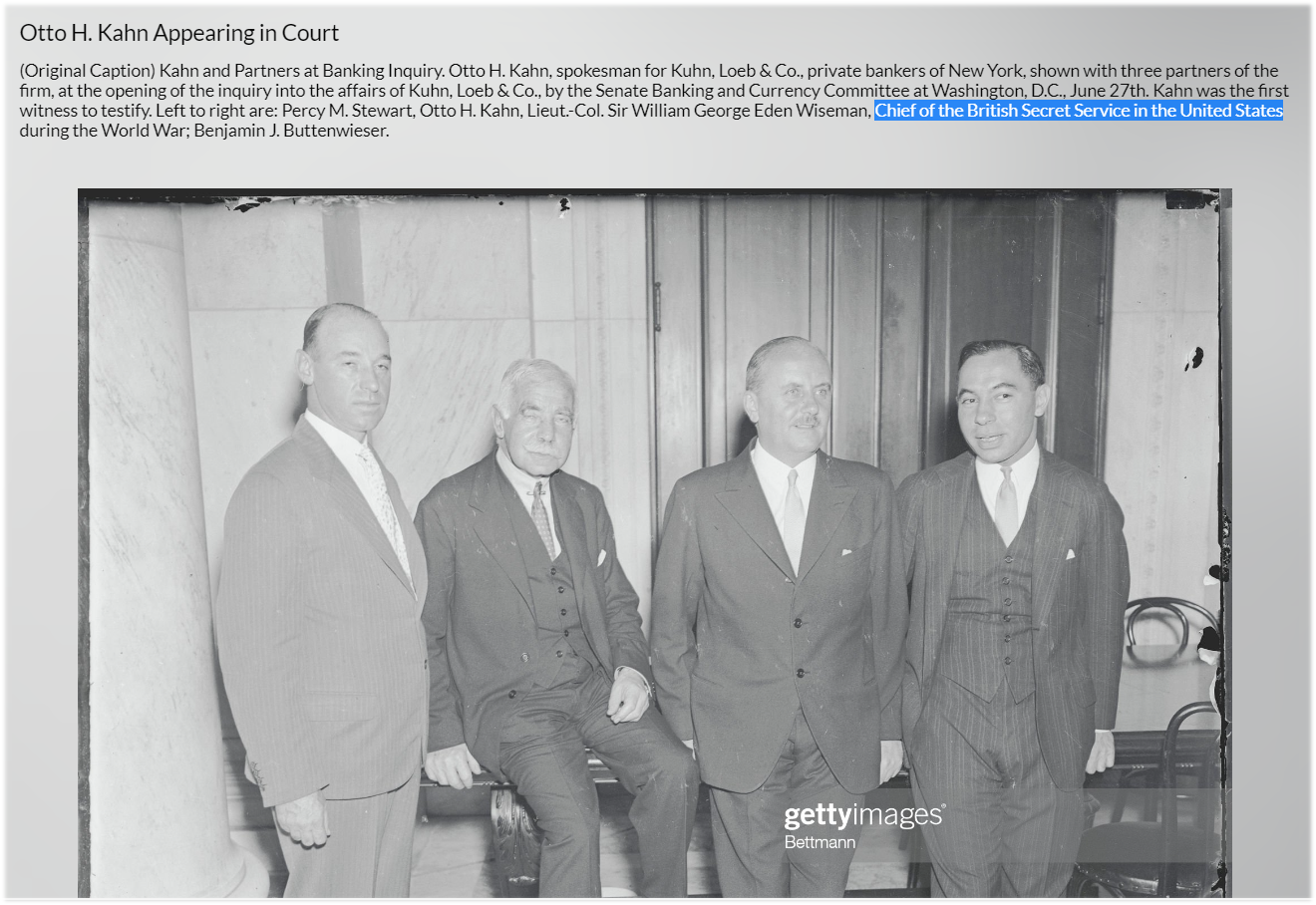
    ORDER
  • Introducing DIANA, NATO’s own DARPA, backed by own bank and venture capital firm, but paid from taxes. More transhumanism at human expense

    Everything you didn’t like about Pentagon’s DARPA, CIA’s In-Q-Tel, and more, but with funds stolen from Queen’s subjects and European peasantry.
    The business of high-tech slavery is the future and the future is now! Advanced by slave work of course.

    UK to host world-leading Nato Defence Innovation Headquarters

    From: UK Ministry of Defence, Published 5 April 2022

    The UK will partner with Estonia on the Defence Innovation Accelerator for the North Atlantic (DIANA) programme to maintain NATO’s technological edge.

    The United Kingdom, in partnership with Estonia, will host the European HQ of a programme for NATO allies to accelerate, test, evaluate and validate new technologies that address critical defence challenges and contribute to Alliance deterrence.

    Announced today by the NATO Secretary General, Jens Stoltenberg, the Defence Innovation Accelerator for the North Atlantic (DIANA) will see transatlantic cooperation on critical technologies and help NATO work more closely with industry and academia.

    The UK’s accelerator will be twinned with a new accelerator in Tallinn, Estonia to encourage the sharing of expertise, explore the use of virtual sites to trial vehicles, including autonomous ones, and test cyber innovations.

    As hosts, the UK and Estonia will:

    • Support start-up companies with funding, guidance and business expertise through twinned accelerator networks.
    • Offer the use of ‘deep tech’ test centres to assess technological solutions to military problems, utilising the Defence BattleLab.
    • Work with NATO to develop a virtual marketplace to connect start-ups with trusted investors, as well as a rapid acquisition service to connect products to buyers at pace.

    UK Defence Secretary, Ben Wallace said:

    The UK and Estonia are two of the most innovative countries in NATO and our hosting of DIANA will harness that innovation for the benefit of all Allies tackling future military threats.

    The UK has a vibrant tech community, combining the academia, financiers, and high-tech start-ups that make it an ideal place to develop the next generation of military technologies.

    Estonia was the natural partner for the UK given its international leadership in cyber, autonomy and AI, and our close partnership forged through the Enhanced Forward Presence.

    Ranked in the world’s top ten innovative universities, Imperial College London will bring together academia, industry and government by hosting the headquarters of DIANA and a DIANA Accelerator at the Innovation Hub (IHUB) in the White City Innovation District, in a space shared with the UK’s Defence and Security Accelerator (DASA), Major Defence Contractors and The US Department of Defence’s Tri-Service Office.

    Supported by DASA, the UK and Estonia DIANA HQ is expected to be operational from July 2022. DIANA is essential to delivering the NATO 2030 vision and ensuring that the Alliance develops the military capabilities needed to deter and defend against existing and future threats.

    Estonian Defence Minister, Kalle Laanet.

    The goal of DIANA is to support deep technologies companies that contribute to defence. It will bring together talented innovators with new technologies end-users in the area of defence. We are very glad to see that the good cooperation we have with the UK will expand even further and also encompass our universities and private sector more,

    Cooperation between the UK and Estonia is working well on every level because we have a common understanding of defence policy. Good relations with Allies is a cornerstone of Estonian defence policy, and a successful start to this programme for us is a sign that this cornerstone is strong.

    Co- Director, Institute for Security Science and Technology, Imperial College London, Professor Deeph Chana, said:

    As one of the top STEM-B universities in the world, in one of the most diverse cities, Imperial College London is uniquely placed to power a progressive, responsible and holistic dual-use security and defence technology innovation program by hosting DIANA. Coordinated through our Institute for Security Science and Technology and Business School we’re committed to working on disruptive research and innovation to reduce insecurity and to deal with global threats and challenges.

    DIANA will support all seven of the key emerging and disruptive technologies that NATO has identified as priorities: artificial intelligence, big-data processing, quantum-enabled technologies, autonomy, biotechnology, hypersonics and space.

    She is Estonia’s Prime Minister

    What the Estonian Ministry of Defense has to say on this:

    Estonia chosen as one of the initiators of the NATO DIANA future technologies programme

    5. April 2022 – 19:13

    At the NATO summit last June in Brussels, NATO leaders decided to create an innovation accelerator – the DIANA (Defence Innovation Accelerator for the North Atlantic) programme will allow Allies to join their strengths in developing and adopting new and breakthrough technologies in the area of security and defence.

    In cooperation between the Estonian ministries of defence, foreign affairs, and economic affairs and communication, Estonia and the United Kingdom submitted a bid for the programme, which was approved in full at the proposal of the NATO Secretary General. Together with the UK, Estonia is set to create the DIANA European headquarters, a NATO start-up accelerator will be founded in Estonia, and several existing testing sites for new technologies will be added to the DIANA accelerator network.

    “The goal of DIANA is to support deep technologies companies that contribute to defence. It will bring together talented innovators with new technologies end-users in the area of defence. We are very glad to see that the good cooperation we have with the UK will expand even further and also encompass our universities and private sector more,” commented Minister of Defence Kalle Laanet. “Cooperation between the UK and Estonia is working well on every level because we have a common understanding of defence policy. Good relations with Allies is a cornerstone of Estonian defence policy, and a successful start to this programme for us is a sign that this cornerstone is strong.”

    “Estonia and the UK are two of the most innovative nations in the Alliance, hosting respectively the most unicorn firms per capita, and the most unicorns in total. With Estonia’s impressive leadership in cyber, autonomy and AI, and the close partnership forged through our enhanced Forward Presence (eFP), they were a natural partner for the UK on this important initiative,” said UK Defence Secretary Ben Wallace.

    “Trust in this Estonian initiative is a sign of our good reputation in creating favourable ecosystems for start-up innovation and developing new technologies. The fact that DIANA will be launched both in Estonia and the UK is an example of cooperation at work – both domestically between ministries, universities and the private sector, as well as across borders,” added Minister of Foreign Affairs Eva-Maria Liimets.

    DIANA is a highly ambitious cooperation format that will bring together civil and military experts to develop and implement dual-use technologies in member states as well as across the transatlantic Alliance.

    In addition, Estonia will participate at the negotiations for the founding of a NATO innovation fund. The objective of the fund is to support dual-use deep technology start-ups with investments, by offering trusted capital and creating additional opportunities for growth. States that have decided to join the fund will formalise the agreement at the NATO summit set to take place at the end of June.

    Going forward, Estonia will continue preparations for the launch of the DIANA programme in 2023.

    Additional information: press@mod.gov.ee

    “Dual use” as in vaccines / bioweapons, I shall add.

    Here’s a clue on how much DIANA’s future victims will be paying for it. This will be just launch money:

    Defence sector innovation: NATO to invest €1B in startups

     THE RECURSIVE, 24 JUNE 2021  3 MINS READ

    us-army-soldiers-army-men-54098

    NATO, the intergovernmental defence alliance between 30 European and North American countries, launches a €1B fund and an accelerator targeting deeptech startups in the defence sector. The goal is to leverage the innovation capabilities of startups to develop the next generation of war machines. Part of NATO 2030, the move follows a period of concern for Alliance leaders regarding China’s increased reliance on tech for its military strategy.

    At the end of two virtual meetings in early June, Foreign and Defence ministers agreed on the need to reinforce the transatlantic defence partnership between Europe and North America amid intensifying global competition. We need to sharpen our technological edge (…) We see that new and disruptive technologies, such as autonomous systems, artificial intelligence, and big data are really changing the way our militaries are going to operate in the future,” NATO Secretary-General Jens Stoltenberg said.

    The Defence Innovation Accelerator for the North Atlantic (DIANA) is to become the center point for countries in the alliance to coordinate and cooperate on developing new technologies. DIANA will add offices and test centers throughout Alliance countries. 

    “The goal is to have DIANA reach initial operating capability (IOC) by 2023,” David van Weel, assistant secretary-general for emerging security challenges, added in a virtual roundtable with reporters, following the 31st annual summit on June 14 in Brussels.

    Planning to stay ahead of the curve is particularly important, as China has been investing heavily in new technologies to strengthen its military power and fuel its ambition to become a leader in the use of AI. The defence accelerator is also a recognition from European and North American leaders of the prevalence of disruptive technologies – and a decision to harness their unique potential to strengthen common defence strategies. 

    How startups benefit from NATO’s initiative

    For startups, this will be an opportunity to work together with the government sector and academia towards accelerating the achievement of national security and transatlantic collaboration goals. “Sometimes a technology company may not realize that their product could be viable for the defence community,” David van Weel said. Startups will also benefit from entering a network of stakeholders that can help them develop and get funded.

    DIANA will be supporting startups working on either of the seven key emerging and disruptive technologies (EDTs) that NATO deems critical for the future: AI, big-data processing, quantum-enabled tech, autonomy, biotechnology, hypersonics, and space.

    The accelerator includes a trusted capital marketplace that will enable funding opportunities for companies by connecting them to pre-qualified investors. Additionally, startups will receive support through a venture capital fund. The NATO Innovation Fund has been set up to support companies developing dual-use and key tech that could serve the Alliance. The fund will be an opt-in for member countries and would be underwritten by about €70M per year. Van Weel added that NATO would be looking for a partner from the private sector to help run the daily business operations of the fund.

    DIANA is unique to NATO’s innovation efforts in that it has been built with the needs of the startup community in mind. It specifically targets early-stage startups rather than larger companies and traditional defence firms, in order to harness their unique ability for innovation.

    IF YOU’RE NAIVE ENOUGH TO THINK THIS IS ABOUT DEFENSE, AND NOT THE INSANE DAVOS TRANSHUMANIST AGENDA…

    … I will bring to your attention the fact that NATO has already adopted its own “Agenda 2030”, titled “NATO 2030”, and both of these are just “The Great Reset for Different Niches of Dummies” in their specific lingo. That’s all they are.
    Proportionally, “NATO 2030” talks about climate change about as much as “The Great Reset”.

    Also note how NATO presents itself more and more as a business accelerator.
    Transhumanist businesses with a multinational army funded by half a billion unsuspecting dupes and NPCs in NATO countries and beyond. What could go wrong, right?

    NATO hopes to launch new defense tech accelerator by 2023

    DEFENSE NEWS,  Jun 22, 2021

    Secretary-General Jens Stoltenberg gives press conference at the NATO summit in Brussels on June 14, 2021. (Photo by FREDERIC SIERAKOWSKI/BELGA MAG/AFP via Getty Images)

    STUTTGART, Germany — In less than two years, NATO hopes to have its own, modified version of the U.S. Defense Advanced Research Projects Agency (DARPA) up and running.

    Alliance members agreed at the 31st annual summit, held June 14 in Brussels, to launch a new initiative dubbed the Defence Innovation Accelerator of the North Atlantic, or DIANA, meant to speed up trans-Atlantic cooperation on critical technologies, and help NATO work more closely with private-sector entities, academia and other non-governmental entities.

    The goal is to have DIANA reach initial operating capability (IOC) by 2023, David van Weel, assistant secretary-general for emerging security challenges, said at a Tuesday virtual roundtable with reporters. By next year, the hope is to have “the initial parts … starting to come up into fruition,” he added.

    In the long term, DIANA will have headquarters both in North America and in Europe, and link to existing test centers throughout NATO member countries that will be used for “validating, testing, and co-designing applications in the field of emerging and disruptive technologies,” van Weel said. DIANA will also be responsible for building and managing a network meant to help relevant startups grow and support NATO’s technology needs via grant programs.

    The focus will be on national security and defense purposes, and DIANA will not ask for or solicit companies’ intellectual property, van Weel noted.

    While he singled out artificial intelligence, big-data processing, and quantum-enabled technologies, DIANA is meant to support all seven of the key emerging and disruptive technologies — or EDTs — that NATO has identified as critical for the future. The other four include: autonomy, biotechnology, hypersonics and space.

    Sometimes a technology company may not realize that their product could be viable for the defense community, he added.

    One key component of DIANA will be a trusted capital marketplace, where smaller companies can connect with pre-qualified investors who are interested in supporting NATO’s technology efforts. Ensuring that investors are vetted ahead of time will allow NATO to ensure “that the technology will be protected from illicit transfers,” van Weel said.

    The fund is modeled after a The U.S. Defense Department set up its own trusted capital marketplace in 2019 as a tool that then-DoD acquisition czar Ellen Lord said could help encourage domestically based venture capitalists to fund national security and defense projects. That marketplace served as inspiration for the announced NATO trusted capital marketplace, per the alliance.

    Members also agreed for the first time to build up a venture capital fund to support companies developing dual-use and key technologies that could be useful to NATO, and which will be optional for member-nations to participate in. The NATO Innovation Fund, as it’s called, would have a running time of about 15 years to start, and would be underwritten by about 70 million euro (about $83 million) per year, per van Weel.

    The goal is not for NATO headquarters or for its member-nations to run the innovation fund, he noted. “The actual running of a venture capital fund, we believe, should be done by companies that have a broad range of experience in the field.” He cited the U.S.-based capital venture firm In-Q-Tel as an example of the type of partner NATO would seek to run the “day-to-day” business of the fund.

    “I read somewhere that NATO is not a bank—we’re not,” van Weel said. “But it will be the nations providing the funds, and giving the general direction.”

    These two initiatives of a technology accelerator and innovation fund are “hopefully going to … bring the alliance forward into the 21st century,” van Weel said.

    NATO has previously invested in information technology (IT) and software through the NATO Communications and Information Agency (NCIA), but the difference with the innovation fund, and DIANA, is that the alliance wants to better connect with early-stage startups, rather than larger software companies or traditional defense firms, van Weel said.

    “DIANA is not about taking over innovation for the NATO enterprise,” he said. “It’s a different community, and requires different funding mechanisms and different types of engagement.”

    These two initiatives have been long awaited and demanded by NATO observers, and versions of both a “DARPA-like” technology accelerator and an alliance-wide investment bank were included in a 2020 list of recommendations by NATO’s advisory group on emerging and disruptive technologies.

    But it is still early days. While the IOC goal is 2023, “step one is we want to know from allies what they want to offer to DIANA,” van Weel said. Once the NATO Innovation Fund has its participating members, for example, a charter will be set up that will lay out the funding models, rapid contracting processes, and leadership guidelines.

    “We are trying to do this as fast as we can,” van Weel assured, but then noted, “we do want to get it right, because … with the startup community, you only get one chance.”

    If you want to deepen your understanding of the situation and the context here, also read:

    EVERYTHING WE PUBLISHED ON DARPA

    BOMBSHELL! GERMAN & UK DEFENSE WORK ON MASSIVE “HUMAN AUGUMENTATION” PROJECT FOR CIVILIAN POPULATION! SWEDEN AND FINLAND INVOLVED TOO

    To be continued?
    Our work and existence, as media and people, is funded solely by our most generous supporters. But we’re not really covering our costs so far, and we’re in dire needs to upgrade our equipment, especially for video production.
    Help SILVIEW.media survive and grow, please donate here, anything helps. Thank you!

    ! Articles can always be subject of later editing as a way of perfecting them

  • Smirked at my Borg references? 2001 NASA file predicts The Great Reset AKA The Assimilation in spooky details

    This document has been published by NASA in July 2001, only a few months before 9/11. And it took 12 years to get some spotlight. Ten more years and we see it coming to life. And now it dwarfs the Great Reset in terms of revelations and implications.

    Figuring out The Great Reset was like in those cartoons where some people celebrate killing Godzilla just to discover it was a baby Godzilla, and a raging Godzilla-mom is approaching fast. This is how I felt bumping into this:

    Dennis M. Bushnell, “Future Strategic Issues/Future Warfare [Circa 2025]” (sic), NASA Langley Research Center (National Aeronautics and Space Administration), July 2001, 113 pp.; PDF, 1400357 bytes, MD5: c833f3fbc55d07fe891f5f4df5fb2f57. The aforesaid PDF was found on the US Department of Defense’s Defense Technical Information Center (DTIC) website, as archived by the following Internet Archive URL: http://wayback.archive.org/web/20031224161719/http://www.dtic.mil/ndia/2001testing/bushnell.pdf

    Dennis M. Bushnell is the Chief Scientist at NASA’s Langley Research Center. The following is a biography page for him:

    Joe Atkinson, “Dennis Bushnell”, NASA Langley Research Center (National Aeronautics and Space Administration), Mar. 21, 2013. http://www.nasa.gov/centers/langley/news/researchernews/snapshot_DBushnell.html

    Bushnell’s above presentation was given on August 14, 2001 at the 4th Annual Testing and Training for Readiness Symposium and Exhibition organized by the National Defense Industrial Association (NDIA) and held at the Rosen Centre Hotel (formerly the Omni Rosen Hotel) in Orlando, Florida. For information on that, see the following page in which the above presentation is available:

    “The 4th Annual Testing and Training for Readiness Symposium & Exhibition: Emerging Challenges, Opportunities and Requirements, 13-16 August 2001”, Defense Technical Information Center (DTIC).

    http://wayback.archive.org/web/20020409151859/http://www.dtic.mil/ndia/2001testing/index.html ,

    SOURCE

    See also the following announcement page for this conference:

    “4th Annual Testing and Training Symposium and Exhibition: A National Partnership, on August 14-16, 2001 in Orlando, FL at the Omni Centre Hotel”, National Defense Industrial Association (NDIA).

    The following is the conference proceedings:

    Testing and Training for Readiness Symposium and Exhibition (4th Annual): Emerging Challenges, Opportunities and Requirements Held on 13-16 August 2001 (on CD-ROM), National Defense Industrial Association (NDIA), Aug. 2001; National Technical Information Service (NTIS) Issue Number: 1014.

    https://web.archive.org/web/20140212003319/http://www.ntis.gov/search/product.aspx?ABBR=ADM002244

    The text on each page stating “Future Strategic Issues, 7/01” within the above PDF refers to the document’s finalization date of July 2001. The creation date of the above PDF is given as Thu 13 Dec 2001 08:48:04 AM EST, which possibly refers to when the PDF was created from a Microsoft PowerPoint file (.ppt), as it looks like the document was perhaps originally a PowerPoint file.Addeddate 2014-02-11 00:44:28Identifier FutureStrategicIssuesFutureWarfareCirca2025Identifier-ark ark:/13960/t05x4vt08Ocr ABBYY FineReader 9.0Ppi 300Scanner Internet Archive HTML5 Uploader 1.5.1Year 2001

    Dr. Dennis M. Bushnell is the Chief Scientist at NASA Langley Research Center. He is responsible for Technical Oversight and Advanced Program formulation for a major NASA Research Center with technical emphasis in the areas of Atmospheric Sciences and Structures, Materials, Acoustics, Flight Electronics/Control/Software, Instruments, Aerodynamics, Aerothermodynamics, Hypersonic Airbreathing Propulsion, Computational Sciences and Systems Optimization for Aeronautics, Spacecraft, Exploration and Space Access .
    44 years experience as Research Scientist, Section Head, Branch Head, Associate Division Chief and Chief Scientist. Technical Specialties include Flow Modeling and Control across the Speed Range, Advanced Configuration Aeronautics, Aeronautical Facilities and Hypersonic Airbreathing Propulsion .
    Author of 252 publications/major presentations and 310 invited lectures/seminars, Member of National Academy of Engineering , Selected as Fellow of ASME, AIAA and the Royal Aeronautical Society, 6 patents, AIAA Sperry and Fluid and Plasma Dynamics Awards , AIAA Dryden Lectureship, Royal Aeronautical Society Lanchester, Swire and Wilber and Orville Wright Lectures, ICAS Guggenheim Lecture, Israel Von Karman Lecture, USAF/NASP Gene Zara Award, NASA Exceptional Scientific Achievement and Outstanding Leadership Medals and Distinguished Research Scientist Award, ST Presidential Rank Award,9 NASA Special Achievement and 10 Group Achievement Awards, University of Connecticut Outstanding Engineering Alumni, Academy of Engineers ,Pi Tau Sigma and Hamilton Awards, Univ. of Va. Engineering Achievement Award , service on numerous National and International Technical Panels and Committees and consultant to National and International organizations. DOD related committee/consulting assignments include USAF Rocket Propulsion Laboratory, BMDC, ONR, Intelligence Community/STIC, AFOSR, NRAC, NRC, WL, LLL, HASC, NUWC, DARPA, AGARD, ARL, IAT, AEDC, JANNAF, NAVSEA, Air Force 2025, AFSOC, Sandia, SAB, Army War College, ACOM Joint Futures, SOCOM, TRADOC, SEALS, JFCOM, IDA, NDU, DSB and Army After Next.
    Reviewer for 40 Journals and Organizations, Editor, Volume 123 of AIAA Progress Series “Viscous Drag Reduction in Boundary Layers.”
    Responsible for invention/ development of “Riblet” approach to Turbulent Drag Reduction, High Speed “Quiet Tunnels” for Flight-Applicable Boundary Layer Transition Research, Advanced Computational Approaches for Laminar Flow Control and Advanced Hypervelocity Airbreathing and Aeronautical Concepts with revolutionary performance potential. Contributions to National Programs include Sprint, HSCT/SST, FASTSHIP, Gemini, Apollo, RAM, Viking, X15, F-18E/F [patent holder for the “fix” to the wing drop problem],Shuttle, NASP, Submarine/Torpedo Technology ,Americas’ Cup Racers, Navy Rail Gun, MAGLEV Trains and Planetary Exploration.
    B.S. in M.E. degree from University of Connecticut with Highest Honors, Distinction, University Scholar (1963), M.S. degree in M.E. from University of Virginia (1967).U.S. Govt. ST.

    SOURCE
    Dennis Bushnell sits in front of a wall filled with his awards and recognitions in Building 1212.

    A voracious reader, Bushnell casually tosses around those kinds of facts. The shelves in his office are jam packed with titles like “The Singularity Is Near,” “Warped Passages,” “The Elegant Universe” and “The World in 2050.”
    One of his hobbies is to go to thrift stores and buy big bags of cheap books. Fiction, non-fiction: he reads whatever he can get his hands on.
    “It’s just more input,” he said. “I’m an info junkie.”

    NASA

    Besides these “very military” preoccupations, Bushnell is also obsessed with climate change, which seems to be the focus of about half his scientific efforts.
    “From Moon landing to Climate change.”.. Quite some title for a bio!

    The only notable mention of this paper that I’ve found so far in media is this one from 2020 Counterpunch:

    The War on You: How the Pentagon is Militarizing Social Control

    SEPTEMBER 11, 2020

    BY T.J. COLES


    Neoliberalism benefits the few and makes life for the many increasingly impossible. Big data and blanket surveillance give state and corporate intelligence confidence that they can pre-empt and manage mass, social reactions to neoliberalism. This article is an excerpt from my new book, The War on You.

    TARGET: “EVERYONE”

    In 1997, the U.S. Space Command published its Vision for 2020. The Vision says that military force is necessary to “protect” U.S. trade and investment. Colonial forces repelled Native American attacks, Navies enforced sea-based commerce, the Air Force had the advantage of the “high ground.” In modern times, space is an additional domain of warfare. The technologies that we take for granted—cargo tankers, computers, e-commerce, drones, GPS, the internet, jet aircraft, touchscreens, and the satellites that make these things possible—were developed in the military sector with public treasure before their transfer to private, for-profit corporations. This, says the Space Command, will lead to “Full Spectrum Dominance.”

    A few years later, Dennis M. Bushnell, the chief scientist at NASA’s Langley Research Center, gave a presentation based on the work of a host of powerful U.S. (and other) institutions, including: the Central Intelligence Agency, Defense Advanced Research Projects Agency, Defense Intelligence Agency, Federal Bureau of Investigation, Joint Forces Command, the National Research Council, and many others.

    Entitled Future Strategic Issues/Future Warfare [Circa 2025], the PowerPoint presentation anticipates: a) scenarios created by U.S. forces and agencies and b) scenarios to which they might have to respond. The projection is contingent on the use of hi-technology. According to the report there are/will be six Technological Ages of Humankind: “Hunter/killer groups (sic) [million BC-10K BC]; Agriculture [10K BC-1800 AD]; Industrial [1800-1950]; IT [1950-2020]; Bio/Nano [2020-?]; Virtual.”

    In the past, “Hunter/gatherer” groups fought over “hunting grounds” against other “tribal bands” and used “handheld/thrown” weapons. In the agricultural era, “professional armies” also used “handheld/thrown” weapons to fight over “farm lands.” In the industrial era, conscripted armies fought over “natural resources,” using “mechanical and chemical” weapons. In our time, “IT/Bio/Bots” (robots) are used to prevent “societal disruption.” The new enemy is “everyone.” “Everyone.”

    Similarly, a British Ministry of Defence projection to the year 2050 states: “Warfare could become ever more personalised with individuals and their families being targeted in novel ways.”

    Read the rest of the article on Counterpunch.

    “KNOWLEDGE DOMINANCE”

    The war on you is the militarization of everyday life with the express goal of controlling society, including your thoughts and actions.

    A U.S. Army document on information operations from 2003 specifically cites activists as potential threats to elite interests. “Nonstate actors, ranging from drug cartels to social activists, are taking advantage of the possibilities the information environment offers,” particularly with the commercialization of the internet. “Info dominance” as the Space Command calls it can counter these threats: “these actors use the international news media to attempt to influence global public opinion and shape decision-maker perceptions.” Founded in 1977, the U.S. Army Intelligence and Security Command featured an Information Dominance Center, itself founded in 1999 by the private, veteran-owned company, IIT.

    “Information Operations in support of civil-military interactions is becoming increasingly more important as non-kinetic courses-of-action are required,” wrote two researchers for the military in 1999. They also said that information operations, as defined by the Joint Chiefs of Staff JP 3-13 (1998) publication, “are aimed at influencing the information and information systems of an adversary.” They also confirm that “[s]uch operations require the continuous and close integration of offensive and defensive activities … and may involve public and civil affairs-related actions.” They conclude: “This capability begins the transition from Information Dominance to Knowledge Dominance.”

    ALSO THIS: :

    SOURCE

    “Copy/paste NPC from fact-check website can’t find anything” is a debunk these days. On Planet Tardia.
    This thing is in dude’s official bibliography. With the NASA logo on it and the timestamps in the document. What else?

    And these are my earlier Borg references:

    THE INTERNET OF BODIES AKA THE BORG IS HERE, KLAUS SCHWAB SAYS (BIOHACKING P.5)

    Now let’s compare our notes with what more aware people warned us long ago.

    TruthStream Media never disappoints, here they are, as far back as 2013, and it’s pretty guaranteed to blow your mind:


    Dated same year, when this kinda broke out in the public attention for the first time, there’s interview with Deborah Tavares made by actor Trevor Coppola for Anthony J. Hilder. It was posted on Hilder’s YouTube channel on July 23, 2013. The video was filmed at Conspiracy Con 2013, which was held over the weekend of June 1-2 that year in Milpitas, California.

    Next, in 2017, former Navy Seal and scientist turned occultist and friend of Timothy Leary, Dr Richard Alan Miller uses the NASA documents as starting point for an even wider and more mind-blowing discussion. It seems all over the place ag times, but it all comes together nicely and there’s a few very interesting connections, prophecies and revelations for everyone, worth going through all of it even when we don’t buy all of it.
    Anyway, you know our motto: Trust no one, research everything.

    Perfect for longer car trips:

    “Remember: If you want to now what’s gonna happen next, watch Hollywood!”

    Dr Richard Alan Miller u

    Hollywood and CIA News Network, I’d add…

    To be continued?
    Our work and existence, as media and people, is funded solely by our most generous supporters. But we’re not really covering our costs so far, and we’re in dire needs to upgrade our equipment, especially for video production.
    Help SILVIEW.media survive and grow, please donate here, anything helps. Thank you!

    ! Articles can always be subject of later editing as a way of perfecting them

  • Turns out measles parties were the true Operation Warp Speed